



Modern organizations rely on knowledge to move fast. But that knowledge is spread across dozens of tools: Google Drive, Slack, Confluence, Jira, Salesforce, Notion, email, databases, and beyond.
The result? Employees waste hours every week digging through apps, asking teammates for links, or recreating existing work. McKinsey estimates that the average employee spends 20% of their time searching for information—a full day lost each week.
Enterprise search solutions address this problem. By bringing every document, message, and file into a single, secure, searchable hub, enterprise search empowers employees to find what they need instantly.
In this guide, we’ll cover everything you need to know about enterprise search in 2026: what it is, why it matters, how it works, use cases across departments, and how GoSearch is shaping the future of enterprise search with AI.
What is Enterprise Search?
Enterprise search is the ability to find information across all of your company’s systems, tools, and documents through one unified, secure interface.
Unlike traditional web search (Google, Bing), enterprise search solutions are built for the unique complexity of organizational knowledge. They don’t just index web pages—they integrate with internal tools, apps, and databases.
With enterprise search, employees can:
- Retrieve knowledge across platforms (Slack, Confluence, Google Drive, Notion, Jira, Salesforce, and more).
- Search securely with access controls that respect company permissions.
- Use natural language search (“What’s our PTO policy?”) and get direct answers instead of just a list of files.
In short, enterprise search turns scattered information into an accessible, searchable knowledge system.
Why Do Organizations Need Enterprise Search?
The shift to remote and hybrid work has only amplified the information overload problem. Companies now rely on dozens of SaaS tools, which leads to:
- Fragmented knowledge: Documents and messages live in silos.
- Wasted time: Employees jump between apps and ask teammates for information that already exists.
- Duplicate work: Projects get re-created because knowledge is hard to find.
- Frustration: Slow answers impact productivity and morale.
By implementing enterprise search, organizations unlock:
- Productivity gains: Reduce wasted time and let employees focus on high-value work.
- Improved collaboration: Teams share knowledge seamlessly.
- Faster onboarding: New hires get answers without bottlenecking HR or IT.
- Knowledge retention: Insights aren’t lost when employees leave.
IDC found that knowledge workers spend nearly 30% of their day searching for or recreating information. Enterprise search dramatically reduces this.
Key Features of Modern Enterprise Search Solutions
Not all enterprise search platforms are created equal. The best enterprise search solutions go beyond keyword search, combining AI, security, and scalability to deliver real answers fast. Here are the must-have capabilities:
- Unified search across all tools – Centralize data from Google Workspace, Slack, Jira, Notion, Salesforce, Confluence, and more—eliminating silos and context switching.
- AI-powered relevance – Surface the most accurate, context-rich results with semantic ranking and intelligent filters.
- Natural language queries – Let employees ask questions conversationally (“Show me the latest revenue report”) and receive direct answers.
- Permission-aware search – Respect existing access controls so sensitive data stays secure.
- Scalability – Handle millions of documents while maintaining speed and reliability.
- Analytics & insights – Track search patterns, uncover knowledge gaps, and improve documentation.
- Easy integrations – Out-of-the-box connectors simplify setup and reduce IT lift.
→ Explore GoSearch Connectors to see how you can unify your tools.
Use Cases for Enterprise Search
Enterprise search isn’t one-size-fits-all—each team leverages it differently based on their workflows, tools, and priorities. The right enterprise search solution flexes to every department, enabling employees to spend less time searching and more time driving impact.
HR
- Instantly surface policies, benefits information, and onboarding documents.
- Empower employees to self-serve answers to common questions (e.g., “What’s our parental leave policy?”), reducing repetitive HR requests.
- Speed up onboarding by giving new hires quick access to all relevant resources without creating bottlenecks.
Engineering & IT
- Search across Confluence pages, Jira tickets, GitHub repos, and technical documentation.
- Quickly troubleshoot by locating past incident reports and solutions.
- Reduce duplicate work by ensuring engineers can find existing code snippets, design docs, or architecture diagrams.
Sales & Marketing
- Pull up the latest product one-pagers, case studies, and pricing guides.
- Access competitive battlecards, proposal templates, or pitch decks during customer conversations.
- Eliminate wasted time digging through email threads or outdated file folders, so reps can focus on selling.
Customer Support
- Search across Zendesk, historical tickets, and internal knowledge bases to resolve issues faster.
- Respond more accurately by pulling verified solutions instead of escalating to engineering or product teams.
- Improve customer satisfaction (CSAT) by shortening resolution times and reducing repetitive answers.
C-Suite
- Gain visibility across reports, dashboards, and analytics without asking teams for manual updates.
- Make informed decisions faster by pulling insights from multiple departments in seconds.
- Keep a pulse on organizational knowledge and alignment, even in distributed or global teams.
No matter the department, enterprise search solutions are the backbone of productivity, putting relevant information at everyone’s fingertips and ensuring work moves forward faster.
Enterprise Search vs. Traditional Search
| Aspect | Web Search | Enterprise Search |
| Data Scope | Public web pages | Internal company knowledge & systems |
| Permissions | Open to all | Respects enterprise security & access levels |
| Results | Links to web pages | Answers, documents, and insights |
| Relevance | SEO-driven | Context-driven for business needs |
Enterprise search isn’t just a better Google for your company – it’s a different category of technology designed for workplace productivity.
The Evolution of Enterprise Search
Enterprise search has come a long way from its early beginnings. What started as a simple way to locate files within company systems has evolved into an intelligent, AI-driven layer of organizational knowledge. Here’s how the journey has unfolded:
[2000s] → [2010s] → [2020s] → [2025+]
→ Early 2000s: Basic keyword search – Enterprise search tools functioned much like a local file search, allowing employees to enter keywords and retrieve documents. Results were often limited and lacked context, making knowledge discovery slow and inefficient.
→ 2010s: Unified indexing across business apps – As companies adopted more SaaS tools, enterprise search solutions began to centralize data by indexing multiple platforms like SharePoint, Confluence, and Google Workspace. While this reduced silos, search was still primarily keyword-driven.
→ 2020s: AI-powered semantic search – Natural language processing and semantic ranking entered the picture, enabling enterprise search platforms to understand context, intent, and relationships between data. Employees could ask questions conversationally and receive more relevant results.
→ 2025 and beyond: Generative AI integration – The latest wave is transformative. Enterprise search solutions are no longer limited to surfacing documents; they can synthesize knowledge from multiple sources to deliver direct, conversational answers. Instead of scanning five reports, an employee can ask a question and receive a precise, AI-generated summary.
GoSearch represents this new era – combining multimodal AI with enterprise-grade security and compliance to deliver fast, trusted insights at scale.
Common Challenges in Implementing Enterprise Search Solutions
Even the most powerful enterprise search solutions can face obstacles during deployment. Organizations often encounter several common roadblocks:
Data silos – Legacy systems, disconnected apps, and fragmented databases make it difficult to unify knowledge. Without integration, employees continue wasting time searching across multiple platforms.
Permissions and security – Balancing strict access controls with usability is challenging. Sensitive information must remain secure, yet overly restrictive settings can frustrate users and limit adoption.
User adoption – Employees often resist changing established workflows. Even with a powerful search platform, low adoption can prevent teams from realizing its full value.
Scalability – Traditional or outdated systems struggle to handle millions of documents, messages, and tickets, resulting in slow performance and incomplete search results.
GoSearch was designed to overcome these challenges. With fast setup, intuitive design, and deep integrations, it ensures employees can find the knowledge they need quickly while maintaining enterprise-grade security. High adoption and measurable impact are built in from day one.
How to Choose the Right Enterprise Search Solution
Selecting the right enterprise search solution can make or break your organization’s knowledge management strategy. With so many vendors and features available, it’s important to evaluate platforms carefully to ensure they meet your teams’ needs. Here are key questions to guide your decision:
Does it integrate with the tools your teams actually use?
A powerful enterprise search solution should connect seamlessly to the apps and platforms your organization relies on—Google Workspace, Slack, Jira, Confluence, Salesforce, Notion, and more. Integration reduces silos and ensures employees can access all knowledge from a single interface.
Is it secure and compliant?
Data security is critical. Look for SOC 2, GDPR, HIPAA, and other compliance certifications. A secure platform balances accessibility with strict permission controls to protect sensitive information.
Does it support AI-powered, natural language search?
Modern search solutions go beyond keywords. AI-driven platforms understand intent, context, and conversational queries, delivering accurate answers quickly and reducing time spent digging through documents.
How quickly can it be deployed?
Time-to-value matters. A solution that requires lengthy implementation can slow adoption and delay ROI. Look for platforms designed for fast setup and minimal IT overhead.
Is the user experience simple and intuitive?
Enterprise search should be accessible to all employees—not just technical teams. A clean, easy-to-use interface encourages adoption and ensures your workforce can find the knowledge they need without friction.
Pro Tips for Evaluating Enterprise Search Vendors
- Test with real queries: Pilot the platform using the questions your teams ask daily to see if results are relevant and actionable.
- Check AI relevance: Look for solutions that deliver context-aware answers, not just keyword matches.
- Assess analytics capabilities: Ensure the platform provides insights on search trends, knowledge gaps, and adoption metrics.
- Consider scalability: Confirm the solution can handle growth in users, data, and tools without performance degradation.
- Review support and training: Vendor onboarding, documentation, and customer support can make a big difference in successful adoption.
For a deeper dive into evaluating enterprise search software, explore our guide: Learn more about choosing enterprise search software.
Why GoSearch is the Best Enterprise Search Platform for 2026
GoSearch is designed for the modern enterprise:
- Search across all tools instantly – Slack, Confluence, Google Drive, Jira, Notion, Salesforce, and more.
- AI-powered answers – Not just search results, but direct insights.
- Enterprise-grade security – Permissions respected, SOC 2 compliant.
- Frictionless setup – Deploy in minutes, not months.
- Scalable – Works for fast-growing startups and global enterprises alike.
With GoSearch, employees stop wasting time searching—and start focusing on building, selling, and innovating.
The Future of Enterprise Search Capabilities
Looking ahead, enterprise search will continue to transform:
- Generative AI: From search to synthesized answers.
- Personalized results: Tailored to roles, projects, and context.
- Predictive insights: Search that surfaces knowledge before you even ask.
- Voice search: Hands-free enterprise knowledge retrieval.
The future is clear: enterprise search is becoming the backbone of modern knowledge work.

“By leveraging GoSearch’s agentic search and automated workflows, we’ve transformed our support operations, achieving a 47% productivity boost, over $400k in savings, and gained a trusted, indispensable partner.”
– Vernon Clemons, VP of Global Customer Support at Model N
Unlock Knowledge with GoSearch
Enterprise search is no longer optional—it’s the foundation of productivity in 2026. Companies that implement enterprise search unlock faster decision-making, stronger collaboration, and smarter use of their knowledge.
GoSearch is leading this movement with a platform that’s AI-powered, secure, and easy to deploy.
Ready to transform the way your team finds knowledge? Request a demo today.
Search across all your apps for instant AI answers with GoSearch
Schedule a demo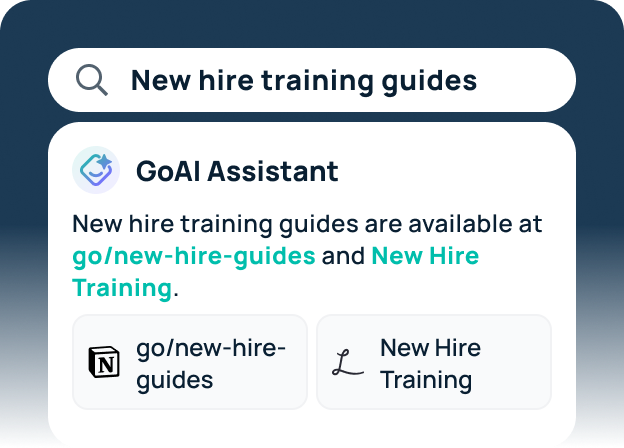
Enterprise search is searching across all internal company tools, apps, and documents through one secure platform.
It reduces wasted time, improves collaboration, and ensures knowledge is accessible and secure.
Examples include GoSearch, Coveo, Glean, Elastic Enterprise Search, and Microsoft Search.
AI enables natural language queries, semantic understanding, and contextual ranking—making search faster and more accurate.
Web search indexes public content, while enterprise search indexes private, internal knowledge within a company.

![Selecting the Best Enterprise Search Software [Features + Vendors]](https://images.gosearch.ai/blog/content/uploads/2023/10/17234328/Blog-Header-3-370x184.png)