Need a little productivity boost? Join our monthly newsletter and we'll go/link you to the latest tips and trends in tech!
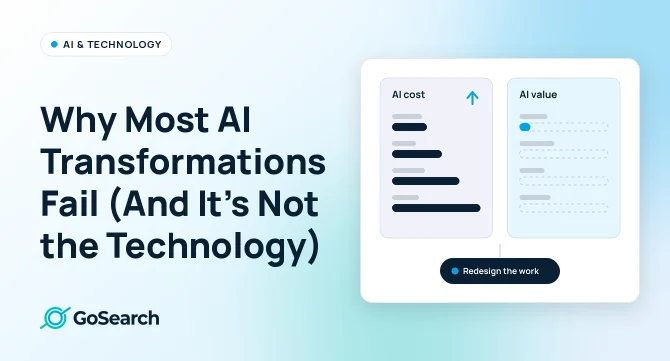
Most companies have two ledgers for AI: costs keep rising each quarter, while the value side remains mostly empty.
Two-time founder Rohit Chikballapur described the pattern on our AI Innovators series. A CIO gets a mandate, rolls a chatbot out to every employee, and calls it done. The spend shows up right away. The return never does.
It’s a familiar story. According to one frequently cited estimate, up to 95% of enterprise generative AI pilots yield no measurable financial return. Meanwhile, AI infrastructure spending has reached hundreds of billions, with some of the biggest tech companies borrowing heavily to keep up.
The models themselves aren’t the problem. The real issue is that AI is often purchased like any other software, when it actually requires a full operational redesign with new workflows, new habits, and accessible knowledge. Here are four common breakdowns in that redesign, with lessons from AI and HR leaders we’ve interviewed on AI Innovators and HR GameChangers.
Key Takeaways
Redesign, don’t just buy: AI fails when it’s purchased as software rather than treated as a redesign of how work gets done.
Invest in people, not just tools: Budgets favor technology, but fear and trust, not skills, are what stall adoption.
Connect your knowledge first: AI is only as good as the information it can reach, so connected, permissioned data comes first.
Measure outcomes, not activity: Track business results and daily use, not logins or hours saved.
Start with one real bottleneck: Pick a painful, measurable problem everyone feels, like finding information fast.
1. A faster step inside a slow process
Most AI rollouts start with a tool and then go looking for a problem. A team buys a generative AI assistant to draft emails or summarize reports, only to drop it into processes designed decades ago. The World Economic Forum has warned that this approach mostly automates the inefficiency that’s already there.
Trust drives a lot of that last mile. Rohit’s view is that AI doesn’t need to be perfect. It needs to make its mistakes easy to spot and easy to fix. When people can’t tell where an answer went wrong, they double-check everything, and the time savings disappear.
2. Budgeting for software, not for people
If you ask where most AI budgets go, the answer is usually licenses and infrastructure. McKinsey research cited by EO Network suggests that about 90% goes to technology and only 10% to change management, even though employee resistance is the biggest barrier. Yet roughly 70% of transformation success depends on reskilling, governance, and organizational adaptability.
HR leaders see that imbalance from the inside. On HR GameChangers Episode 21, Gusto HR executive Monique Arrington explained that what separates power users from everyone else isn’t technical skill. It’s fear, professional identity, and a quiet worry that leaning on AI means you aren’t good at your job. Generic training doesn’t touch any of that.
That’s why ownership matters. Vanessa Monsequeira led an AI rollout as a VP of People before starting her own transformation practice. She argues the job shouldn’t default to IT or data:
“AI transformation doesn’t need a functional owner. It needs a change leader.” — Vanessa Monsequeira, Founder, Intelligence Rewired, on AI Innovators
3. AI can’t use what it can’t find
An AI assistant is only as good as the knowledge it can access. In most enterprises, that knowledge is scattered across wikis, drives, ticketing systems, chat threads, and legacy tools that don’t talk to each other. Common estimates put more than 80% of enterprise data in disconnected systems like these. When AI can’t see your latest policy or last quarter’s deck, it fills the gap with a guess, and every wrong answer chips away at trust.
The other problem is aim or direction. Competitive FOMO pushes companies to point expensive models at vague goals like “use more AI.” Vanessa’s advice runs the other way: companies don’t need a standalone AI strategy. They need a business strategy, with AI as one capability inside it. Practitioners in manufacturing and beyond land in the same place: start with a specific, high-value bottleneck you can measure.
4. Counting activity instead of outcomes
The license fee is the easy part to budget. Compute, energy, security, and model maintenance keep adding up after launch, and agentic workloads multiply token use. Chip and token costs have climbed sharply over the past year. Vanessa has even heard people leaders warn that some companies may soon spend as much on tokens as on headcount. It’s no surprise that a McKinsey survey found 63% of executives saw no impact on profitability from their AI investments.
Part of the problem is what gets measured. Logins, prompts, and hours saved are easy to count, but they say little about whether the business got better. On HR GameChangers, Practi co-founder Shlomit Gruman-Navot boiled it down:
“Understand the what for, then measure the what for.” — Shlomit Gruman-Navot, Co-Founder & Sr. HR Advisor, Practi, on HR GameChangers
Rohit adds a companion metric: frequency of use. If people aren’t coming back to a tool at least once a day, the ROI won’t follow.
What do the companies getting it right do differently
The organizations filling in their value ledger flip the usual order: problem first, then process, then people, then tools.
Pick one painful bottleneck. Tie it to a business result you can measure, not a usage target.
Redesign the workflow around it. Map the handoffs and approvals, and decide who owns AI-assisted output.
Put a change leader in charge. Vanessa recommends starting with a small working group across IT, security, data, finance, and HR before any company-wide push.
Fund adoption, not just access. Managers who model AI use, and teams with room to experiment, go further than mandates do.
Connect knowledge before expecting answers. Give AI permission-aware access to the information people already rely on.
Choose tools people come back to. Tools that are easy to use and fit existing habits earn the daily use that drives ROI.
Where GoSearch fits in: AI people actually use
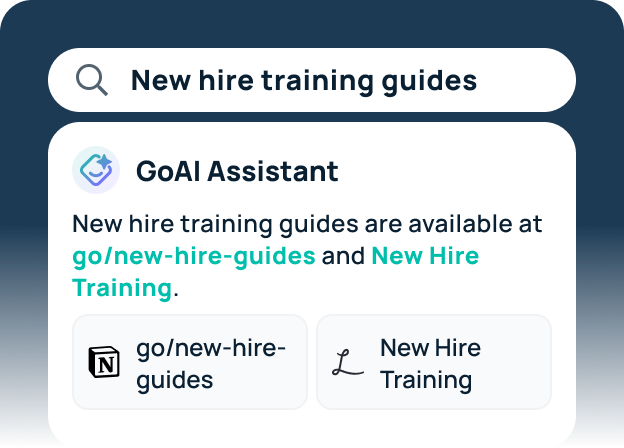
GoSearch starts with a problem every employee already feels: finding the right information takes too long. Answers exist somewhere in your apps, docs, and chats, but tracking them down eats hours every week.
A clear problem with a measurable payoff. Instead of a vague AI mandate, GoSearch targets one bottleneck: getting from question to answer. Time-to-answer and daily use are easy to track, so the value ledger has something to show for it.
Easy to use on day one. Ask a question in plain language and get an answer with links to the sources. There’s no prompt training required, which lowers the fear and friction that stall adoption.
Your knowledge, connected and permissioned. GoSearch connects to 100+ enterprise apps and respects existing permissions, so people only see what they’re already allowed to see. That’s the data foundation most AI pilots skip.
Built for the way people already work. GoSearch meets employees in the tools they use every day, such as the browser, Slack, and mobile, rather than asking them to adopt a new destination.
Answers you can verify. Every answer cites its source, so mistakes are easy to spot and fix. That’s the production-ready standard Rohit describes.
Room to grow. Start with search and AI answers, then add custom agents and workflows on the same knowledge foundation.
There’s also the build-versus-buy question. Search is one of the fastest-moving categories in AI, and Rohit’s advice is to leave it to specialists:
“It’s not your business to build enterprise search.” — Rohit Chikballapur, Board Member, Raining Code & Founder, NettWorth, on AI Innovators
The bottom line
AI transformation isn’t a purchase. It’s a redesign of how work gets done, and it needs three things most rollouts skip: connected knowledge, people who trust the tools, and a problem worth solving.
The companies that win won’t be the ones with the biggest AI budgets. They’ll be the ones whose people use AI every day because it makes their work easier. Start with a problem everyone feels, like finding the right answer fast, and build from there.
Ready to put something in your AI value ledger?Book a GoSearch demo and see how fast your team can find answers across every tool they use.
Search across all your apps for instant AI answers with GoSearch
Frequently asked questions about AI transformation
What is AI transformation?
AI transformation is the process of redesigning how an organization works around AI, including its workflows, roles, incentives, and access to data. It goes well beyond buying AI tools. The goal is measurable business results, not just AI usage.
Why do most AI transformations fail?
Most fail because companies bolt AI onto existing processes without redesigning them. They also underinvest in change management, leave data scattered across disconnected systems, and measure activity instead of business outcomes.
What percentage of AI projects fail?
By one widely cited estimate, up to 95% of enterprise generative AI pilots fail to deliver a measurable financial return. The failures usually come from how AI is rolled out, not from the technology itself.
Who should lead an AI transformation?
The best leader is whoever is strongest at change leadership, whether that’s a COO, CTO, or Chief People Officer. AI touches every function, so the leader needs to build cross-functional buy-in across IT, security, data, finance, and HR.
How do you measure AI ROI?
Tie each AI initiative to a specific business outcome, such as faster time-to-answer, higher retention, or more proposals completed. Track frequency of use too. Logins, prompts, and hours saved alone don’t show whether the business improved.
How do you increase employee AI adoption?
Address fear and job-identity concerns directly, and have managers model AI use themselves. Give teams room to experiment, and choose tools that are easy enough to use without special training.
What is the first step in an AI transformation?
Start with one painful, measurable bottleneck instead of a broad AI mandate. Then make sure AI can securely reach the knowledge it needs to solve that problem.
Should companies build or buy AI tools like enterprise search?
A useful frame is own versus rent. Own the capabilities that are core to your business. Rent fast-moving categories like enterprise search from a specialist that is investing to stay ahead of them.
Brandon Most
Brandon Most is Head of Marketing at GoLinks, GoSearch, and GoProfiles, where he helps enterprise teams navigate the AI landscape and deploy tools that actually improve how work gets done. With nearly 20 years of SaaS marketing experience, he connects buyers with solutions that deliver measurable impact — and advises the boards and executive teams of several venture-backed startups.
Perplexity Enterprise Pro costs $40/seat/mo; Enterprise Max is $325. See every plan, what's new, and the best Perplexity alternatives for enterprise teams.