Need a little productivity boost? Join our monthly newsletter and we'll go/link you to the latest tips and trends in tech!
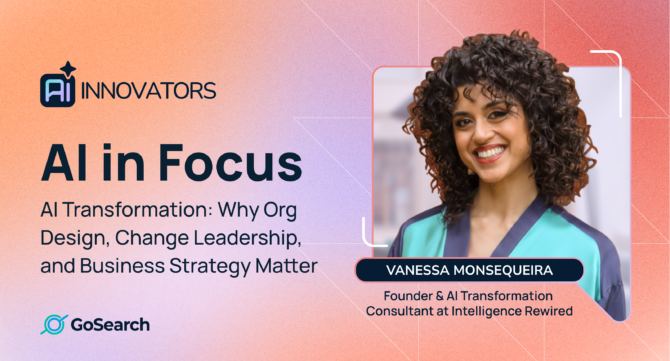
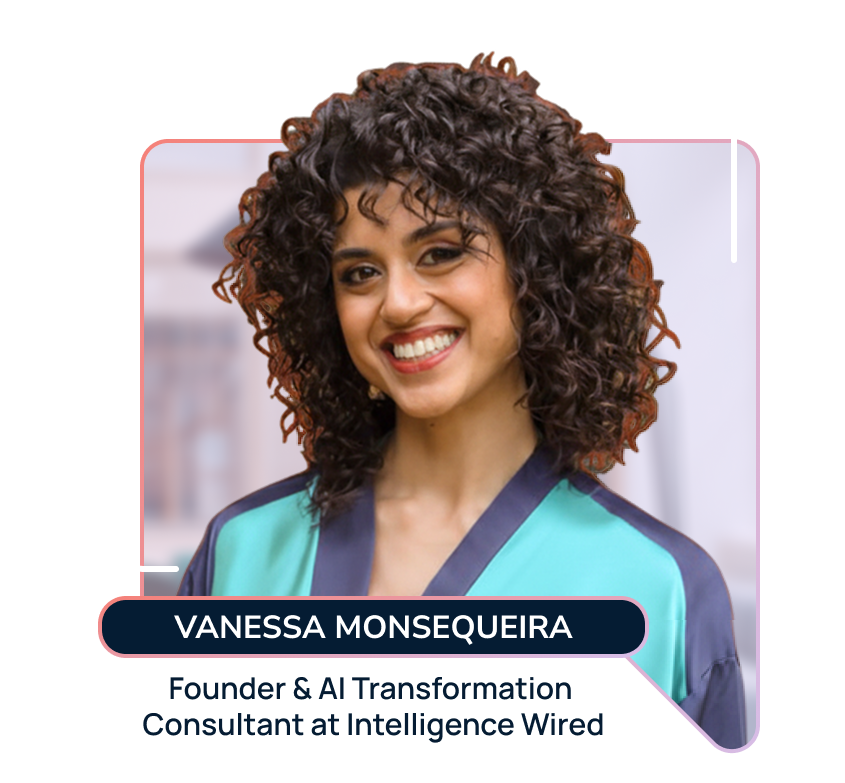
In this edition of AI Innovators, we sat down with Vanessa Monsequeira, founder of Intelligence Rewired, to discuss what actually separates successful AI transformations from the ones stuck on pilots and vanity metrics.
Vanessa previously served as VP of People at Gorilla, a Series B energy tech scale-up in Europe, where she led the company’s AI rollout firsthand. She now runs her own AI transformation and change leadership consulting practice, working with Series A-D companies and private equity portfolios.
Key Takeaways
Org Design, Not Tech Rollout: AI transformation success is about redesigning processes, roles, incentives, and systems around business strategy, not picking tools.
Change Leadership Wins: The right person to lead AI transformation is whoever is strongest at change leadership, regardless of function or title.
Cross-Functional From Day One: Successful rollouts start with a small working group spanning IT, security, data, finance, and people, not a company-wide mandate to “go experiment.”
Kill the Standalone AI Strategy: AI doesn’t need its own strategy document. It’s an execution choice, not a starting point — it belongs inside your business and functional strategy.
Speed to Value, Not Productivity: Vanity productivity metrics like time saved or tickets closed don’t guarantee real outcomes. Speed to value does.
You’ve made a pretty big career shift this year, moving from VP of People into full-time AI transformation consulting. What’s your background, and what prompted the move?
Vanessa Monsequeira: My career has moved between technology, products, and people and culture. Most recently, I was VP of People at a Series B energy tech scale-up in Europe, where I led the AI rollout. Something in me just knew I wanted to do this full-time. So, as of this year, I’m full-time in AI transformation and change leadership consulting for Series A–D companies as well as private equity firms.
The shift really came down to two things. First, when you’re deep into a rollout like that, you see all the pitfalls and mistakes. I didn’t want other people making them. We also did a lot right, so I wanted to share that knowledge at scale.
Second, I loved leading people functions, but that was only ever part of my career. I missed the business strategy side. It felt like a convergence of human-centered design, organizational psychology, technology consulting, and HR. When people ask what they should do next in their career, they’re often looking at title, salary, or company status. For me, the question is always: what problem do I want to solve next? This was it.
“AI transformation sits at the intersection of technology, human-centered design, organizational psychology, and business strategy. The reason I made the shift was simple: I wanted to help companies navigate the complexity of change and avoid the mistakes I saw firsthand.”
— Vanessa Monsequeira, Founder & AI Transformation Consultant at Intelligence Rewired
You work with companies from Series A through D and with private equity portfolios. What function typically brings you in, and what are you actually tasked with solving?
Vanessa Monsequeira: Mostly it’s CHROs and people leaders bringing me in, and the question on their minds is what use cases they can apply AI to for HR and tooling. That’s where it starts. But I’m not sure it’s the right question. For me, it’s really: what is the problem? What is AI actually solving? There’s so much FOMO and so much hype right now. The real question is, what is our business strategy, and where are we going, and how does AI fit into the picture?
If I had to summarize AI transformation in three words, it’s ‘organizational design transformation.’ Most people confuse org charts, roles, and job descriptions with org design. Org design is understanding your business strategy and how that links to processes, roles, incentives, and business systems.
So who should actually lead an AI transformation inside a company?
Vanessa Monsequeira: My answer is really clear: it’s the person, executive, or team members who are good at change leadership. That’s who should lead it. We’re seeing companies like Atlassian and Zapier put their Chief People Officer in charge as chief people and AI enablement officer, and that’s brilliant. I’ve also worked with amazing COOs and CTOs who are great at change leadership. It’s not about which function. It’s about who can look across this change holistically, because it impacts every function. It’s about who can be accountable and bring in the right leaders to inform and lead the transformation from their domain expertise (e.g., data, security, L&D specialties).
I’ve talked to a Chief People Officer whose company made their data and AI specialist the lead, and that person only worked on AI within their own function, with no company-wide metrics. That’s not the right approach.
“AI transformation doesn’t need a functional owner. It needs a change leader — someone who can connect the entire organization, establish accountability, and bring the right experts together.”
— Vanessa Monsequeira, Founder & AI Transformation Consultant at Intelligence Rewired
Beyond leadership, what does a successful rollout actually require in practice?
Vanessa Monsequeira: When I led the AI rollout at my last company, the CEO’s target was to double productivity. Before telling everyone to start experimenting, I pulled together a cross-disciplinary working group: myself, the CEO, someone from IT, someone from security, our head of product, engineering, and a few people from the people function. It wasn’t necessarily the most senior people. It was the people closest to execution.
From there, a few things mattered most. Upskilling is generally owned by the people team. Compliance, especially in the EU, where I’ve seen a lot of HR tech, particularly in recruitment, is facing multi-million-euro fines. Data quality gets underplayed because everyone’s wowed by generative AI, but isn’t looking at the actual datasets it runs on. And finance: I was talking to another Chief People Officer a few months ago about how people aren’t considering AI token costs, and when they do, they’ll be shocked to learn they’re spending as much on tokens as on headcount.
A month later, Uber made headlines for blowing through their AI budget inside a roughly $3.5 billion R&D budget. HR and finance need to work closely together here, because AI probably isn’t going to take cost out in the near term. It’s likely going to cost more in the interim, given compute and energy costs.
You’ve said companies don’t actually need an “AI strategy.” What do you mean by that?
Vanessa Monsequeira: I don’t think people need an AI strategy. I think strategy itself is misunderstood. You need a business strategy and functional strategies. My favorite model is Roger Martin’s cascade of choices: where will we play, how will we win, and the subsequent capabilities and systems that support this. A strategy should scare you a little, because you’re making a bet on how you’ll win in the market, and you don’t know if it’ll work.
Most people confuse strategic planning — a plan and an approach — with an actual strategy. AI might sit at the top of the cascade but for most companies I think AI sits further down that cascade, as a capability, not the starting point. Without that thinking, you miss the main point which is what are we actually trying to achieve in our business and for our customers over the next X months. This is the most critical part of change management: change readiness and authentic communication, the WHY. Without this people rely on their WHY being increase productivity and efficiency.
You end up with employees asking, “I saved time, do I get that time back? Why are we doing this? Am I going to lose my job?” I’m looking to support executives with meaningful thinking executives, because that’s how you avoid wasting time and tokens automating the wrong things.
“I don’t think people need an AI strategy. You need a business strategy. AI is further down that cascade, as a capability, not the starting point.”
— Vanessa Monsequeira, Founder & AI Transformation Consultant at Intelligence Rewired
You’ve also pushed back on “productivity” as a metric. What do you use instead?
Vanessa Monsequeira: I’m against the vanity feel of “we saved this much time” or “we made this many fewer calls,” because that doesn’t tell you if it moved the dial on customer value, churn, revenue, or retention. My approach to HR is to build people solutions like you’d build software.
For me, the real metric is speed to value, not speed to delivery. If someone on my team runs an experiment and it fails, but it fails faster because they used AI to transcribe discovery calls and distill a hypothesis quickly, that’s productive. I’m not a big fan of time-to-hire or time-to-fill as primary metrics. I care more about the employee cost of acquisition against lifetime value. I don’t care if a recruiter fills a seat faster if that person leaves within three years. The cost of acquisition outweighed the value. Every function needs to be specific about what it’s actually trying to achieve before it claims a productivity win.
Rapid Fire Questions:
What’s one AI myth you hear constantly in HR circles?
Vanessa Monsequeira: That AI won’t replace jobs. It will, and I think we’re underestimating it.
What’s one tool every employee should be using today?
Vanessa Monsequeira: Their own brain. I always quote something Dominic Price, formerly of Atlassian, said: a fool with a tool is still a fool. You’ve just made them faster and potentially more dangerous.
What’s one skill every leader needs to build right now?
If you weren’t leading organizational transformation, what would you be doing instead?
Vanessa Monsequeira: I’d open a bookstore — one that features books from cultures around the world and doubles as a community space for authors, writers, poetry events, and creative gatherings. Despite predictions that reading would decline, I still believe in the power of books and knowledge-sharing. It’s something I’d love to do one day.
Zooming out three to five years, what does the people function look like inside an AI-native company?
Vanessa Monsequeira: I don’t think there’s one model. It depends on industry and company size. A more regulated industry might look similar to today, with augmentation. In an AI-native SaaS company, I think it’ll be a much more hybrid function of agents and humans, with people teams building products the way you’d build software. I think it will be leaner overall, but that’s still up to business strategy.
The companies that win will understand their business strategy and org design. And I think this is one of the first times HR could actually ask for what they’re worth from a salary band perspective, because it’s always been the poor cousin to finance and sales. If you needed a use case for HR as a strategic partner, this is it.
Every company seems to be searching for the “AI people function.” Is there a blueprint organizations should follow?
Vanessa Monsequeira: Many organizations are looking for a predefined AI operating model, much like companies once copied the Spotify model during the agile transformation wave. But there isn’t a universal answer. The organizations that succeed are the ones that start with their own business strategy, determine how they want to compete, and then design their people function and organizational structure to support those goals, rather than copying someone else’s model.
What should leaders focus on instead of trying to replicate another company’s AI strategy?
Vanessa Monsequeira: Focus on understanding your organization’s strategy first. AI transformation shouldn’t begin with organizational charts or technology choices; it should begin with a clear understanding of how your business creates value. From there, leaders can design the right operating model, roles, and ways of working that fit their unique needs.
What’s one misconception leaders have about leading AI transformation?
Vanessa Monsequeira: Many leaders believe they need to become AI experts before they can lead transformation. That’s simply not true. Effective leaders don’t need to know every technical detail—they need to know how to lead change, ask the right questions, and bring together the right technical experts. Leadership, not technical expertise, is what drives successful transformation.
Why is this such an important moment for HR leaders?
Vanessa Monsequeira: AI presents one of the biggest workforce transformation opportunities HR has ever had. HR leaders are no longer just supporting change—they’re helping redesign how work gets done across the organization. That means HR has a unique opportunity to become a truly strategic function, provided leaders strengthen their business strategy capabilities and engage executive teams in shaping the future of work.
Turning AI Strategy into Business Impact
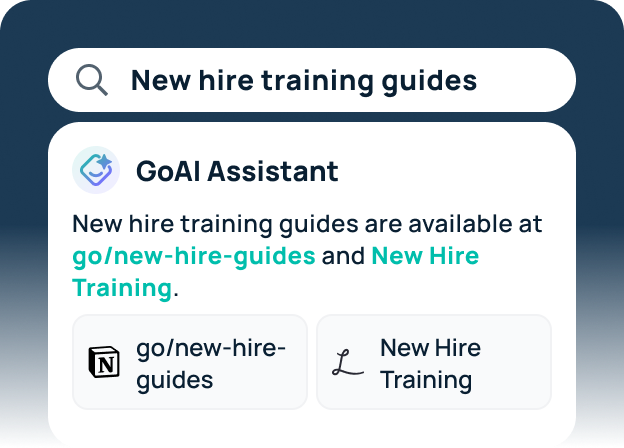
We see this play out with our own customers: AI adoption without a clear business rationale produces experimentation, not transformation. That’s exactly why we built GoSearch around real workflows instead of standalone tools — connecting across 100+ enterprise systems with permissions-aware retrieval, so every employee, not just technical teams, can put AI to work in the tools they already use.
Vanessa’s framework — business strategy over tooling, change leadership over function ownership, speed to value over vanity metrics — is a useful lens for deciding what to prioritize. Here’s how the GoLinks suite puts it into practice:
GoSearch: AI enterprise search with custom agents, AI-generated answers, and instant information discovery.
GoProfiles: An AI employee directory that fosters connection, recognition, and achievement across your organization.
GoLinks: Internal short links (Go Links®) that make finding and sharing resources instant.
For more, catch Vanessa on Episode 18 of HR GameChangers, where she breaks down her AI playbook for CHROs and CPOs — how to sequence rollout, build change readiness, and avoid the token-cost surprises she flagged above — orschedule time with us to explore the GoLinks suite of work tech solutions.
Search across all your apps for instant AI answers with GoSearch
Brandon Most is Head of Marketing at GoLinks, GoSearch, and GoProfiles, where he helps enterprise teams navigate the AI landscape and deploy tools that actually improve how work gets done. With nearly 20 years of SaaS marketing experience, he connects buyers with solutions that deliver measurable impact — and advises the boards and executive teams of several venture-backed startups.
Two-time founder Rohit Chikballapur on why production-ready AI is about verification, not perfection, the own-vs-rent framework, and why distribution beats building.