Need a little productivity boost? Join our monthly newsletter and we'll go/link you to the latest tips and trends in tech!
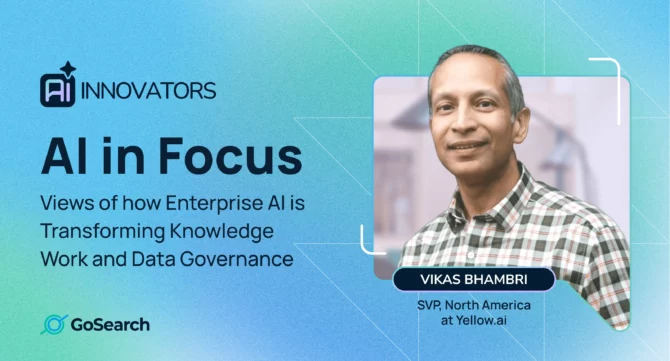
At GoSearch, our AI Innovators series highlights visionary leaders redefining the future of intelligent work. In this edition, we sat down with Vikas Bhambri, SVP at Yellow.ai, to explore how artificial intelligence is reshaping enterprise operations, from customer experience to internal productivity.
With three decades of experience across Oracle, LivePerson, and Yellow.ai, Vikas has led teams through multiple waves of digital transformation—from the rise of cloud computing to today’s AI-first era. His perspective blends deep technical understanding with real-world insights into how businesses can deploy AI responsibly and effectively.
The Highlights
Q&A with Vikas Bhambri
Tell us a bit about your background and how you found your way into AI.
Vikas Bhambri: I started my career as a software developer nearly 30 years ago, back when client-server architecture was cutting-edge. Over time, I transitioned into leadership roles across customer success, product, and go-to-market. But no matter the role, I’ve always stayed close to the technology—understanding how it solves real business problems.
AI was a natural next step. I’ve lived through multiple inflection points—SaaS, mobile, and now AI—and this one is by far the most transformative. AI’s speed, accessibility, and potential impact go beyond anything we’ve seen before. It’s not just changing how we work; it’s redefining what’s possible.
What sparked your passion for AI in particular?
Vikas Bhambri: What fascinates me about AI is its ability to democratize expertise. It puts knowledge and capability in the hands of anyone with curiosity and intent. You no longer need to be a data scientist to automate a workflow or extract insights from complex systems. That’s incredibly empowering.
But with that power comes responsibility. As leaders, we need to ensure that AI is used ethically and transparently. How we train models, manage bias, and protect data will shape the next decade of innovation. I’m passionate about that intersection of possibility and responsibility—how we scale AI safely while unlocking its full potential.
What advice do you have for industries hesitant to adopt AI?
Vikas Bhambri: Start small, but start now. Too many companies get stuck in analysis paralysis, waiting for the perfect use case or a “mature” technology stack. The truth is, there’s no perfect moment. The organizations that move early—even with pilot programs—gain a learning advantage that compounds over time.
AI shouldn’t be seen as a replacement for people; it’s an augmentation of human capability. A good example is customer support. AI doesn’t replace agents; it helps them respond faster, with more context and empathy. The same logic applies across industries—from law to healthcare to manufacturing. The question isn’t if AI will touch your business; it’s how fast you’re willing to embrace it.
“AI isn’t a replacement for people—it’s an augmentation of human capability. The real question isn’t if AI will touch your business, but how fast you’re willing to embrace it.”
— Vikas Bhambri, SVP, Americas, Yellow.ai
How do you think about the role of enterprise AI search in empowering knowledge workers?
Vikas Bhambri: Knowledge work is drowning in information overload. Employees spend hours every week digging through tools like Slack, Confluence, Jira, and SharePoint—often just to find something that already exists.
Enterprise AI search changes that equation. It brings your institutional knowledge into one unified, searchable layer, powered by natural language. That’s not just a productivity boost—it’s a transformation in how people interact with information.
The entire organization benefits when a salesperson instantly pulls up competitive intel or a support rep can surface a resolved ticket in seconds. That’s why I’m excited about platforms like GoSearch—they help teams move from searching for knowledge to acting on it.
“Knowledge work today is drowning in information overload. Enterprise AI search changes that by bringing institutional knowledge into one unified, searchable layer. When teams can instantly find what they need, they move from searching for knowledge to acting on it.”
— Vikas Bhambri, SVP, Americas, Yellow.ai
Why do so many AI initiatives fail to deliver ROI?
Vikas Bhambri: A big reason is misaligned expectations. Many companies approach AI like traditional SaaS—buy a license, flip the switch, and expect instant results. But AI isn’t plug-and-play. It’s more like hiring a new team member—you need to train it, monitor performance, and continuously refine its outputs.
Another factor is how success is measured. If your only goal is to cut costs or reduce headcount, you’re setting yourself up for disappointment. The real ROI of AI comes from expansion—handling more customer interactions, generating insights faster, or delivering better outcomes with the same resources. When you redefine success around impact, not just efficiency, that’s when the returns compound.
What AI advancements excite you most right now?
Vikas Bhambri: Two stand out.
First is vertical AI—solutions built for specific industries or business functions. These systems go beyond generic chatbots to deeply understand context, terminology, and workflows in areas like healthcare, finance, or retail. That depth of understanding makes AI truly valuable at the enterprise level.
Second is the rise of agentic AI, where systems can take actions autonomously. Instead of just answering a question, an AI agent might schedule a meeting, update a CRM, or generate a report on your behalf. We’re moving from “AI that assists” to “AI that acts,” and that’s a fundamental shift in what digital work looks like.
Security is top of mind. How should companies think about AI governance?
Vikas Bhambri: Security and governance can’t be afterthoughts—they need to be built into every stage of AI adoption. The key is purpose-based access, which grants AI systems only the data they need for a specific function.
Frameworks like Model Context Protocol (MCP) are helping standardize how data is shared safely between tools and agents. That’s the future—AI systems that can collaborate across platforms without exposing sensitive data. The companies that invest in strong governance now will move faster and more confidently later.
“Start small, measure impact, and scale intentionally. The most successful AI initiatives don’t try to do everything—they solve one meaningful problem exceptionally well.”
— Vikas Bhambri, SVP, Americas, Yellow.ai
Where is enterprise AI heading in the next 2–5 years?
Vikas Bhambri: We’re heading into an era where AI agents will talk to each other. Your personal AI might handle scheduling, travel booking, or document drafting by communicating directly with another organization’s AI.
That future is both exciting and challenging. It requires clear parameters, robust context, and transparent communication between systems. Humans will move more into supervisory roles—setting goals, defining policies, and monitoring results. It’s a world where AI handles the busywork, and people focus on creativity, judgment, and relationship-building.
“We’re moving from AI that answers to AI that acts. The next generation of enterprise AI will execute tasks, not just provide information.”
— Vikas Bhambri, SVP, Americas, Yellow.ai
What’s the biggest myth about AI?
Vikas Bhambri: That AI is magic. It’s not. AI is powerful, but it still depends on people—our data, creativity, and oversight. It requires continuous iteration. The companies succeeding with AI treat it as a living system that learns and improves alongside their teams.
The myth of “set it and forget it” has probably killed more AI projects than bad data ever did. Real progress comes from patience, learning, and a mindset of constant improvement.
Outside of AI, what keeps you energized?
Vikas Bhambri: Pickleball! I play about three times a week and love coaching others. It’s strategic, fast-paced, and surprisingly social. In a way, it’s a metaphor for leadership—reading the game, anticipating moves, and working as a team.
Staying active outside of work helps me recharge and think more creatively. The best ideas often come when I’m not at a desk.
Closing Thoughts
Vikas’s insights reflect what forward-thinking AI leaders are realizing: success isn’t about replacing people but amplifying what they can achieve.
At GoSearch, we share that mission. By unifying company knowledge across apps and empowering employees to find, reason, and act with AI, we help teams move from information overload to intelligent action.
Because, as Vikas said, AI doesn’t replace people—it makes them more effective.
Personal access to agentic enterprise search, free with GoSearch.
Brandon Most is Head of Marketing at GoLinks, GoSearch, and GoProfiles, where he helps enterprise teams navigate the AI landscape and deploy tools that actually improve how work gets done. With nearly 20 years of SaaS marketing experience, he connects buyers with solutions that deliver measurable impact — and advises the boards and executive teams of several venture-backed startups.
Two-time founder Rohit Chikballapur on why production-ready AI is about verification, not perfection, the own-vs-rent framework, and why distribution beats building.