Need a little productivity boost? Join our monthly newsletter and we'll go/link you to the latest tips and trends in tech!
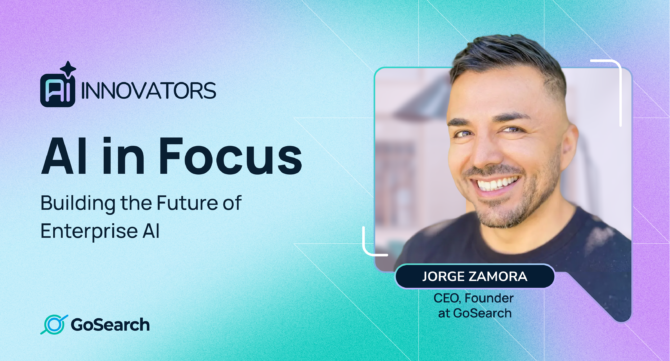
At GoSearch, our AI Innovators series spotlights the builders, thinkers, and visionaries shaping the next era of intelligent work. In this edition, we sat down with Jorge Zamora, founder of GoLinks and creator of the GoSearch and GoProfiles ecosystem, to explore the evolution of internal tools, the rise of enterprise AI search, and what comes next as AI accelerates at unprecedented speed.
Jorge’s journey started long before AI went mainstream. A self-taught engineer and one of the earliest YC-backed innovators in internal tools, he brings a rare blend of deep technical foundations and firsthand experience navigating enterprise security, scale, and product-market fit. His perspective is shaped not just by building products, but by living inside the systems—and constraints—that modern organizations face every day.
Key Takeaways
Internal tools define effective enterprise AI: AI delivers value when it is built inside real workflows, reflecting how work actually happens across systems and teams.
Permission-aware access is essential: Enterprise AI must respect real-time user permissions to be trusted, secure, and deployable at scale.
AI is a foundation, not a feature: The shift from links to answers requires rebuilding search architecture with AI embedded at the core.
Context determines AI usefulness: Personal connectors and federated, real-time context enable AI to move from information retrieval to actionable insight.
The future of work is ambient AI: AI is evolving into an always-on layer embedded across tools, workflows, and devices, rather than a separate destination.
Q&A with Jorge Zamora
Tell us a bit about your background, and what inspired you to start GoLinks.
Jorge Zamora: I’ve been building software since before I even knew what a startup was. I was a self-taught engineer, creating web apps before most people even knew what a web app was — long before AI went mainstream. I didn’t think of it as a career path at the time; I just loved the process of building something from nothing. Nights, weekends, whenever I had a free moment, I was experimenting, testing ideas, and teaching myself how great products come to life.
So I earned my master’s in computer science and joined Yahoo to work on internal tools. That’s where everything changed. I realized these internal tools were mission-critical — yet completely invisible to the outside world. And that’s when the opportunity clicked for me.
How did working on internal tools at Yahoo shape the idea for GoLinks?
Jorge Zamora: At Yahoo, the internal tools world completely changed how I saw software. These were the applications that powered everyday work — and yet no one outside the company even knew they existed.
What really struck me was that this wasn’t unique to Yahoo. Meta, Netflix, LinkedIn — they were all building the same kinds of tools, solving the same internal problems, again and again. Different companies, same challenges, same solutions — all rebuilt behind closed doors.
That’s when it hit me: these tools were essential, but no one was building them for mass adoption. They were created in-house, over and over again, inside every large company.
“Internal tools were mission-critical, but invisible. Every big tech company was rebuilding the same tools behind closed doors — and no one was bringing them to the world. That’s where GoLinks began.”
— Jorge Zamora, CEO, Founder at GoSearch
Someone needed to take them out of the walls of big tech and bring them to everyone else. That realization became the spark for GoLinks.
You eventually went through Y Combinator. What convinced them GoLinks could become a category-defining company?
Jorge Zamora: Fundraising was brutal in the beginning. I cold-called VCs, managed to get a handful of meetings, and none of them invested. I didn’t have the “right” background or network — and at one point, I almost quit entirely.
I ended up applying to Y Combinator the night before the deadline.
My pitch was simple:
GoLinks isn’t just another internal tool — it’s the wedge into every tool companies already rely on. It becomes the default way people access and share information at work. And once it’s deeply embedded in daily workflows, it creates a natural path to expand into a full suite — search, profiles, and beyond.
When people hear that idea for the first time, they usually fall into one of two camps.
The first reaction is: “I’ve never used this — I don’t get it.” The second is: “I used this at Google — it completely changed how we worked.”
At the end of my YC interview, I said something that caught everyone off guard: “Someone on this panel already bought our product – your company is already a customer.”
Ten minutes later, they told me I was in.
“Once you actually experience GoLinks, it stops being theoretical — it becomes obvious why it belongs at the center of how work gets done.”
— Jorge Zamora, CEO, Founder at GoSearch
The Early Vision for GoSearch
You had a broader vision that expanded into GoProfiles and GoSearch. How did GoSearch come into focus?
Jorge Zamora: Enterprise search existed at Yahoo, but it was never the first place people turned. Employees relied on shortcuts through GoLinks, people context from GoProfiles, and internal chat.
Because of that, I always knew we’d build search eventually — but it wasn’t the highest-ROI place to start. That shifted once competitors entered the market and positioned search as the simpler, more familiar concept. Search is easier to explain than GoLinks, and customers naturally gravitated toward it.
YC ultimately funded four different enterprise search startups around the same time. I met with all of them. They were exceptional engineers — deeply technical and incredibly smart. Still, they had no fundamental understanding of how to build a SaaS business, navigate enterprise security requirements, or work effectively with IT organizations. Those gaps matter at scale.
That’s when it became clear to me that none of them were positioned to succeed — which meant Glean would be left standing alone in the enterprise search space. At first, I considered supporting other teams going up against them. But once it was obvious they couldn’t execute — not on product, not on security, not on go-to-market — the path forward became obvious. If we wanted to solve this problem the right way, we had to build GoSearch ourselves.
AI Strategy — and the Early Leap Into AI
Did GoSearch exist before you added AI, or were those developed together?
Jorge Zamora: We built search first. AI came after.
Why did you move so aggressively into AI adoption?
Jorge Zamora: We were one of the first companies to launch AI directly inside a product — starting with GoLinks. From a product perspective, you never want to sit around waiting for the future to arrive. You want to build toward it, shape it, and meet users where they’re heading, not where they’ve been.
What really accelerated everything was the shift in user behavior. Practically overnight, people stopped wanting links and started wanting answers. They didn’t want to navigate to a page — they wanted the synthesis, reasoning, and context delivered instantly. The whole mental model changed from searching for information to asking for insight.
“Practically overnight, people stopped wanting links and started wanting answers. AI didn’t become a feature — it became the new foundation for search.”
— Jorge Zamora, CEO, Founder at GoSearch
Once we saw that shift happening at scale, it became obvious that search itself had to evolve. AI wasn’t a feature — it was the new foundation. So we moved immediately.
How would you describe the AI strategy behind the GoLinks ecosystem — and GoSearch specifically?
Jorge Zamora: Our mindset has always been to move early, but with intention. When we added AI to GoSearch, we weren’t just layering a chatbot on top of search. We focused on the foundational problems that were holding enterprise AI back.
We were early with personal connectors, real-time context, and an architecture that ultimately mirrored what the industry would later call Model Context Protocol. At the time, there wasn’t a name for it — we were just solving real problems: how to give AI meaningful context without breaking permissions, how to deliver answers in real time, and how to make AI genuinely useful inside complex enterprise environments.
At a high level, our strategy is simple. Identify the gaps that prevent mass AI adoption, eliminate unnecessary friction — especially from IT — and push the technology forward before the market catches up.
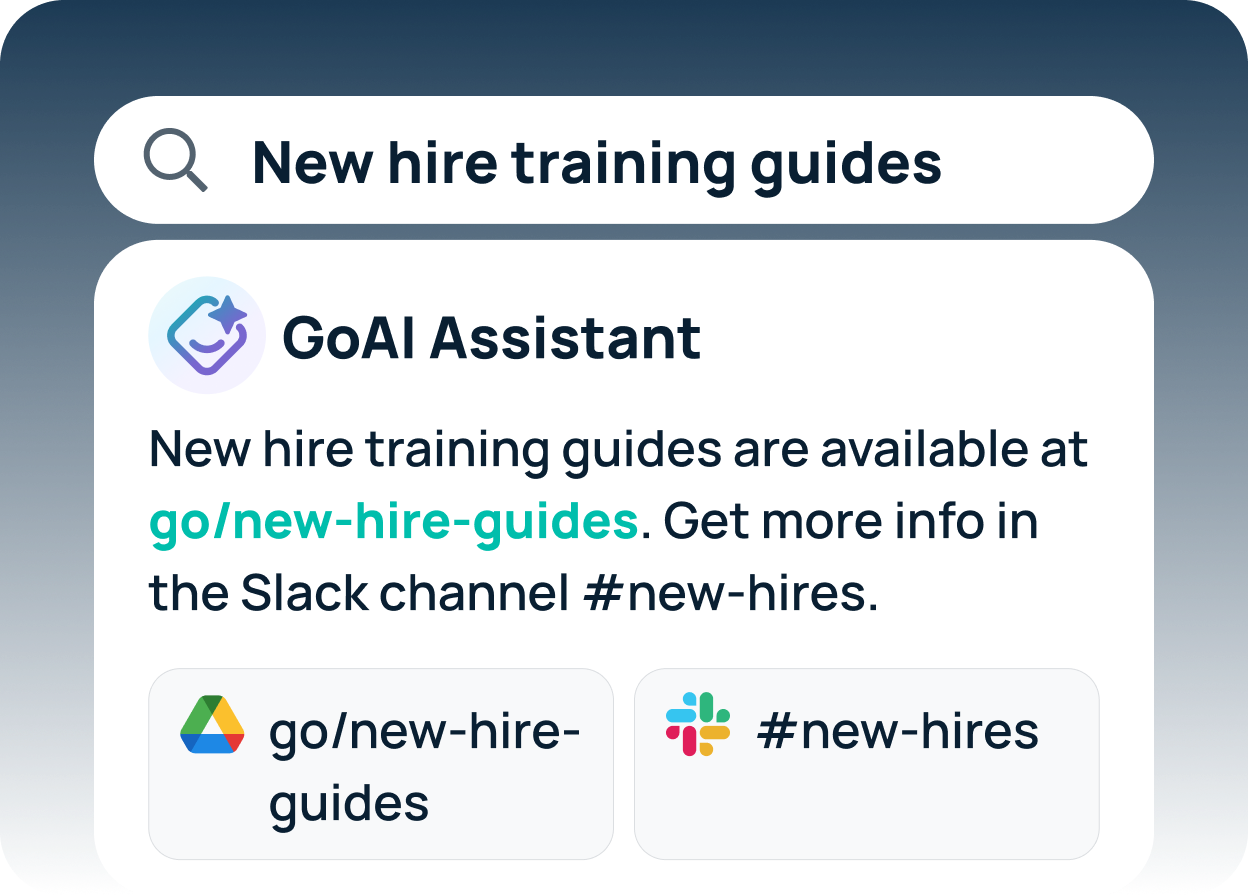
GoSearch Free is a good example of that philosophy in action. It gives teams access to AI without gatekeepers, approvals, or long setup cycles. If AI is going to change how people work, it has to be accessible first.
Why Enterprise AI Search Isn’t About Vendors — It’s About Product Teams
When customers compare GoSearch to Glean, what do you want them to understand?
Jorge Zamora: I don’t really think about it as GoSearch vs. Glean. I think about it as us versus the entire category of enterprise AI search — whether that’s Glean, Slack AI, Google, or any other platform entering the space.
“Competition isn’t brand versus brand. The real question is, who understands enterprise data, permissions, and security well enough to build AI that works in the real world?”
— Jorge Zamora, CEO, Founder at GoSearch
A lot of people frame competition as brand versus brand, but that’s not how these products are actually built or differentiated. What matters most is product development team versus product development team.
Do you deeply understand enterprise data — not just how to index it, but how it actually lives across tools, teams, and permissions? Do you understand internal tools because you’ve worked inside them for years, not just studied them from the outside? Do you understand how security teams think, where deals break down, and why certain approaches get blocked before they ever reach users?
And most importantly, do you know how to balance AI with real-time access and permissions — so that AI only sees what the user is allowed to see, at the moment they ask?
We do — because we’ve lived it. This isn’t theoretical for us. It comes from years of building and operating internal tools inside large enterprises, working alongside security teams, and seeing firsthand where AI succeeds and where it fails.
That lived experience shapes how we build GoSearch. And it’s something that’s very hard to replicate if you haven’t been in those environments yourself.
You were early with federated, real-time search. How did you know this would be essential?
Jorge Zamora: While I was at Yahoo, I spent time on the security team, working directly on SaaS vendor evaluations and internal tool audits. We reviewed everything — permissioning models, access controls, compliance risks, and how data moved across systems.
That experience was foundational. It gave me a firsthand understanding of where enterprise tools get rejected, how permissioning breaks down in real environments, and what security teams actually need in order to approve an AI-powered product. You see very quickly where most enterprise search tools fall short — not because the idea is wrong, but because the implementation doesn’t align with how security organizations operate.
That perspective directly shaped how we built personal federated search. From the beginning, it was designed to respect real-time permissions and mirror the access a user already has, rather than forcing security teams to compromise. It’s a big reason GoSearch can succeed in environments where other solutions struggle — and why competitors are still trying to catch up.
The Future of AI at Work
LLMs are evolving quickly. What advancements do you think will transform workplace tools next?
Jorge Zamora: I think about this constantly. We’ve been early to AI, so we’ve watched the evolution happen in real time — and it’s come in very clear phases.
The first challenge was context. Large language models were powerful, but they didn’t know enough about your world to be useful. RAG helped solve part of that by grounding responses in data. Then the question became scale — how much context can you actually give an LLM, and how do you prioritize the right information? That’s where context models started to emerge.
After that, the real bottleneck became access. People didn’t just want smarter answers — they wanted AI connected to everything they use at work. Integrations suddenly mattered. That’s why having 100+ connectors gives us such a meaningful advantage — it lets AI operate across the full surface area of enterprise knowledge.
But access alone isn’t enough. Once AI can connect to everything, permissions become the critical question: Does AI only see what I’m allowed to see? That’s why we built personal connectors — to ensure AI inherits the user’s exact access, nothing more, nothing less.
The next shift goes beyond connectors entirely. You can’t build a connector for every app forever — that approach doesn’t scale. The one place where everything is already connected is the browser. That’s why efforts like OpenAI Atlas, Perplexity’s Comet, and Gemini embedded into Chrome are so powerful.
But even that is just a step along the way.
The future is AI that has access to every tool on your computer — not just browser tabs, but your file system, native applications, and workflows across the device. When that happens, knowledge work undergoes a fundamental change. AI stops being a separate destination and starts becoming an ambient layer across everything you do.
That’s the world we’re building toward with GoSearch — and we’re already thinking deeply about how the product evolves to meet that moment.
Anything in the next six months that excites you?
Jorge Zamora: What excites me most isn’t a single feature — it’s the pace of improvement across large language models themselves. We’re seeing rapid gains in context, accuracy, and speed.
Right now, LLMs still have real limitations. They hallucinate. They take time to respond. Context windows are finite. Those constraints mean AI is powerful, but not yet frictionless for everyday work.
But that’s changing — fast.
As models get faster, as context windows expand into the tens of millions of tokens, and as accuracy moves closer to near-perfect, the entire experience shifts. AI stops feeling like a tool you occasionally consult and starts functioning like a true work companion — present in every moment of your workflow.
That’s the future we’re building toward. And we’ve already laid the foundation so that GoSearch can ride the full wave of LLM evolution.
“We’re building the future, not waiting for someone else to build it for us. That mindset is what pushes the entire ecosystem forward.”
— Jorge Zamora, CEO, Founder at GoSearch
Breaking Down AI Myths — and Resetting Expectations
What do you do when customers want AI to retrieve data from apps that don’t allow access?
Jorge Zamora: We educate them — honestly and transparently. Some applications simply don’t expose the data. Some LLMs don’t yet have enough context about the user. Some AI capabilities are simply not mature enough to support certain use cases.
ChatGPT has only been in mainstream use for three years. We’re still at the very beginning of what’s possible. There’s extraordinary innovation happening — but there are also real constraints today. Helping customers understand both sides is how we empower them to get the most value out of AI right now.
There’s a perception that AI should work perfectly. What’s your take?
Jorge Zamora: To be a leader in this space, you have to understand its limitations. We’re still early, and leaders everywhere are trying to figure out what effective AI adoption actually looks like. Our responsibility is to help them understand not just what AI is, but what it isn’t.
Clear expectations lead to smarter strategies, better outcomes, and ultimately more trust in the technology.
How has using your own products shaped your perspective on what comes next?
Jorge Zamora: Limitations spark creativity. When something doesn’t work, your first thought is, “What if it could?” That leads to new features, new ideas, new directions.
Using our own products every day gives us this constant feedback loop. You don’t just see what’s possible — you see what’s missing. And that’s where the ideas come from.
I’m excited about every innovation ahead. We’re building the future, not waiting for someone else to build it for us.
Closing Thoughts
Jorge’s perspective illustrates what happens when deep technical expertise meets an obsession with solving real workplace problems. His insights underscore a core truth about enterprise AI today: we are still at the very beginning. Yet the pace of innovation — from federated search to personal connectors to OS-level AI — is already laying the groundwork for a new era of intelligent work.
GoSearch is bringing that future closer. By unifying knowledge across tools and delivering a single, AI-powered search experience that is both contextual and actionable, we help employees move from information overload to intelligent action. Teams don’t just find information — they understand it, reason over it, and use it to make better decisions, faster.
And as Jorge’s story makes clear, the future of work won’t belong to those who wait for change. It will belong to the builders — the teams willing to move early, experiment boldly, and shape what comes next.
Personal access to agentic enterprise search, free with GoSearch.
Brandon Most is Head of Marketing at GoLinks, GoSearch, and GoProfiles, where he helps enterprise teams navigate the AI landscape and deploy tools that actually improve how work gets done. With nearly 20 years of SaaS marketing experience, he connects buyers with solutions that deliver measurable impact — and advises the boards and executive teams of several venture-backed startups.
Two-time founder Rohit Chikballapur on why production-ready AI is about verification, not perfection, the own-vs-rent framework, and why distribution beats building.