Need a little productivity boost? Join our monthly newsletter and we'll go/link you to the latest tips and trends in tech!
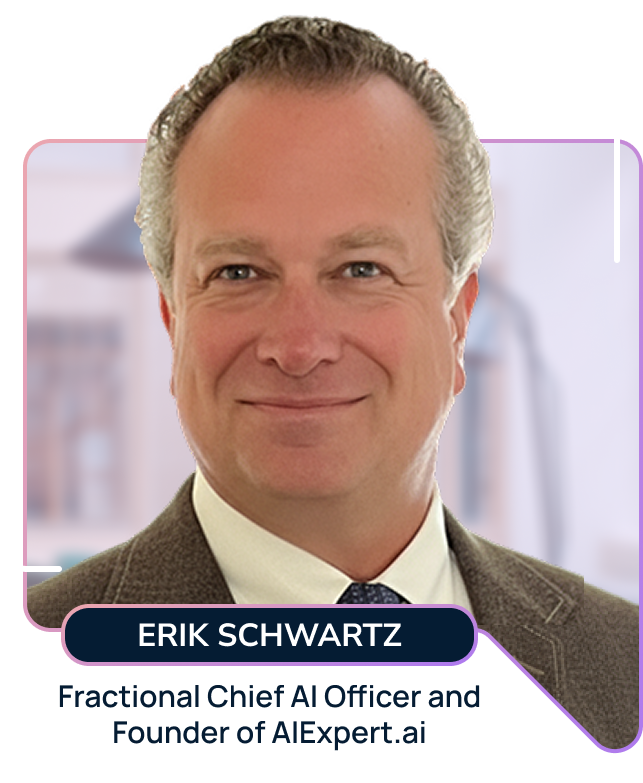
In this edition of AI Innovators, we sat down with Erik Schwartz, Fractional Chief AI Officer and founder of AIExpert.ai, to explore his journey into AI, how businesses can adopt AI effectively, and how tools like enterprise search and specialized AI agents are reshaping the modern workplace.
Erik shares insights from decades of experience running search engines for large organizations and consulting for small and medium businesses, highlighting how AI is not just about automation but multiplying human impact.
Key Takeaways
AI as a Multiplier, Not a Replacement: The goal isn’t to reduce costs by replacing employees but to enable teams to 10x their capabilities and focus on higher-value work.
Start with Education: Successful AI implementation begins with literacy and understanding what AI can and cannot do, not with jumping straight to solutions.
Focus on Problem and Workflow, Not Tools: The problem usually isn’t with the AI tool itself but with the workflow it’s trying to automate. Identify manual, labor-intensive, or error-prone processes first.
SMBs are Ideal for AI Transformation: Small and medium businesses with domain expertise but limited time for exploration can achieve rapid, meaningful results with AI.
Security Concerns are Often Overblown: Most AI models don’t retain user data in their training, and with proper protocols, the benefits typically outweigh the risks.
ROI Follows a Clear Path: From personal productivity to operational savings to innovation-driven revenue growth, AI investments can be justified through concrete metrics.
Everyone can Build Now: AI tools have democratized the ability to create and ship products, enabling non-technical people to solve problems they couldn’t tackle before.
Can you share your journey and how you became a Fractional Chief AI Officer and founder of AIExpert.ai?
Erik Schwartz: Absolutely. My career began in information retrieval—essentially building digital libraries and working with search engines right after school in the mid-90s. I worked for several search engine vendors, eventually moving to Microsoft, and then managing large-scale knowledge discovery platforms at organizations like Comcast.
“I shifted from running search engines for large corporations to building solutions for individuals and small businesses. That’s where AI moves from theory to real-world impact.”
— Erik Schwartz, Fractional Chief AI Officer and Founder of The AiExpert.ai
After moving to the UK post-COVID, I started AIExpert.ai, a consultancy focused on helping businesses leverage AI in practical, high-impact ways. The goal is to create actionable, measurable solutions, not just theoretical experiments.
Outside of AI and tech, what are your hobbies?
Erik Schwartz: Family life takes center stage—I have three kids, and a lot of my time is spent taking them to school events, sports games, and other activities. Beyond that, I thrive in outdoor settings. I love sailing, skiing, beach days, and being in the sun whenever possible.
I’m also a big foodie. My wife is an incredible cook, so I really enjoy experimenting with food, trying new flavors, and exploring culinary experiences. These hobbies give me balance, which is critical when you’re deeply immersed in a technology-heavy career.
If you weren’t in tech, what would your dream role be?
Erik Schwartz: Creativity has always drawn me in. I’ve long envisioned running a game studio, producing films, or creating immersive storytelling experiences. Even in my consultancy, I get to blend technology with creativity and problem-solving—designing AI solutions is as much an art as a science.
“The intersection of creativity and technology is where I feel most alive. AI lets me bring both to life in practical ways.”
— Erik Schwartz, Fractional Chief AI Officer and Founder of The AiExpert.ai
I’ve also pursued writing; my second book is coming out soon. If I weren’t in tech, I think I’d be exploring the worlds of creative media, gaming, or storytelling.
What kinds of companies come to you, and what problems are they trying to solve?
Erik Schwartz: I focus primarily on small and medium businesses (SMBs). These organizations often have deep domain expertise but limited time or resources to explore AI. They typically have teams of 15–50 people and are hitting growth ceilings.
Clients come to me with a wide range of challenges:
Converting large video libraries into interactive learning experiences using AI chatbots
Automating email-heavy workflows for legal, sales, or customer support teams
Streamlining compliance and legal review processes in highly regulated industries like pharma
“The real power of AI isn’t cutting costs—it’s multiplying the impact of your people and letting them do what they do best.”
— Erik Schwartz, Fractional Chief AI Officer and Founder of The AiExpert.ai
The common thread is that these businesses want to amplify the impact of their employees, not just reduce costs. AI allows them to work smarter and focus on higher-value activities.
How do you approach building AI solutions for clients?
Erik Schwartz: My approach is structured yet iterative:
AI Literacy: Educate leaders on what AI can realistically do and its limitations. Many misconceptions exist, so building this understanding is foundational.
Strategy: Identify high-impact areas where AI can improve workflows, automate repetitive tasks, and unlock value.
Execution: Build functional MVPs that can interact with real data. These aren’t just prototypes—they’re production-ready solutions that demonstrate tangible value.
Often, the real problem isn’t the technology itself—it’s the workflow. By analyzing how people work and where bottlenecks occur, we design AI solutions that are practical, grounded in real business needs, and scalable for future growth.
What do you see as the most significant AI advancement impacting the modern workplace?
Erik Schwartz: AI is a force multiplier. It allows employees to be exponentially more productive by automating routine tasks and freeing time for strategic work. Beyond personal productivity, AI is starting to reinvent business processes themselves.
Specialized AI agents will anticipate needs, solve problems proactively, and integrate seamlessly into daily workflows. For instance, sending personalized emails at scale, predicting follow-ups, or identifying friction points in processes—all of this will enhance efficiency and elevate the role of employees rather than replace them.
How do you see tools like enterprise search evolving with AI?
Erik Schwartz: Enterprise search has historically been a major pain point because of siloed and fragmented data. AI changes the game by allowing contextualized search across systems—CRMs, emails, ticketing systems, FAQs, and more.
Using frameworks like Model Context Protocol (MCP), AI agents can securely access multiple data sources, bring relevant information together, and answer complex questions. This is the next step in knowledge management: giving employees the ability to query all organizational knowledge seamlessly, as if it were in one place.
How should businesses think about security with AI?
Erik Schwartz: Security is critical. AI should only interact with data through controlled APIs using existing user permissions. Prompt injection and malicious inputs remain risks, so endpoints must be secured, and read/write access must be carefully managed.
The key is balancing risk and reward. With proper controls, the productivity gains from AI—faster workflows, better insights, and reduced manual effort—far outweigh the potential security concerns.
How do you justify AI ROI to a CFO?
Erik Schwartz: ROI is demonstrated through efficiency, cost savings, and employee impact. For example, IBM implemented AI HR bots to handle policy-related inquiries, drastically reducing HR workload. Automating repetitive queries allows employees to focus on higher-value activities, providing clear and measurable ROI.
→ Key Takeaway: AI’s value is both operational and strategic—it enhances employee productivity while improving organizational agility.
The AI Advantage in Enterprise Search
Erik’s insights emphasize starting with the problem, not the tool. AI and enterprise search solutions like GoSearch empower employees by connecting siloed data, contextualizing information, and deploying specialized agents to automate workflows.
“The combination of AI literacy, strategic implementation, and secure data access creates a measurable competitive advantage for any organization.”
— Erik Schwartz, Fractional Chief AI Officer and Founder of The AiExpert.ai
For businesses, this means driving efficiency, improving decision-making, and unlocking the full potential of teams across the organization. Tools like GoSearch demonstrate how specialized AI agents and unified search across enterprise applications can make this vision a reality today.
About GoSearch
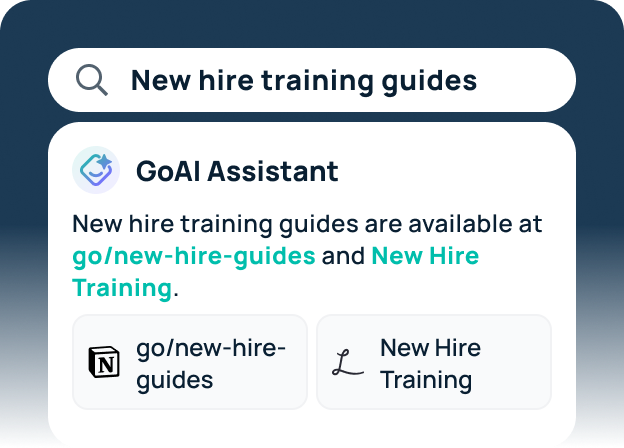
GoSearch is an enterprise search and knowledge discovery platform designed to help organizations unlock the full value of their data. By connecting to all enterprise applications and data sources, GoSearch provides a single, AI-powered search experience that’s both contextual and actionable.
With GoSearch, teams can:
Search across silos in real time, including CRM, emails, tickets, and document repositories.
Leverage AI to summarize, contextualize, and extract insights from complex data.
Deploy specialized agents to automate workflows and support decision-making.
Trusted by teams in tech, sales, legal, and operations, GoSearch empowers employees to find what they need faster, collaborate more effectively, and make smarter, data-driven decisions—turning enterprise knowledge into a true competitive advantage.
Brandon Most is Head of Marketing at GoLinks, GoSearch, and GoProfiles, where he helps enterprise teams navigate the AI landscape and deploy tools that actually improve how work gets done. With nearly 20 years of SaaS marketing experience, he connects buyers with solutions that deliver measurable impact — and advises the boards and executive teams of several venture-backed startups.
Two-time founder Rohit Chikballapur on why production-ready AI is about verification, not perfection, the own-vs-rent framework, and why distribution beats building.