Need a little productivity boost? Join our monthly newsletter and we'll go/link you to the latest tips and trends in tech!
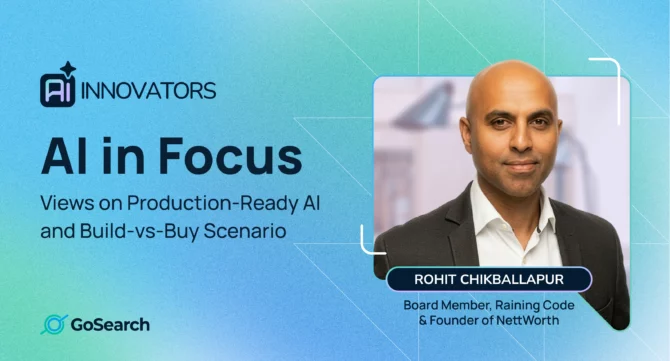
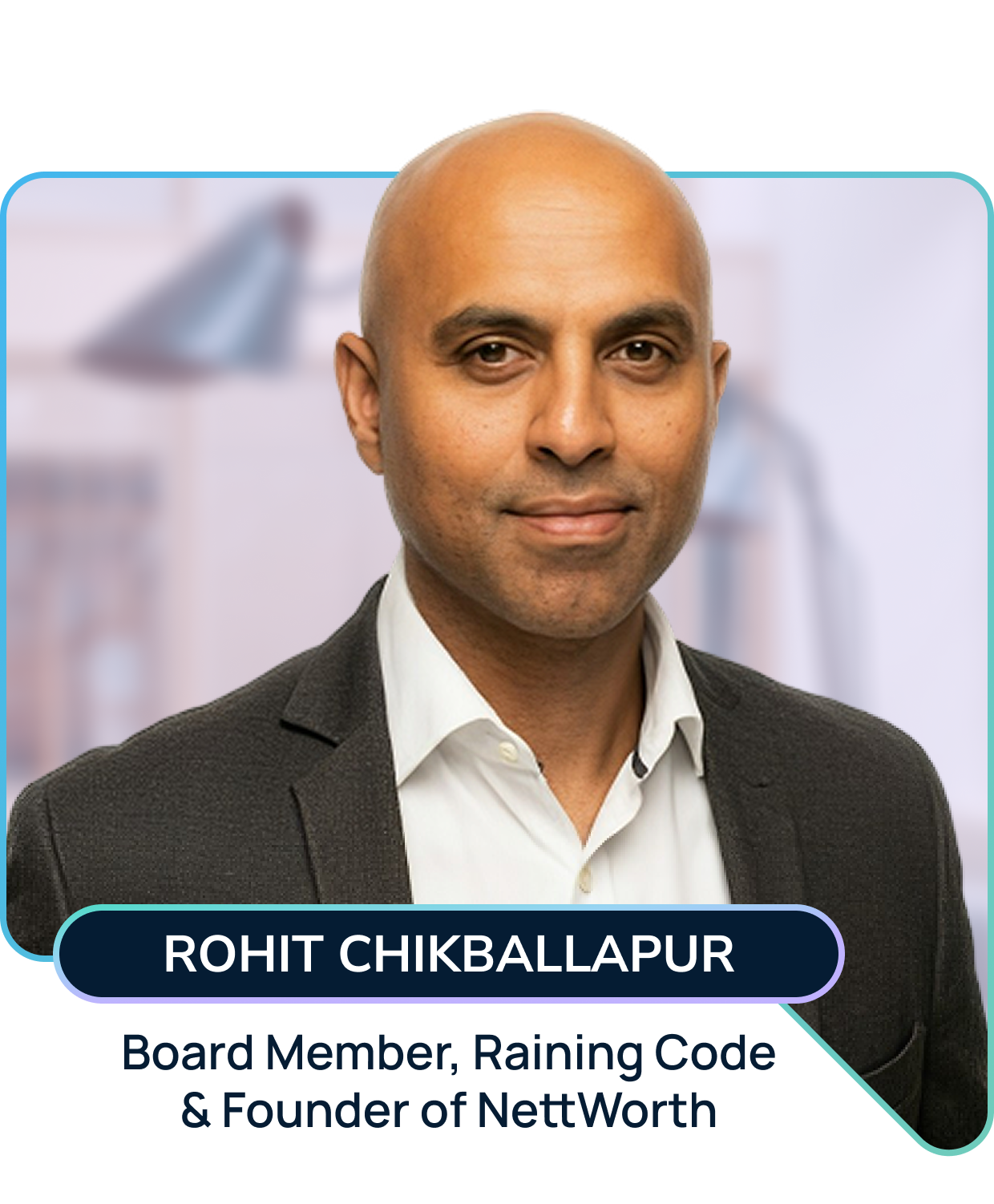
In this edition of AI Innovators, we sat down with Rohit Chikballapur, a two-time founder and enterprise operator with 20 years of experience deploying technology across five countries. Rohit currently serves on the board of Raining Code, an enterprise AI advisory firm, and is the founder of NettWorth, an AI-native personal finance startup he built to solve a problem he encountered himself: managing a financial history spread across five different countries.
Early in his career, Rohit spent years helping a large enterprise deploy SAP globally, working out of Hong Kong, France, China and Australia. Before Raining Code, he also founded a vertical software company in industrial maintenance. That mix of horizontal and vertical experience shapes almost everything he had to say about where AI creates real value and where it doesn’t.
Key Takeaways
Production-Ready Means Verifiable, Not Perfect: AI doesn’t need to be right every time. It needs to make its mistakes easy to catch and easy to correct.
Security Is Table Stakes: Without it, there’s no conversation about governance or value. It’s the price of entry, not a differentiator.
Horizontal AI Builds IP, Vertical AI Builds Services: The strongest AI software is built on horizontal use cases that compound across customers, not on codifying what one customer already knows.
Own vs. Rent, Not Build vs. Buy: The question isn’t whether you can build it. It’s whether the category is moving fast enough that you’d rather have someone else stay ahead of it.
Distribution Beats Building: Anyone can build fast right now. The founders who break through solve distribution first.
You’ve spent 20 years as a two-time founder and enterprise operator. How has that experience shaped what you believe makes an AI product truly production-ready?
Rohit Chikballapur: Twenty years ago, I was helping a large company deploy SAP across the world. I was in Hong Kong, Korea, Argentina, China, and Australia. That experience taught me that a large part of the deterministic workflows in companies has already been solved. There’s software for that, and the answer is exact. There’s no need to reinvent that wheel because it already works very well.
I think the benefits of AI are much more apparent where you have unstructured information and unstructured interactions between people that aren’t captured in a system today. So what does that mean for a production-ready AI system? In the end, AI is just another tool. And for any tool, you want it to be reliable and trustworthy. You want it to do what it says it will do every time.
More importantly, if you can easily identify when it hasn’t done what you wanted and intervene to change direction, that’s something you can actually use. Then it becomes a question of how often you need to intervene. If it’s not very often, I’d say that’s a production-ready system.
Security and infrastructure seem to be top of mind for enterprise AI buyers right now. How does security factor into production-ready software?
Rohit Chikballapur: If it isn’t secure, it doesn’t have any play at all. I take that as table stakes. Once it’s secure, has governance in place, and adds real value to the user and the company, then it matters.
You’ve argued that many enterprise AI startups are really services businesses dressed up as SaaS. What separates true, defensible IP from a high-margin services trap?
Rohit Chikballapur: I think a lot of IP can be built in AI software when it’s horizontal. HR, finance, even parts of sales and marketing tend to be similar enough across companies. There will be edge cases, but they’re far fewer than the bulk of the workflow, and that’s where it makes sense to build AI-native software with real IP, because what you learn from one customer benefits every other customer on your system.
When you get into vertical software, what you’re really trying to do is take the information, insights, and experience inside people’s heads and codify it into something AI can read and act on. That’s where the special sauce lives for that individual customer. So you have to ask: are you just giving away all your IP to a vendor who documents it and rents it back to you? That’s generally how I think about it. It makes sense when a startup brings in data that’s difficult for the customer to get on their own, and the customer genuinely benefits from that external data. That’s where you can build IP. Otherwise, it’s the customer’s IP, and you can’t really reuse it.
We’re seeing a lot of horizontal AI platforms, but also a wave of narrower, vertical-specific tools. Do you think vertical AI is the future, or does horizontal still win for most organizations?
Rohit Chikballapur: I could be wrong here, I’m human. But my opinion is that horizontal is where the value is for software companies. Vertical is where you build services businesses.
The hardest 20% of enterprise workflows often involves institutional knowledge and judgment calls. How does AI struggle with those, and what should companies build around verification and human oversight?
Rohit Chikballapur: It’s okay for AI to be wrong. The problem is that when a user or customer can’t determine where it’s wrong, it compounds. If it’s a workflow with multiple agents, every mistake, even if it only happens 5 or 10% of the time, multiplies across the flow and over time. No company can live with that.
So you want a human in the loop practically every single time, provided there’s a verification step that flags when the AI is likely wrong and surfaces it efficiently for someone to make the call. If that happens too often, the tool isn’t useful. If it never happens, it’s not workable either.
“It’s okay for AI to be wrong. The problem is when you can’t determine where it’s wrong.”
Do you see AI moving from human-in-the-loop toward fully autonomous over time, or will human oversight always be necessary?
Rohit Chikballapur: Honestly, I don’t think there’s a good answer, but let me explore it with you. Right now, nobody trusts AI to be 100% accurate, even at the frontier. With verification, you could get close enough to accept it, but you’d still want someone in the loop to confirm.
The harder question is this: Do you want no one in the company to have context on how the company actually works anymore? I’ve documented features of a product we’re building myself, then forgotten I’d done it. Over time, your opinions on how to do something change. Do you go back and update the context so the AI follows the new version? What’s the cadence for that? Even when a system is completely trustworthy, there’s a real problem in how you keep feeding it what you’re learning so it keeps doing what you want. If it’s purely about trustworthiness, we’ll get there eventually. The bigger question is whether we want to lose control of what it is that we do.
“Every sales conversation, every water cooler discussion brings in context that needs to be easy to bring back into the AI. The easier you make that, the richer your tool.”
Who typically brings you in as an advisor, and what are you actually being asked to solve?
Rohit Chikballapur: Given my background, I mostly work with industrial companies. The hardest part is usually educating them that AI isn’t a good candidate for deterministic problems. You don’t ask AI a calculator question when you already have a calculator. But there are clear use cases around automating things like RFP responses. Those are usually large contracts, and it’s typically the sales team that comes to us. We’ve had customers increase the number of proposals a smaller team can respond to by 30%, which is significant for a public sector-focused business.
A second common use case is customer service emails. Not support exactly, more responding to queries about products and parts, where there’s usually a transaction behind it. In most cases, though, it’s sales. We’ve had requests from logistics and other functions, but those use cases weren’t beneficial enough to justify an AI implementation, so we didn’t take them on.
I’ve also seen the failure mode a lot. You get a CTO or CIO with a mandate, so they deploy a chatbot, usually Microsoft’s, hand it to every user, and call it done. There’s a new line in the cost ledger, but nothing in the value ledger. Or you get a string of pilots launched across the org with no clear measurement, a lot of pomp and show that eventually fizzles out.
A lot of organizations come to you already committed to an AI initiative without a clear goal or business outcome attached to it. How do you get them to think beyond just putting budget toward a tool?
Rohit Chikballapur: When we pitch ourselves, we say we’re product-agnostic. We don’t have a product to sell. I also have a strong opinion about what a company should rent versus own, so sometimes we tell them not to sign up for a SaaS solution because the thing is critical enough that they should own it.
We start with the business case. If there’s a financial case for doing something, we document it so it’s easy to verify later whether it’s actually delivering. Sometimes it looks positive on paper, but once you factor in the AI’s accuracy rate, it isn’t. In those cases, we tell them the technology isn’t mature enough yet and to revisit in three to six months, because it’s moving fast.
How do you think about build versus buy for a use case like this?
Rohit Chikballapur: I’d reframe it. The argument isn’t build versus buy, it’s own versus rent. It doesn’t matter whether you build in-house because you have the team, or buy from an external supplier because they have the competence. The real question is whether the use case is critical enough that you want to own it, or whether the capability is evolving fast enough that you’d rather rent it from a supplier who lives in that space every day.
“The argument isn’t build versus buy, it’s own versus rent. The maintainability of the code isn’t the hard part; it’s the maintainability of the context.”
We built one tool in-house for a customer service mailbox, basically an inquiry-for-spare parts workflow. Once the model hit a reasonable accuracy bar with a human verifying it before anything goes out, it didn’t need to evolve much. It’s a standalone tool that just does its job. If the CRM the company was using rolled out something similar tomorrow, you could unplug it and switch over. I wouldn’t bring in a third-party SaaS product just for that.
But then you have use cases like enterprise search, where so much is changing that you don’t want to get stuck on a version that falls further behind every few months. It’s not your business to build search, so work with a supplier whose business it is, and who’s investing heavily in staying ahead in that space. You want to be with them.
“It’s not your business to build enterprise search. Work with a partner whose business it is—and who is relentlessly investing to stay ahead. You don’t want to be stuck on yesterday’s version while the world moves forward.”
AI sprawl seems to be a growing concern, with different teams reaching for different tools. Is it a real problem, and how should organizations think about it?
Rohit Chikballapur: Yes, and I suspect it’s going to start killing a lot of AI projects quickly. I’m seeing it in two different places. Among tech companies, it’s fashionable for everyone to be using AI. Everyone has a favorite model and tool set. On my own team, we build our own harnesses. I hadn’t written code since 2004, and from late 2025 to now I’ve written a hundred times more than I ever did before, mostly harnesses. In tech, people generally have the competence to do more with more judgment, though there are also token-maxing types companies are starting to wake up to.
In the non-tech segment, it’s a different divergence. You’ve got CIOs and CTOs handing AI to everyone and saying “figure out what you want to use it for.” Some people abuse it, some don’t know how to use it and treat it like search. But the more interesting shift is companies starting to segment by use case as costs come into focus. Something like document AI works fine with a well-defined use case and a less frontier model. Once you move into agentic work, you have to start asking whether it’s a long-context task, a multi-step task, whether you want different models at different steps. That tooling isn’t quite there yet, but the demand for it is much stronger outside tech, where the diversity of use cases is so much wider than “write code.”
Rapid Fire Questions:
If you weren’t in tech or AI, what would you be doing?
Rohit Chikballapur: I think I’d be teaching, probably high school. Anything between history and English. I was an English teacher at university, and I look back on that time very fondly. I might go back to it someday.
What’s the one overrated trend in the current AI hype cycle?
Rohit Chikballapur: I think today’s frontier models are already good enough for most of what people want to do. A lot of what’s come after that bar was cleared is arguably overrated.
What’s the most underrated metric for measuring enterprise AI ROI?
Rohit Chikballapur: Frequency of use. Almost everyone finds it useful the first time. But if people aren’t coming back a few times a day, at least once a day at the enterprise level, it won’t catch on, and the ROI won’t be there.
What’s one workflow you believe AI should never fully automate?
Rohit Chikballapur: Right now, I’d say none of them, because you can’t fully trust AI with any of it yet. Over time, it comes down to how much control and awareness we’re willing to give up, which is a human question more than an AI one. For truly deterministic workflows, I’d say never, though that isn’t an AI problem to begin with.
What’s the single best piece of advice you have for founders building in AI today?
Rohit Chikballapur: Building is easy. Distribution is hard. The sooner people focus on distribution, maybe even before they build, the better, because right now anyone can build anything, and build it fast.
Rent the Category That Moves Fastest
Rohit’s framing, own versus rent instead of build versus buy, is a useful lens for enterprise search. It’s exactly the kind of category he describes: one evolving too fast for any single team to keep pace with on their own. That’s the case for working with a supplier investing in staying at the cutting edge of it, rather than trying to own it in-house.
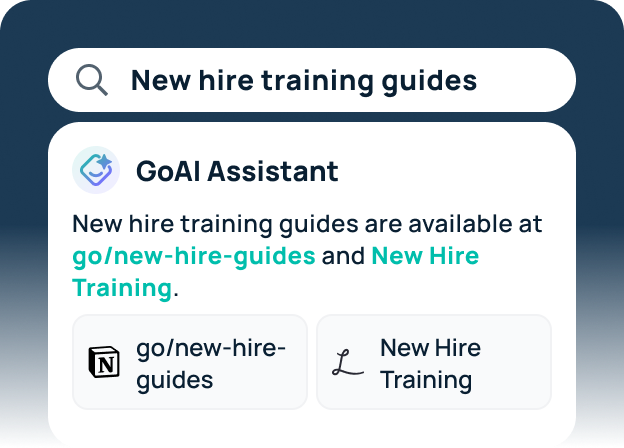
It’s also the thinking behind GoSearch, which connects across existing enterprise resources instead of asking teams to rebuild their stack around it, with a support team that stays hands-on once you’re live. That combination is what turns “we deployed a chatbot” into a tool people come back to, which is the frequency-of-use bar Rohit points to as the real measure of ROI.
GoSearch: AI enterprise search with custom agents, AI-generated answers, and instant information discovery.
GoProfiles: An AI employee directory that fosters connection, recognition, and achievement across your organization.
GoLinks: Internal short links (Go Links®) that make finding and sharing resources instant.
Want more conversations like this one? Browse the full AI Innovators series, or schedule time with us to explore the GoLinks suite of work tech solutions.
Search across all your apps for instant AI answers with GoSearch
Brandon Most is Head of Marketing at GoLinks, GoSearch, and GoProfiles, where he helps enterprise teams navigate the AI landscape and deploy tools that actually improve how work gets done. With nearly 20 years of SaaS marketing experience, he connects buyers with solutions that deliver measurable impact — and advises the boards and executive teams of several venture-backed startups.