


Ask a coworker, “What’s our PTO policy?” and you’ll get an answer based on what they remember. Ask an AI assistant, and you’ll get one of two answers: a generic response stitched together from the internet, or the right one, pulled from your actual HR handbook, current as of last week, and filtered for your permissions.
The difference isn’t the model. It’s the context.
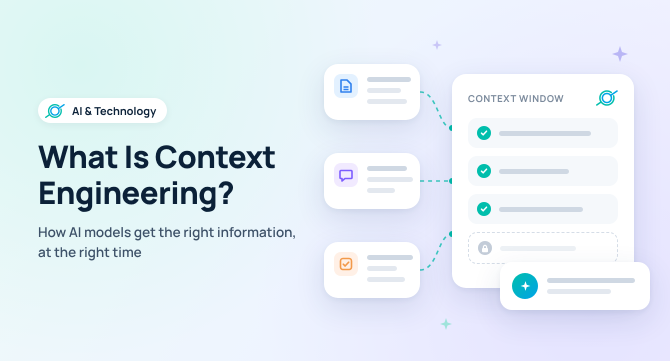
Context engineering is the practice of designing the systems that give an AI model the right information, in the right format, at the right time, so it can complete a task accurately. Where prompt engineering focuses on how you ask, context engineering focuses on what the model knows when it answers. For enterprise AI, that means connecting company data, respecting permissions, and keeping the context window focused on what matters.
What is Context Engineering?
Context engineering is the discipline of deciding what information an AI model sees before it responds and building the systems that deliver that information reliably.
A large language model (LLM) only knows two things: what it learned in training and what’s in its context window at the moment you ask. Everything else, your Jira tickets, last quarter’s board deck, the Slack thread where a decision was made, is invisible unless something puts it there.
As Andrej Karpathy puts it, an LLM is like a CPU, and its context window is like RAM. Just as your computer can only work with what’s in memory, an AI model can only use what’s loaded into its context. Context engineering is about ensuring the right information is available when it’s needed.
Anthropic describes it as “the set of strategies for curating and maintaining the optimal set of tokens (information) during LLM inference” (Anthropic). In plain terms, it answers three questions for every request:
- What does the model need to know? Instructions, relevant documents, prior conversation, available tools.
- Where does that information live? Across dozens of apps, in formats that rarely match.
- What should be left out? Stale, irrelevant, conflicting, or unauthorized content.
Context Engineering vs. Prompt Engineering vs. RAG
Prompt engineering is one part of context engineering. RAG is one technique within it. Context engineering is the whole system.
| Core question | How should I phrase the request? | Which documents should I fetch? | What does the model need to know, from where, and in what form? |
| Scope | A single prompt or instruction | Retrieval of external knowledge | Instructions, memory, retrieved data, tools, permissions, output format |
| Who owns it | The user or prompt author | ML or search engineers | Platform and AI system designers |
| Time horizon | One turn | One query | Multi-turn conversations and long-running agent tasks |
| Typical failure | Vague or ambiguous wording | Irrelevant or outdated results | Missing, stale, conflicting, or unauthorized information |
| Enterprise example | “Summarize this in 3 bullets” | Pulling the top 5 matching docs | Pulling the latest policy the user is allowed to see, plus the related Slack decision, ranked by recency and owner |
Prompt engineering still matters. A clear instruction beats a vague one. But as AI moves from chat to agents that take multi-step actions, the bottleneck shifts from wording to information. A perfectly phrased prompt can’t fix an answer built on the wrong document.
Why Context Engineering Matters for Enterprise AI
Most enterprise AI failures aren’t model failures. They’re context failures: the model never saw the right information, or saw too much of the wrong kind.
Three realities make this harder at work than in a consumer chatbot:
- Knowledge is scattered. The answer to one question might span Confluence, Salesforce, Google Drive, and a Slack thread. No single app holds the full picture.
- Access is uneven. An engineer, a recruiter, and a CFO should get different answers to “What’s the status of Project Atlas?” because they’re allowed to see different things.
- More context isn’t better context. Long context windows tempt teams to stuff everything in. But researchers have documented “context rot”: as the number of tokens grows, a model’s ability to accurately recall information from that context declines. Anthropic calls context “a finite resource with diminishing marginal returns” and frames it as an attention budget.
This matters even more for agents. If a chatbot makes a mistake, you can ignore it. But if an agent has the wrong information, it might file the wrong ticket, email the wrong customer, or update the wrong record. That’s why good context engineering is what makes agents safe to trust with real work.
Why Does Context Engineering Matter for Enterprise Seearch?
Enterprise search has shifted from returning links to returning answers, and an AI answer is only as good as the context behind it.
When search hands a list of 10 links, people can judge which one is right. When AI writes one answer, the system has to make that judgment first. Context engineering is how it does that.
Here’s how it changes enterprise search:
| Traditional enterprise search | AI enterprise search with context engineering | |
|---|---|---|
| Output | A ranked list of links | A direct answer with cited sources |
| Who judges relevance | The person reading results | The system, before the model responds |
| Permissions | Applied to the results list | Applied before anything reaches the model |
| Freshness | Depends on the last index sync | Live queries for fast-changing sources, indexing for the rest |
| Company language | Keyword matching | Understands internal terms, acronyms, and project names |
| What it powers | Finding documents | Answers, chat, agents, and automated workflows |
Four reasons it matters most for search teams and IT leaders:
- Retrieval quality becomes answer quality. In AI search, the model writes from whatever retrieval hands it. If ranking surfaces last year’s pricing sheet, the answer will quote last year’s prices, confidently. Also use the context of the person to rank the content priority (location, department, role, etc).
- Permissions become a security boundary, not a filter. A results page can hide a link the user can’t open. An AI answer can’t un-say a sentence it already summarized from a restricted file. Permissions have to be enforced before retrieval.
- Every AI feature inherits search’s context. Chat assistants, agents, and workflows all sit on top of the same retrieval layer. Get context right in search, and every downstream AI tool gets more accurate at once.
- Trust drives adoption. Employees stop using AI search after a few wrong answers. Grounded, cited, permission-aware answers are what turn a pilot into daily use.
In short, context engineering is what separates enterprise search that finds documents from enterprise search that employees and agents can rely on to do real work.
The Building Blocks of Context
Everything an AI model sees when it answers falls into one of seven categories. Context engineering decides what goes into each.
| System instructions | Standing rules for how the model behaves | “Cite sources. Never share salary data.” |
| User input | The question or task itself | “Draft a renewal email for Acme.” |
| Short-term memory | The current conversation history | Earlier turns where the user said Acme is on the Enterprise plan |
| Long-term memory | Facts that persist across sessions | The user’s role, team, and preferred format |
| Retrieved knowledge | Documents and records pulled from company systems | Acme’s contract in Drive, open tickets in Zendesk, and the account in Salesforce |
| Tools | Actions and live lookups that the model can call | Search, create a Jira ticket, query a CRM via MCP |
| Output format | The structure the response must follow | A table, JSON for a downstream workflow, or a Slack-ready message |
Retrieved knowledge is usually the hardest piece in an enterprise. It has to be found across many apps, ranked by relevance, filtered by permission, and trimmed to fit.
How Context Engineering Works, Step by Step
Between the moment you hit Enter and the moment the model starts writing, a well-engineered system runs through six steps.

- Understand the request. Identify who is asking, what they want, and which systems likely hold the answer. “Our Q4 roadmap” means something different to a product manager than to a sales rep.
- Retrieve from the right sources. Pull candidates from connected apps. Some sources are indexed ahead of time for speed. Others are queried live so the data is current and never copied.
- Enforce permissions. Drop anything the user can’t open in the source app. This happens before the model sees it, not after.
- Rank and filter. Score results by relevance, recency, ownership, and whether the content is verified. Remove duplicates and stale versions.
- Compress and structure. Summarize long material, keep only high-signal passages, and label each piece clearly (source, date, author) so the model can cite it.
- Generate, act, and remember. The model answers or calls a tool. Useful facts carry forward into memory; noise doesn’t.
For long-running agents, two more techniques keep context healthy over time. Compaction summarizes a conversation as it nears the window limit and restarts with the summary. Just-in-time retrieval keeps lightweight references (file paths, links, queries) in context and loads full content only when needed (Anthropic).
Common Context Failures (and How to Prevent Them)
When AI gets it wrong at work, the cause is usually one of five context failures. The first four come from a taxonomy by AI researcher Drew Breunig; the fifth is the one enterprises can’t afford.
| Failure | What happens | How to prevent it |
|---|---|---|
| Context poisoning | A wrong fact or hallucination enters context and gets repeated | Ground answers in cited sources; verify or hide outdated content |
| Context distraction | So much history piles up that the model over-focuses on it | Summarize and compact long sessions |
| Context confusion | Irrelevant documents or too many tools muddy the response | Rank tightly; expose only the tools the task needs |
| Context clash | Two sources disagree (an old policy vs. the new one) | Rank by recency and owner; boost verified content |
| Context leakage | The model surfaces data that the user isn’t allowed to see | Enforce source-app permissions before retrieval, not after generation |
The last row is why permissions can’t be an afterthought. If an AI system indexes everything and filters later, sensitive data is already in the pipeline.
How GoSearch Handles Context Engineering for You
Most teams don’t want to build a context pipeline from scratch. GoSearch is an AI enterprise search knowledge layer that does the context engineering behind every search, GoAI chat, agent, and workflow.
- Connected to where knowledge lives. 100+ integrations across indexed, federated, and MCP connectors, so context comes from Slack, Google Drive, Confluence, Jira, Salesforce, GitHub, and more.
- Hybrid retrieval. Choose which sources to index for fast AI-powered search and which to query live for real-time data, with no waiting for data to sync.
- Permissions first. GoSearch mirrors permissions across every connected app. If someone can’t open a file, it never reaches their search results, their AI answers, or their agents.
- Ranking that fights context clash. Results rank by recency, owner, and team relevance, and verified documents rank higher. A company glossary helps the model understand your internal terms.
- Model flexibility. Switch between frontier models from OpenAI, Anthropic, Google, xAI, and more, with no lock-in. The context layer stays the same.
- Enterprise-grade security. SOC 2 Type II certified, GDPR and CCPA compliant, with zero data retention agreements with LLM providers and prompt injection protection.
The result is AI that answers with your company’s knowledge, not the internet’s. Model N’s support team, for example, saw a 47% productivity boost and a 49% reduction in ticketing backlog after rolling out GoSearch. And because setup takes days, not months, teams get there without a six-month implementation project.
The model you choose matters less every quarter. The context you give it matters more. Teams that get context engineering right get AI that’s accurate, secure, and trusted enough to hand real work to agents.
GoSearch gives every search, chat, and agent the right company context, with permissions built in from the start. Book a demo or try GoSearch free.
Personal access to agentic enterprise search, free with GoSearch.
Sign up
Frequently Asked Questions
Context engineering is making sure an AI model has the right information when it answers. It covers what data gets pulled in, from where, in what format, and what gets left out.
Prompt engineering focuses on how you word a request to an AI model. Context engineering focuses on the information the model has access to when it responds, including documents, memory, tools, and permissions. Prompt engineering is one part of context engineering.
No. Retrieval-augmented generation (RAG) is one technique within context engineering. RAG fetches relevant documents. Context engineering also decides how those documents are ranked, filtered by permission, compressed, and combined with instructions, memory, and tools.
Agents take multi-step actions, so mistakes compound. An agent with incomplete, outdated, or unauthorized context can take the wrong action. Context engineering keeps each step grounded in accurate, permitted information.
Not on its own. Larger windows hold more information, but model accuracy tends to decline as context grows, a problem known as context rot. Selecting the most relevant information still beats including everything.
Most companies use an enterprise AI search platform that connects their apps, enforces permissions, and ranks results before passing them to a model. Building this in-house requires connectors, a retrieval and ranking layer, permission syncing, and memory management.