Need a little productivity boost? Join our monthly newsletter and we'll go/link you to the latest tips and trends in tech!
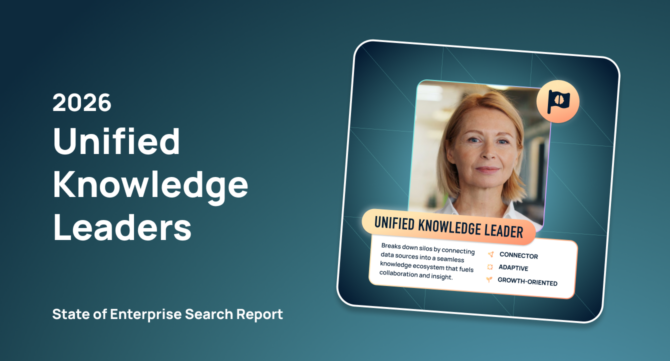
GoSearch recently surveyed enterprise search and AI professionals to better understand how organizations are approaching knowledge management today. Based on their responses, participants were grouped into profiles that reflect their priorities and strategies. One of the most adaptable profiles that emerged was Unified Knowledge Leaders.
These leaders focus on connecting data across tools and teams to create a more coherent knowledge environment that supports collaboration and better decision-making. Their responses point to a group that is growth-minded and focused on building practical, integrated knowledge experiences rather than adding more isolated systems.
Key Takeaways
Unified Knowledge Leaders focus on connecting existing tools and data rather than adding new silos. Integration matters more than accumulation.
Productivity gains come from reducing friction. Unified search and fewer context switches save time and help teams work more effectively.
Adoption is the real success metric. Knowledge systems only create value when they are easy to use and fit naturally into daily workflows.
AI is most valuable when it can act on information, not just surface it. Agentic workflows and automation depend on a strong, unified knowledge foundation.
Many organizations are still early in their journey. Starting without legacy constraints allows teams to define strategy, metrics, and success on their own terms.
Security and risk management are not afterthoughts. Trust, compliance, and control are essential for unified knowledge systems to scale.
The path forward is incremental. Focused integrations, measurable wins, and continuous learning drive sustainable progress.
Balancing Productivity, Experience, and Innovation
Unified Knowledge Leaders tend to balance three core goals for enterprise search:
Boosting productivity while managing costs
With efficiency under constant pressure, these leaders see knowledge unification as a way to reduce wasted time and effort. Connecting data sources helps eliminate redundant searches, minimize context switching, and simplify everyday workflows, all while keeping technology spend in check.
“The real power of AI isn’t cutting costs—it’s multiplying the impact of your people and letting them do what they do best.”
— Erik Schwartz, Fractional Chief AI Officer and Founder of The AiExpert.ai
Improving employee and customer experiences
Easy access to accurate information improves outcomes across the board. Employees get answers faster, and customers benefit from more informed, consistent interactions.
Turning information into action with AI
For Unified Knowledge Leaders, the goal is not just finding information, but using it. They focus on building the foundation that allows AI to generate insights, support decisions, and automate meaningful work.
The Challenge of Silos and Adoption
Two obstacles consistently stand in the way:
Information spread across too many tools
Specialized applications often solve individual problems but create fragmentation over time. Unified Knowledge Leaders aim to connect these systems instead of introducing another standalone tool.
Low adoption and engagement
Even well-designed knowledge systems fail if people do not use them. These leaders see adoption as the real measure of success and prioritize intuitive access that fits naturally into daily work.
Capabilities That Support a Unified Approach
Unified Knowledge Leaders tend to align around a few core capabilities:
Unified hybrid search
Searching across on-prem and cloud systems from a single interface is table stakes. Employees should not need to know where information lives in order to find it.
“Enterprise AI search changes the equation by bringing institutional knowledge into one unified, searchable layer.”
— Vikas Bhambri, SVP, Americas, Yellow.ai
Agentic AI workflows
Beyond search, many leaders are exploring AI that can take action across systems, such as creating tickets or updating records. This marks a shift from passive access to active support.
Analytics and admin visibility
Usage data helps leaders understand how knowledge is being used, where gaps remain, and which silos still need attention.
Starting Without Legacy Constraints
Many Unified Knowledge Leaders do not yet have a dedicated enterprise search solution in place. Rather than a disadvantage, this gives them flexibility. They can choose tools designed for integration and modern work environments instead of adapting older systems that were never built for this level of connectivity.
Security as a Baseline Requirement
Even in early stages, security remains a priority:
Data storage controls and compliance with regulations like GDPR and HIPAA
Monitoring and auditability of access and usage
Flexibility to use approved LLMs or cloud environments
This reflects an understanding that unified knowledge systems touch sensitive information across the organization and must earn trust to succeed.
A Realistic View of AI Risk
Unified Knowledge Leaders are pragmatic about AI challenges, including:
Accuracy and reliability of outputs
Risks around data exposure and intellectual property
Ongoing compliance and audit requirements
Connecting knowledge also means managing risk consistently across systems, which makes strong guardrails essential.
An Adaptive, Exploratory Mindset
When asked about their enterprise search strategy, many Unified Knowledge Leaders say they are still figuring it out. This is intentional. They take time to:
Understand where fragmentation actually exists
Evaluate how tools work together
Build alignment across stakeholders
Learn from early experiments before scaling
Foundations Already in Place
Even without a fully defined strategy, many leaders have started building:
RAG-based workflows
Early experimentation with task-oriented AI
These building blocks allow them to move quickly once priorities are clear.
Defining Success From Scratch
Most Unified Knowledge Leaders report that they do not yet have formal metrics for knowledge or search success. This creates an opportunity to define meaningful measures such as:
Time saved finding information
Reduction in unanswered or abandoned searches
Increased cross-team collaboration
Employee satisfaction with knowledge access
Improvements in customer experience tied to better information
Connection as a Long-Term Strategy
Unified Knowledge Leaders move from fragmentation to cohesion by focusing on:
Targeted integrations that address the most painful silos first
Gradual expansion based on real impact
Systems that encourage collaboration naturally
Platforms that can evolve as needs change
“AI is not just a tool. It’s a new way of working.”
— Jessica Hreha, AI Transformation Director @ Jasper
A Future Without Knowledge Barriers
Unified Knowledge Leaders are shaping how organizations access and use collective knowledge. Their work enables:
Employees to find information quickly, regardless of where it lives
Teams to collaborate more easily because knowledge is shared by default
AI systems to deliver useful insights and automation with full context
Organizations to make better decisions faster
By connecting systems thoughtfully and building for adoption, Unified Knowledge Leaders show that unified knowledge is less about technology alone and more about how work actually gets done.
If your organization is looking to reduce fragmentation and make knowledge easier to use, this approach offers a practical path forward. GoSearch helps teams connect information, support everyday work, and build toward a more unified knowledge experience.
Search across all your apps for instant AI answers with GoSearch
Charlotte O'Donnelly is Senior PMM at GoLinks, GoSearch, and GoProfiles, where she leads positioning and GTM for enterprise AI products redefining how organizations find, access, and act on institutional knowledge. A 3x founding PMM with 9 years spanning PLG and enterprise sales, she specializes in bringing AI-native products to market — aligning teams around messaging that drives activation, expansion, and revenue.
Six AI agent platforms compared on connectivity, workflow automation, citations, and pricing — plus five criteria for evaluating any platform against your stack.