Need a little productivity boost? Join our monthly newsletter and we'll go/link you to the latest tips and trends in tech!
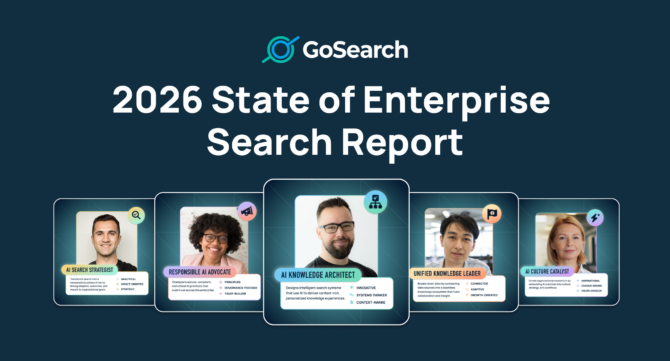
Over the last several months, GoSearch conducted a survey of Enterprise Search and AI leaders, evaluating their top concerns and priorities for 2026, compiled in our 2026 State of Enterprise Search Report.
The survey revealed a clear shift: organizations no longer view enterprise search as a simple information-retrieval tool. Instead, they’re prioritizing AI-powered search, knowledge automation, and intelligent workflows that reduce time spent searching, improve employee experiences, and drive measurable productivity.
Enterprise search is entering a new era. Once viewed as a “nice-to-have,” it’s now becoming foundational to how organizations work, automate, and scale knowledge across teams. But our latest survey reveals something important: while interest is high and expectations are rising fast, most companies are still early in their maturity.
Key findings include:
Strong interest in AI-driven search and automation, despite early maturity levels.
Fragmented systems and inaccurate results are still major roadblocks.
Budgets for enterprise search remain limited, but investment is rising.
Security, governance, and trusted AI outputs are non-negotiable requirements.
RAG, agentic AI, and personalized search top the 2026 adoption roadmap.
This report breaks down the biggest trends shaping enterprise search and knowledge automation heading into 2026, along with what these findings mean for GoSearch’s role in the future of enterprise search.
The Big Shift: From Search → Intelligence → Automation
Enterprise search is no longer just about “finding information.” Organizations want systems that understand context, generate insights, and automate tasks. This shift reflects a broader transformation in how teams expect search to support productivity, decision-making, and intelligent workflows.
“AI systems today don’t just process — they understand context, adapt to user intent, and refine their responses.”
— Ritendra Datta, VP of AI @ Eightfold AI
The motivation behind search investments now goes far beyond basic findability. Respondents consistently tied their goals to:
Productivity gains
Cost efficiency
Improved employee and customer experience
AI-driven insights and automated actions
The takeaway: enterprise search is rapidly evolving into the backbone of intelligent automation. Teams expect AI to help them work smarter, act faster, and streamline workflows across the organization.
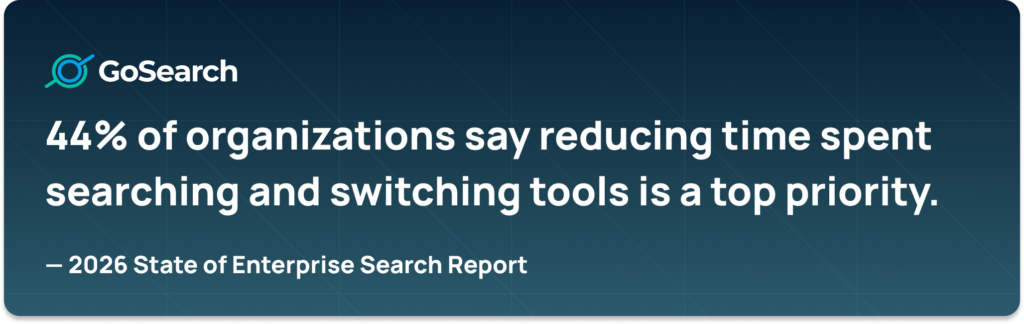
44% of organizations say reducing time spent searching and switching tools is a top priority.
Budget Readiness: High Interest, Low Maturity
While priorities are shifting toward intelligence and automation, budget maturity hasn’t fully caught up. Most organizations remain early in their evaluation journey and are still navigating how to formalize spend in this category.
Only a minority of respondents have dedicated funding set aside for enterprise search, signaling that investment is emerging—but not yet standardized.
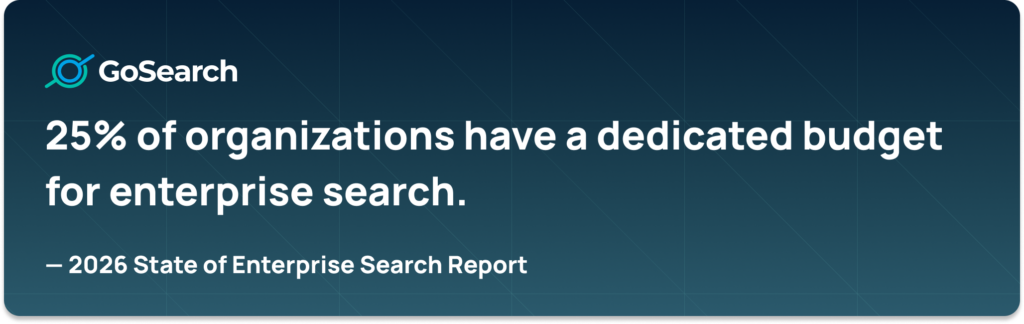
25% of organizations have a dedicated budget for enterprise search.
This budget landscape reinforces that while enthusiasm for AI-powered search is high, most teams still need ROI proof, internal alignment, and clear business cases before committing fully. Enterprise search sits at a pivotal moment: recognized as essential, but still developing its foothold within formal budgeting cycles.
“Most companies get stuck in analysis paralysis, waiting for the perfect moment. The truth is, there’s no perfect moment — the learning advantage goes to those who start now.”
— Vikas Bhambri, SVP, Americas, Yellow.ai
Persistent Pain Points: Fragmented Knowledge and Low Trust in Results
While expectations have grown, the reality of most organizations’ existing search experiences hasn’t caught up.
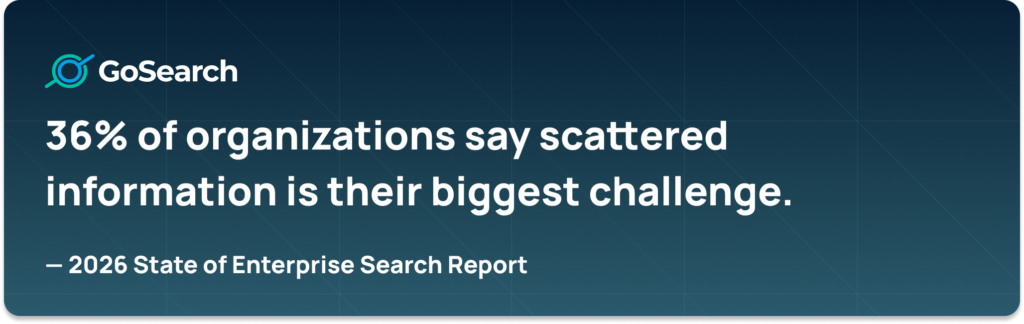
36% of organizations say scattered information is their biggest challenge.
Other recurring pain points:
Search results that aren’t accurate, trusted, or complete
Outdated or low-quality content
Low employee adoption despite availability of tools
This reflects a deeper issue. Respondents don’t trust their existing search tools to produce reliable answers. When results are incomplete or inconsistent, confidence drops. And when confidence drops, usage drops.
“Often the real problem isn’t the technology — it’s the workflow. You need to look at how people actually work before you can automate meaningfully.”
— Erik Schwartz, Fractional Chief AI Officer and Founder of The AiExpert.ai
Fragmentation across tools and content systems remains universal, and it directly impacts perceived ROI.
Adoption Timing: A Coming Wave in 2026
Although budgets are still forming, evaluation activity is high.
Half of respondents said they are actively exploring or planning to adopt enterprise search tools in the near term, aligning with larger AI infrastructure buying cycles in 2026.
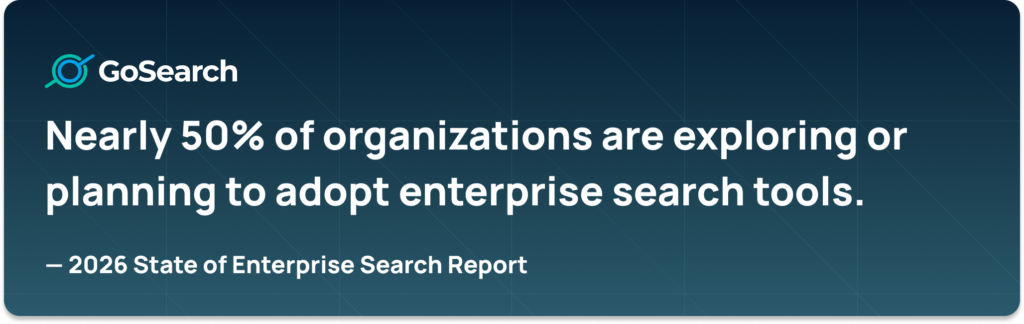
Nearly 50% of organizations are exploring or planning to adopt enterprise search tools.
This suggests we’re on the cusp of a major adoption wave, but the market hasn’t fully matured yet.
“AI is not just a tool; it’s a new way of working. We must motivate people to lean forward, rethink their roles, and contribute uniquely to their organizations.”
— Jessica Hreha, AI Transformation Director @ Jasper
Desired Capabilities: AI-Powered, Actionable, Integrated, and Secure
When asked about the capabilities that matter most, respondents pointed toward a clear set of emerging priorities.
Agentic AI
Teams want AI that performs tasks, not just returns results.
“Agentic workflows will redefine the digital workplace, moving beyond automation to enable AI systems that intelligently plan and execute complex tasks quickly and effectively.”
— Mo Cherif, VP of AI and Innovation @ Sitecore
AI-powered retrieval (including RAG)
Context-aware results reduce hallucinations and improve accuracy.
Strong integrations
Search must work across tools, not operate in silos.
Admin analytics and governance
Admins need visibility into usage, performance, and security.
The resounding message: organizations want search that is intelligent, actionable, and deeply integrated.
AI Adoption Roadmap: RAG, Personalization, and LLM Enhancements Lead
Organizations are actively planning to expand their AI capabilities around search.
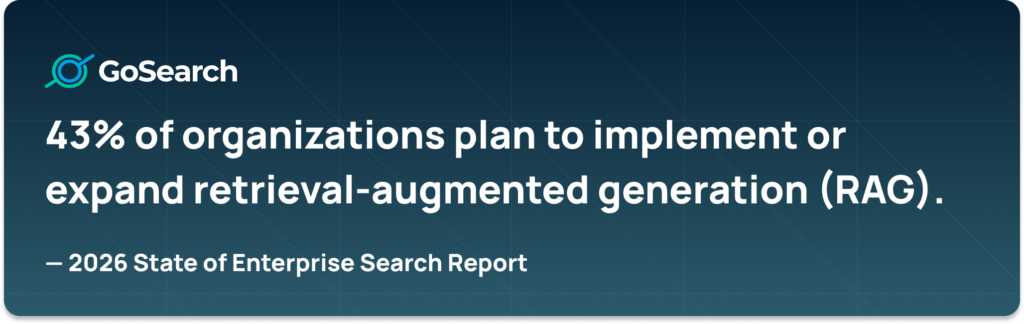
43% of organizations plan to implement or expand retrieval-augmented generation (RAG).
Additional priorities include:
Personalized or role-based search experiences
LLM-rooted enhancements that improve context and accuracy
AI that adapts to behaviors and workflows
Search is evolving into a highly personalized, intelligent system that augments work, rather than just retrieving information.
“We are in the ‘age of intelligence,’ where AI has evolved from manual tasks to advanced systems capable of autonomous decision-making, driving innovation across industries.”
— Sharad Verma, CEO of Vidoso
Security & Governance: A Non-Negotiable Baseline
Every respondent emphasized security and governance expectations. Trust remains a gating factor for any AI adoption, especially when sensitive or proprietary data is involved.
Top concerns included:
Encryption and secure data handling
Monitoring and audit logs
Permissions and access control
Model flexibility, including bring-your-own-model (BYOC) options
Trust, especially with sensitive data, is the defining requirement for any AI-driven search platform.
“The biggest hurdle for AI adoption isn’t the technology—it’s bridging the ‘trust gap’ that prevents organizations from fully leveraging AI’s potential.”
– Tim Sanders, Chief Innovation Officer at G2
Rollout Barriers: Value Proof and Enablement Are Critical
Security isn’t the only challenge organizations face. Rollout complexity, user adoption, change management, and value validation represent significant barriers.
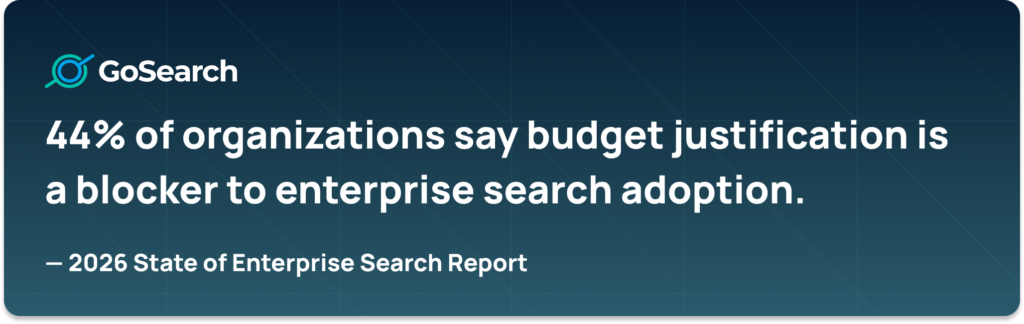
44% of organizations say budget justification is a blocker to enterprise search adoption.
Other obstacles included:
Integrating multiple systems
Data quality issues
Training and onboarding effort
The implication: the solutions that win will be the ones that prove value early, reduce friction, and drive fast adoption.
What These Findings Mean for GoSearch
The survey confirms what we see every day in conversations with prospects and customers: the enterprise search landscape is shifting rapidly from search to intelligence and automation, and organizations want a partner that can grow with them.
GoSearch is uniquely positioned to meet those expectations.
1. Search → Insights → Automation
GoSearch was built from the ground up to go beyond retrieval. Our AI-powered agents perform tasks, trigger workflows, summarize information, and automate knowledge work.
2. Deep integrations to solve fragmentation
Real-time federated search, rich connectors, and unified indexing ensure teams get complete, trustworthy answers across their entire tech stack.
3. Trust, security, and governance at the core
GoSearch provides encryption, permissions, audit logs, and flexible deployment, meeting the governance expectations respondents consistently prioritize.
4. Built-in analytics for proving ROI
With GoSearch Analytics, organizations can measure search effectiveness, adoption, content quality, and automation impact from day one.
5. Designed for fast adoption
From Slack-native workflows to intuitive UX, GoSearch makes rollout frictionless and drives immediate value. This is crucial for teams navigating limited budgets and the need for proof.
6. Affordability for emerging budgets
Budget constraints remain a major barrier to adoption: 44% of survey respondents cited justification and cost as blockers. GoSearch is about a third the cost of other enterprise search tools, making it accessible for teams ready to adopt AI-powered search without overextending spend.
7. Ready for the transition to AI-first knowledge work
With RAG, personalization, and agentic AI built in, GoSearch aligns directly with where respondents say they’re heading over the next 12–24 months.
Looking Ahead: Enterprise Search in 2026
Organizations are ready for a new era of enterprise search: one defined by intelligence, automation, security, and measurable business impact. But they need tools that bridge the gap between early-stage maturity and high expectations.
“We’re building the future, not waiting for someone else to build it for us. That mindset is what pushes the entire ecosystem forward.”
— Jorge Zamora, Founder and CEO, GoSearch
The findings from this survey reinforce that the market is shifting quickly, but also that companies need a trusted, integrated, AI-powered foundation to get there.
GoSearch is built for this moment and for the next wave of AI-driven knowledge work.
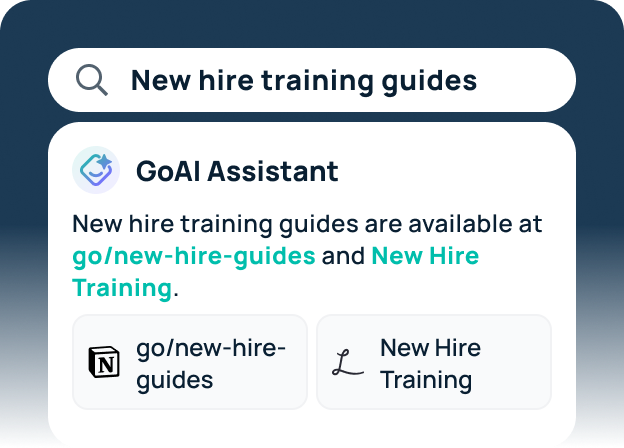
Search across all your apps for instant AI answers with GoSearch
Charlotte O'Donnelly is Senior PMM at GoLinks, GoSearch, and GoProfiles, where she leads positioning and GTM for enterprise AI products redefining how organizations find, access, and act on institutional knowledge. A 3x founding PMM with 9 years spanning PLG and enterprise sales, she specializes in bringing AI-native products to market — aligning teams around messaging that drives activation, expansion, and revenue.
Search finds information — AI collaboration platforms act on it. See the 8 best platforms for 2026, our evaluation criteria, and how to pick the right one.