


Different AI tasks call for different levels of reasoning. A quick question about a project update doesn’t need the same model as an agent coordinating a multi-step process across several business applications. Choosing the right model can affect answer quality, execution time, and cost.
GoSearch now supports Muse Spark 1.3 and Muse Wonder 1.0, two models from Meta’s Muse family. Both bring strong reasoning and agentic capabilities to GoSearch, but they serve different needs.
Muse Spark 1.3 is the more cost-conscious option for agentic work and multi-step tasks. Muse Wonder 1.0 is designed for more demanding work that requires deeper reasoning, extended planning, and complex execution.
This guide covers how the models differ, where each performs best, and how to use them with your company’s connected data in GoSearch.
What are Muse Spark 1.3 and Muse Wonder 1.0?
Muse is Meta’s family of AI models built for reasoning, coding, and agentic work. Its models can work through multi-step instructions, use tools, and handle complex tasks rather than simply responding to individual prompts.
Muse Spark 1.3 and Muse Wonder 1.0 are two models with different capability and cost profiles.
What is Muse Spark 1.3?
Muse Spark 1.3 is Meta’s model for agentic work at scale. It handles multi-step tool use, coding tasks, and long-context reasoning while keeping costs lower than Muse Wonder.
Meta recommends Spark 1.3 for new projects, with improvements to agentic workflows and coding over earlier Spark versions.
In practice, Spark is a good fit for work such as:
- Researching information across connected business applications.
- Summarizing project discussions and extracting key details.
- Running AI agents that need to retrieve information and call tools across multiple steps.
- Handling recurring workflow tasks that follow a defined process.
- Answering knowledge-heavy questions that require reasoning over a large amount of context.
Spark can also serve as the primary model for an agent, making it useful for teams that want more than basic question-and-answer functionality without using their most capable model for every task.
What is Muse Wonder 1.0?
Muse Wonder 1.0 is Meta’s more capable model, built for complex software engineering and long-running agentic tasks. It can plan extended tasks, coordinate multiple agents, call tools in parallel, and recover when something doesn’t go as expected.
Wonder is designed for situations where getting the result right matters more than minimizing model costs.
Good use cases include:
- Complex research that requires gathering and reconciling information from several systems.
- Multi-step agents that need to plan their approach before taking action.
- Technical analysis involving large repositories or detailed documentation.
- Workflows with multiple dependencies and decision points.
- Tasks that require several rounds of tool use, verification, and correction.
Wonder is also useful when an agent needs to follow detailed instructions across a longer task without losing sight of the original objective.
How do Muse Spark 1.3 and Muse Wonder 1.0 compare?
Both models support reasoning, coding, and agentic tasks, but they differ in how much complexity they’re designed to handle. Spark 1.3 is a cost-efficient option for everyday coding assistance and multi-step automation. Wonder 1.0 is the stronger choice for complex software engineering and tasks that require extended reasoning.
| Muse Spark 1.3 | Muse Wonder 1.0 | |
| Core strength | Efficient agentic reasoning | Advanced reasoning and problem-solving |
| Reasoning | Multi-step tasks with clear objectives | Complex problems requiring extended planning |
| Coding | Code generation, debugging, and routine development tasks | Complex software engineering, debugging, and multi-step coding tasks |
| Agentic capabilities | Tool use and repeatable agent tasks | Long-running agents, parallel tool use, and complex execution |
| Research | Information gathering and summarization | Deep research across multiple sources with more involved analysis |
| Best for | Everyday AI tasks and cost-efficient automation | Demanding technical work and complex agent workflows |
| Core positioning | Lower-cost option | Higher-cost, higher-capability option |
Both models have a context window of approximately one million tokens, giving them room to work with substantial amounts of information in a single task.
The practical difference comes down to the complexity of the work. Spark handles a wide range of everyday agentic tasks at a lower cost. Wonder is better suited to work that needs more extensive planning and problem-solving.
When should you use Muse Spark 1.3?
Choose Spark when you have a clear objective and want an agent to work through the steps needed to reach it.
For example, a sales team could use Spark to research an account by pulling recent Slack conversations, reviewing CRM records, and summarizing open opportunities. An engineering team could use it to collect updates from project tickets and documentation before generating a status report.
Other good fits include:
- Enterprise search: Answering questions that require pulling information from multiple connected applications.
- Document summaries: Extracting decisions, action items, and important details from lengthy documents.
- Research: Pulling information from different sources and putting it together.
- Workflow automation: Handling recurring work, from finding information to carrying out the next steps.
- Agent tasks: Following a set of steps and using connected tools without needing the highest reasoning tier.
Spark is a strong default when you want an agent to handle meaningful work without paying for the most capable model on every run.
When should you use Muse Wonder 1.0?
Choose Wonder when a task is difficult to break into a predictable sequence of steps. It is particularly useful when the agent needs to make decisions along the way, coordinate several tools, or revisit earlier steps as new information becomes available.
An operations team might use Wonder to look into a recurring issue across support tickets, internal docs, and project records. The goal isn’t just to pull together what each source says. Wonder can look for patterns, dig into conflicting information, and work out what the team should do next.
Other good fits include:
- Complex research: Investigating a question that requires reconciling information across several systems.
- Multi-step analysis: Working through a problem with several dependencies and possible outcomes.
- Advanced agent workflows: Coordinating multiple tools and subtasks to complete a larger objective.
- Technical work: Analyzing code, technical documentation, and software development problems.
- Complex decision-making: Evaluating competing information and developing a recommendation based on the findings.
Wonder is worth the additional model cost when the task needs more reasoning than a faster, lower-cost model can reliably provide.
How do Muse models fit into GoSearch?
A model’s capabilities matter, but so does the information it can work with. On its own, Muse Spark or Muse Wonder can answer questions and help with tasks based on the context provided. In GoSearch, employees can use these models with the knowledge and information their organization works with every day.
That means employees can ask questions about internal projects, get help with company-specific work, and use AI to move tasks forward without manually gathering context from different apps.
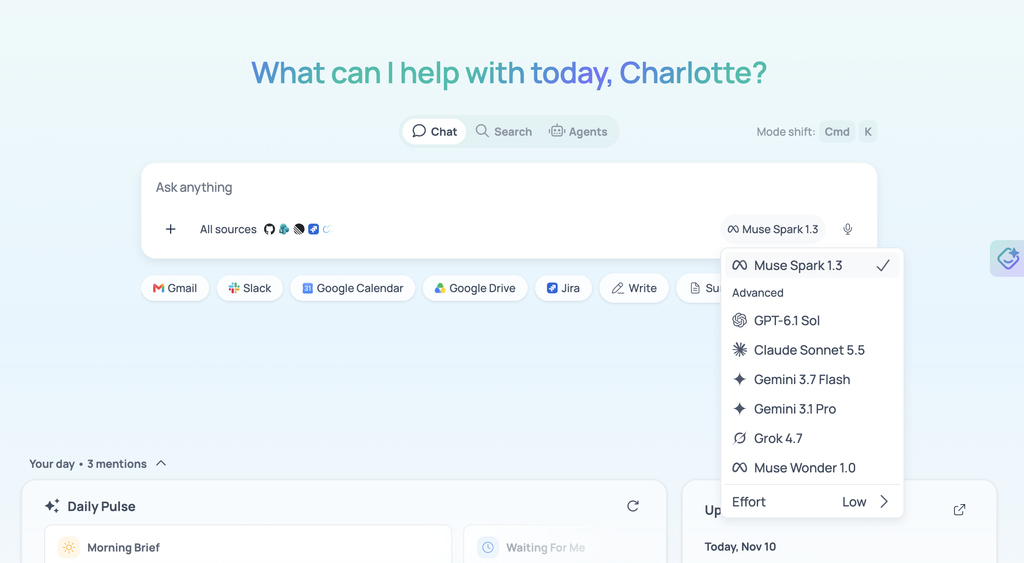
Muse Spark and Wonder are available alongside other leading models in GoSearch. Employees can choose the model that fits the task, whether they need help with everyday questions, coding, deeper analysis, or more involved work.
The result is more choice in how teams use AI, with company knowledge available in the same place.
Use Muse models with GoSearch AI chat
Employees can select a model in GoSearch’s AI chat experience to answer questions using their connected company knowledge.
Spark is a good choice for everyday questions, research, and summaries. Wonder is worth selecting when a question requires deeper analysis across multiple sources or more involved reasoning.
Choose a model for your AI agents
GoSearch’s no-code agent builder lets teams configure AI agents for specific jobs and select the model that powers them.
For example, a team could build:
- A project update agent powered by Spark that collects recent activity from Slack and project management tools.
- A research agent powered by Wonder that investigates an issue across multiple systems and develops a detailed recommendation.
- A support agent powered by Spark that reviews incoming tickets and organizes recurring issues.
Choosing a model for each agent lets teams match the model to the work instead of using the most expensive option across every task.
Build workflows around your connected data
GoSearch workflows can combine AI agents, connected applications, and automated triggers to handle recurring business processes.
The model determines how the AI reasons through each step. GoSearch handles the connections between applications and the actions that move information through the workflow.
Spark is a practical option for workflows with defined steps and repeatable outputs. Wonder is a better fit for workflows that involve more complicated decisions or extended problem-solving.
How do Muse models compare with other AI models in GoSearch?
Muse Spark and Wonder join GoSearch’s growing selection of models from leading AI providers, including OpenAI, Anthropic, and Google.
There isn’t one model that performs best across every task. Different models have different strengths, and the right choice depends on what you’re asking the AI to do.
For example:
- Muse Spark 1.3: Agentic tasks, multi-step tool use, and efficient coding assistance.
- Muse Wonder 1.0: Complex reasoning, advanced coding, and long-running agent tasks.
- GPT-6.1 Sol: Advanced reasoning, coding, and complex professional work.
- GPT-6 Luna: Quick answers and tasks that need fast turnaround.
- Claude Sonnet 5.5: Coding, complex problem-solving, and work involving large amounts of context.
- Gemini 3.1 Pro: Multimodal tasks, research, and complex analysis.
- Grok 4.7: Coding, reasoning, and technical problem-solving.
Teams can use all of these models in GoSearch, choosing one for a particular question, agent, or workflow. Their integrations and company knowledge stay in place, even when they switch providers.
Getting started with Muse Spark and Wonder in GoSearch
Muse Spark 1.3 and Muse Wonder 1.0 are now available in GoSearch’s model selection experience.
To try them, select a model in GoSearch AI chat or choose one when configuring an agent. You can compare their responses on the same task to see which produces the best results for your team’s needs.
Spark is a good default for routine research, AI summaries, and agent tasks. Try Wonder for more demanding questions, then compare how the two handle them. That should give you a better idea of when the added reasoning is worth the extra resources.
With access to models from Meta, OpenAI, Anthropic, and Google, GoSearch gives teams the flexibility to use different AI capabilities without separating their company knowledge, integrations, and workflows.
Get started for free or schedule a demo to see how GoSearch connects AI models to your business.
Search across all your apps for instant AI answers with GoSearch
Schedule a demo
Frequently Asked Questions
Muse Spark 1.3 and Muse Wonder 1.0 are AI models from Meta, now available in GoSearch. Both can handle reasoning, coding, and multi-step tasks, but they’re suited to different levels of complexity. Spark is a good choice for everyday assistance and agentic tasks where efficiency matters. Wonder is better suited to demanding work that calls for deeper reasoning, such as complex coding problems or longer-running agent tasks.
The main difference is the level of complexity they’re designed to handle. Muse Spark 1.3 is a practical option for everyday tasks, multi-step tool use, and coding assistance. Muse Wonder 1.0 is the stronger choice when a task involves more involved reasoning, difficult debugging, or a longer sequence of steps. The best choice depends on the work at hand, rather than one model being the right fit for every request.
Muse Wonder 1.0 is the better choice for complex coding work, particularly when a task involves debugging, understanding an existing codebase, or working through several connected problems. Muse Spark 1.3 can handle routine coding assistance and simpler development tasks, making it a useful option when the work doesn’t require as much reasoning. Both can help with coding, but Wonder is the one to try for more demanding software engineering tasks.
Start with the type of work you need to do. Muse Spark is a good fit for efficient agentic tasks, while Muse Wonder is suited to complex reasoning and coding. GPT-6.1 Sol is useful for advanced reasoning and professional work, GPT-6 Luna for quick answers, Claude Sonnet 5.5 for coding and complex problem-solving, Gemini 3.1 Pro for multimodal tasks and research, and Grok 4.7 for coding and technical questions. You can switch models in GoSearch depending on the task, so you don’t have to rely on one model for everything.