


OpenAI launched ChatGPT Work on July 9, 2026: an agent inside ChatGPT that turns a goal into finished sheets, slides, docs, and web apps. It’s bundled into paid ChatGPT plans rather than sold separately, it includes Codex for coding tasks, and it asks for approval before sensitive actions. For teams already standardized on OpenAI, switching it on is a configuration decision rather than a procurement cycle.
It’s a real step up from a chat window that answers one prompt at a time. It’s also one model family, one vendor, and one context model: Work gathers what it needs at the moment you assign a task, from its built-in browser and whichever plugins an admin has enabled. That’s efficient for self-contained jobs. It’s thinner when the answer depends on a decision your team made six months ago, wrote up in Confluence, and argued about in Slack — the organizational memory that makes a colleague’s version of a deliverable better than a capable stranger’s.
Quick Answer
GoSearch is the strongest ChatGPT Work alternative for teams that need agents grounded in company knowledge. It runs OpenAI, Anthropic, or Google Gemini models, connects 100+ tools into a permission-aware index, includes agent use in every plan rather than metering it, and deploys to your own cloud when regulation requires it.
What Is ChatGPT Work?
ChatGPT Work is an agent inside ChatGPT. You give it a goal; it gathers context across connected apps, files, and the browser, breaks the work into steps, and stays with a project for hours to produce a finished deliverable — a report, a spreadsheet, a slide deck, a Site. It incorporates Codex for coding tasks and requests human approval before taking sensitive actions.
It isn’t a standalone purchase. ChatGPT Work is rolling out across paid plans except Free and Go, with Pro, Pro Lite, Enterprise, and Edu first and Plus and Business following. Usage is metered against plan credits — confirm current availability and usage terms for your plan before committing team workflows.
The two plans most enterprise buyers evaluate:
- ChatGPT Business — $20/user/month billed annually, or $25/user/month monthly, with a 2-seat minimum. Includes ChatGPT Work, Codex, connected apps, workspace agents, SSO, and SOC 2 Type II.
- ChatGPT Enterprise — custom, quote-only pricing, reported in the $45–$75/user/month range. Adds SCIM, Enterprise Key Management, role-based access controls, data residency across ten regions, IP allowlisting, compliance logging, and dedicated support.
That jump is where most governance controls live. SCIM, RBAC, EKM, and data residency are Enterprise-only, so a team on the $20 Business plan running ChatGPT Work doesn’t get them. OpenAI publishes no Enterprise seat minimum — its pricing FAQ states only that Business starts at 2 users and directs Enterprise buyers to sales — but procurement reporting consistently describes a 150-seat floor with an annual commitment. For the full cost picture, see our guide to ChatGPT Enterprise pricing.
ChatGPT Work is a meaningful upgrade for productivity inside the ChatGPT ecosystem. It’s a different product from an enterprise search and knowledge platform built to sit across every tool your company runs, independent of which chat interface your employees prefer.
Why Teams Look for a ChatGPT Work Alternative
Single-model dependency. ChatGPT Work runs on OpenAI’s models and roadmap. There’s no option to route a task to Claude or Gemini, compare outputs, or optimize model choice for cost, speed, or accuracy. OpenAI’s retirement cadence makes that concrete: GPT-4o, GPT-4.1, GPT-5.2, GPT-4.5, and GPT-5.4 all retired within a single year, each on its own deadline. Workflows built around a model get migrated on OpenAI’s schedule.
Task-time context, not a knowledge layer. Work assembles information through its browser and enabled plugins when you assign a goal. Every run starts cold. That’s different from a persistent, indexed, permission-aware layer that already knows your org chart, your access rules, and what changed across connected systems before anyone asks.
Metered usage. Work draws on plan credits, as do Codex, workspace agent runs, and the Excel, Sheets, and PowerPoint integrations. The model is reasonable for capability this expensive to run — but it means the more useful agents become, the more they cost — so finance ends up rationing exactly the adoption the rollout was meant to drive.
Apps arrive switched off. OpenAI enables apps by default on Business but disables them on Enterprise and Edu. An admin enables each app, approves which of its actions the model may call, sets parameter constraints, restricts connectable domains, and grants role access before publishing it. The governance is thorough — and it means the customers paying the most get the least working on day one.
A steep jump to reach governance. SCIM, RBAC, EKM, and data residency exist only on the custom-quoted Enterprise plan, behind a buyer-reported ~150-seat floor. For a 60-person company that needs role-based access, ChatGPT Enterprise isn’t a tier upgrade — it’s out of reach.
SaaS-only, OpenAI-hosted. There’s no bring-your-own-cloud or private deployment option on either plan. For regulated industries, or teams with residency requirements outside OpenAI’s ten supported regions, that’s a hard constraint rather than a configuration choice.
GoSearch vs. ChatGPT Work
| GoSearch | ChatGPT Work | |
|---|---|---|
| What it is | Enterprise search platform with no-code AI agents | Agent inside ChatGPT for longer, multi-step tasks |
| Knowledge model | Hybrid indexed + federated layer, permission-aware, always current | Browser and enabled plugins gather context at task time |
| Primary output | Answers, summaries, and cross-system actions | Finished sheets, slides, docs, and Sites |
| LLM support | OpenAI, Anthropic, Google Gemini, or bring your own key | OpenAI models only (GPT-5.6) |
| Agent billing | Included in every plan | Metered against plan credits |
| Connectors | 100+ including Confluence, Salesforce, Jira, ServiceNow, Slack, Teams, Google Workspace, Notion, GitHub | Broad and expanding Plugin Directory; apps admin-enabled per app and action |
| Deployment | SaaS or bring-your-own-cloud on AWS, Azure, or Google Cloud | SaaS only, hosted by OpenAI |
| Where it lives | Native in Slack, Microsoft Teams, browser extension, and web | ChatGPT web, desktop, and mobile; workspace agents can run in Slack |
| Enterprise governance | Enterprise plan, from 35 seats | Enterprise plan, buyer-reported ~150-seat floor |
| Agent building | No-code agent and workflow builder for non-technical teams | Goal-driven; agent decomposes steps autonomously |
| Entry pricing | Free plan; Pro from $20/user/month, no seat minimum | $20–$25/user/month (Business, 2-seat minimum); Enterprise quote-only, reported $45–$75 |
See how GoSearch compares to other leading enterprise AI and enterprise search alternatives.
How GoSearch Closes These Gaps
One model roadmap becomes model choice. GoSearch runs OpenAI, Anthropic, and Google Gemini models, or your own LLM key, in the same workspace. Teams pick the right model for a given task rather than inheriting whatever ships next, and aren’t exposed to a single vendor’s pricing or capability changes. Zero Data Retention agreements apply with every provider.
Task-time context becomes a persistent knowledge layer. Rather than gathering information at the moment you assign a task, GoSearch’s AI-powered enterprise search platform continuously indexes shared company knowledge while federating personal and sensitive data in real time. Answers reflect what changed in Salesforce or Confluence minutes ago, already scoped to what each employee is permitted to see — before anyone has to ask.
Metered agents become included agents. GoSearch agents are part of every plan. There are no consumption tiers for search, the AI assistant, or agentic workflows, so encouraging broad adoption doesn’t mean forecasting a variable bill.
Governance shouldn’t require an enterprise-sized headcount. Both platforms put enterprise controls on an Enterprise plan. The difference is where the door is. GoSearch Enterprise starts at 35 seats; ChatGPT Enterprise carries a buyer-reported floor around 150. For mid-sized organizations, that’s the difference between reachable and not.
No SaaS-only ceiling. GoSearch offers bring-your-own-cloud deployment on AWS, Azure, or Google Cloud for organizations that need infrastructure isolation, alongside SOC 2 Type II, GDPR, CCPA, and HIPAA readiness. ChatGPT Work has no private cloud or on-premises option on either plan.
Agents anyone can build, once. ChatGPT Work is goal-driven: describe an outcome and it decomposes the steps. That’s elegant for one-off tasks and less suited to codifying a repeatable process that should run the same way for every rep, from the same sources. GoSearch agents are built in natural language and configured once, then run against live systems every time.
What ChatGPT Work Does Well
ChatGPT Work is the most complete agent product OpenAI has shipped, and it deserves credit on specifics. It returns finished artifacts rather than drafts. Its built-in Codex makes it genuinely strong on tasks with a coding element. It stays with complex projects for hours, decomposing goals and asking for guidance when needed, and requests approval before sensitive actions. Its governance surface is deep: per-action approvals, parameter constraints, domain restrictions, compliance logging, EKM, IP allowlisting, and ISO 27001, 27017, 27018, and 27701 certifications alongside SOC 2 Type II.
If your primary need is an agent that turns a goal into a polished deliverable, ChatGPT Work does that well. The two aren’t mutually exclusive either — plenty of teams keep ChatGPT for drafting and coding while running GoSearch as the knowledge layer their other tools query.
Why GoSearch?
GoSearch is the context layer that helps AI understand your business. By connecting your company’s knowledge, people, and business applications, it delivers trusted, context-rich answers and lets AI agents act across your organization. Whether employees search in GoSearch or work in ChatGPT, Claude, or Microsoft Copilot, they get accurate, permission-aware responses grounded in your company’s own context.
Its hybrid architecture indexes shared knowledge for speed while querying sensitive data in place, so PII need never be duplicated into a central index. It connects 100+ business applications, includes no-code AI agents and workflows that turn answers into action, and pairs enterprise-grade security with rapid deployment and transparent pricing.
Search across all your apps for instant AI answers with GoSearch
Schedule a demo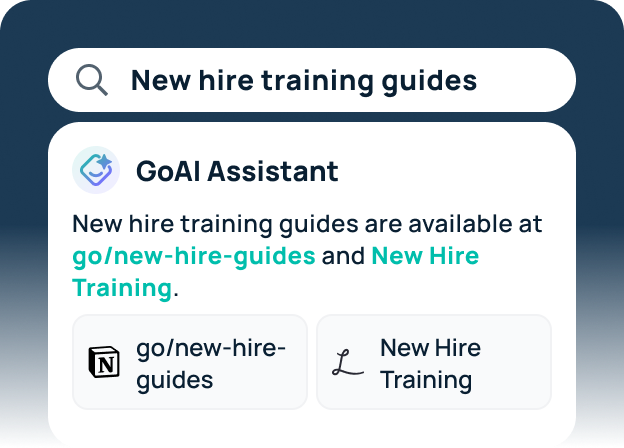
ChatGPT Work FAQs
Yes. ChatGPT Work is built to produce finished deliverables from a stated goal. GoSearch is built to make everything your organization already knows findable and actionable, continuously, not just when someone opens a new task. GoSearch indexes and federates across your connected systems in real time, so answers reflect what changed in Salesforce or Confluence five minutes ago, not just what Work’s browser could gather when you asked.
Yes. GoSearch runs OpenAI, Anthropic, and Google Gemini models, or your own LLM key, so teams can choose based on accuracy, cost, or compliance rather than being locked into whichever model OpenAI ships next. ChatGPT Work only runs on OpenAI’s models. If your organization already uses Claude or Gemini for other work, GoSearch lets you standardize on one platform without giving up model choice.
Yes. GoSearch includes SSO, SCIM, and RBAC standard, plus bring-your-own-cloud deployment for organizations that need infrastructure isolation. ChatGPT Work is SaaS-only on both Business and Enterprise, with no private cloud or on-premises option, and Business customers don’t get SCIM or RBAC at all. That remains a hard constraint for healthcare, financial services, legal, and government teams, and an added cost for everyone else.
Yes. GoSearch is available to every seat on one plan, with SSO, SCIM, and RBAC included from day one. ChatGPT Work is available on both Business and Enterprise, but real governance controls only exist on Enterprise’s custom-quoted tier. Teams that want every employee working with the same tool, on the same plan, with the same admin controls, get there without a pricing tier negotiation with GoSearch.
Not exactly, and it doesn’t need to. Many GoSearch customers also use ChatGPT for drafting, coding, and general reasoning tasks. The difference is what each tool is grounded in. ChatGPT Work is a strong agent for turning a stated goal into a finished document. GoSearch is the knowledge layer underneath that makes sure whatever tool your team uses, including ChatGPT, is working from accurate, permission-aware, up-to-date company information in the first place.
You want AI search and agents that work across your entire stack, not just the ~60 apps on one vendor’s connector list. You need model flexibility instead of a single vendor’s roadmap. You want SSO, SCIM, and RBAC included, not gated behind a custom-quoted tier that costs two to three times as much per seat. And you want one transparent price instead of a two-tier plan structure.