Need a little productivity boost? Join our monthly newsletter and we'll go/link you to the latest tips and trends in tech!
The promise was simple: AI would eliminate drudgery, free up time for meaningful work, and make organizations leaner and more productive. The reality in 2026 is more complicated. Only one in fifty AI investments delivers transformational value at the organizational level— and yet the pressure to adopt, scale, and show results has never been higher. Problems like AI agent sprawl, once theoretical, are now landing on the desks of real operations and IT leaders. The organizations getting it right are showing us what’s actually possible, and the lessons are worth paying attention to.
The Hidden Cost of “Workslop” — When AI Speed Undermines Quality
There’s a word that’s quietly entered the enterprise lexicon: workslop. It describes the low-quality output that emerges when teams are pressured to produce more, faster, using AI tools that aren’t up to the job. The consequences aren’t trivial — research finds that workers spend an average of nearly two hours cleaning up each instance of substandard AI-generated output they encounter. Multiply that across an organization and you have a significant, largely invisible drag on performance.
The dynamic is subtle. AI can be a genuinely capable partner — one that creates real momentum and confidence. But when the tools aren’t the right fit, that partnership breaks down: constant attention-switching, compulsive output-checking, and an ever-growing queue of tasks that AI started but couldn’t quite finish. Volume climbs. Quality doesn’t always follow.
The lesson isn’t that AI creates more work — it’s that the wrong AI tools do. When the underlying system lacks context, accuracy, or the ability to act across your full tool stack, the burden of correction falls back on your team. The organizations pulling ahead aren’t the ones using AI the most — they’re the ones that have equipped their people with tools precise and reliable enough to trust.
The best organizations are building explicit review checkpoints into AI-assisted workflows — not as a sign of distrust, but as a recognition that speed and quality require different kinds of attention. As this look at the human-in-the-loop imperative explores, expert human review doesn’t just catch failures — it raises the quality ceiling. An expert reviewer doesn’t only ask “is this correct?” They ask “is this excellent?” — something AI working alone can’t reliably answer.
AI Agent Sprawl: Why Nobody Knows How Many Agents They’re Running
Ask a typical enterprise technology leader how many AI agents their organization is currently running, and you’ll often get a long pause. The honest answer is: nobody quite knows. As organizations adopt agents from multiple vendors — for customer service, finance, security, HR, operations — each solving a specific problem in isolation, a new and underappreciated risk has emerged: AI agent sprawl.
What is AI agent sprawl? It’s what happens when an organization deploys AI agents faster than it can govern them. Each agent is adopted to solve a discrete problem, but without a unifying orchestration layer, they can’t collaborate, can’t share context, and can’t be governed consistently. One agent’s output becomes another’s unverified input. Security permissions become patchwork. And the humans nominally “supervising” the system end up managing a swarm they can barely see, let alone control.
AI agent sprawl also introduces compounding security risk. Agents that aren’t properly permissioned can access data they shouldn’t, act on instructions they weren’t meant to receive, or create audit gaps that only surface during a compliance review — by which point the damage is done. The answer isn’t fewer agents — it’s better-scoped ones. A well-scoped agent is more predictable, more auditable, and easier to correct when something goes wrong. Scope creep doesn’t just create security risk; it creates governance gaps that make meaningful human oversight practically impossible.
The most innovative players in the agentic AI space are addressing this directly — building security and interoperability into their foundations. And according to Gartner’s research on agentic AI, the window matters: organizations that establish governance frameworks now — before the complexity compounds — will have a meaningful advantage over those that try to retrofit order onto chaos later.
The Rise of the Process Pro: Why Systems Thinkers Are Winning
The finding that most directly challenges the prevailing narrative about AI skills isn’t about technical fluency or tool mastery. The people delivering the best results aren’t the power users — they’re the process professionals.
Gartner’s research found that business units focused on redesigning how work gets done with AI are twice as likely to exceed their revenue goals compared to those focused on individual productivity gains. The differentiator isn’t technical fluency — it’s systems thinking. The ability to step back from a workflow, identify where friction lives, understand how tasks connect and depend on each other, and redesign the whole rather than automate the parts. Crucially, this same skill set is needed to get AI agent sprawl under control: you can’t govern what you haven’t mapped.
This has real implications for how organizations hire, develop, and promote talent. The person who can map a process, spot its inefficiencies, and work backwards from a desired outcome to an AI-enabled solution is more valuable than the person who simply uses AI tools more hours of the day. In a world where AI makes effort cheaper, the scarce resource is judgment about where effort should go. That framing aligns with what enterprise AI leaders describe as the most accurate picture of where agents actually are today: humans still primarily driving, agents dramatically amplifying — and the process pro is the person best positioned to make that partnership work.
“There’s still cultural resistance to using AI for work — [but] there’s also a slower-moving but more impactful opportunity for leaders and managers to recognize and encourage the real work that it takes to use AI effectively.”
The organizations winning with AI in 2026 aren’t the ones doing the most — they’re the ones being most deliberate. That means getting ahead of AI agent sprawl with governance frameworks before the complexity becomes unmanageable. It means investing in process professionals who can redesign systems, not just optimize tasks. And it means taking workslop seriously — because the illusion of productivity is not the same as performance.
AI was never going to deliver on its promise automatically. The hard lessons of recent years are, in a way, good news: they’re clarifying exactly what thoughtful, intentional AI adoption looks like. The organizations paying attention now are the ones that will pull ahead — not because they adopted AI first, but because they adopted it well.
How GoSearch Tackles AI Agent Sprawl Head-On
Most agents are built to operate within a single tool — answering a question in Slack, summarizing a document in Google Drive, filing a ticket in Jira — with no shared context and no coordination across systems. The result is exactly the kind of sprawl this article describes: fragmented visibility, inconsistent governance, and a growing stack of agents nobody can fully account for.
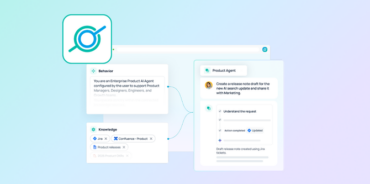
GoSearch addresses this at the architecture level. Agent Actions lets teams build custom AI agents that connect to data sources across their entire tool stack and take action inside them — creating Jira tickets, updating Notion pages, posting Slack summaries — all from a single, governed interface. Instead of deploying a separate agent per tool and losing the thread across all of them, teams get focused, purposeful agents that understand enterprise context and execute multi-step workflows without the sprawl.
Ready to bring your AI agents under one roof?Schedule a demo today and see GoSearch in action.
Search across all your apps for instant AI answers with GoSearch
Emily Deuser is Content Manager at GoLinks, GoSearch, and GoProfiles, where she helps enterprise teams cut through the noise around workplace AI and find tools that actually make knowledge accessible. She specializes in turning complex productivity challenges into clear, actionable guidance that helps teams work smarter every day.
Six AI agent platforms compared on connectivity, workflow automation, citations, and pricing — plus five criteria for evaluating any platform against your stack.