



Coveo remains a well-established enterprise search platform with a strong reputation for AI-powered relevance. Organizations evaluating alternatives may be looking for different pricing models, implementation requirements, integrations, or workflow capabilities—not necessarily because Coveo’s search relevance is inadequate.
Coveo remains a strong player in enterprise search. It powers knowledge workers at thousands of companies and has built a solid reputation around AI-powered relevance. But the companies leaving Coveo aren’t leaving because search quality is lacking. They’re leaving because enterprise search has evolved, and Coveo represents the previous generation of how organizations think about finding and acting on information.
In this guide, we’ll examine why organizations evaluate Coveo alternatives, compare pricing and implementation considerations, and review which platforms fit different use cases.
We also reference what real customers say on G2 and Vendr to help you see the patterns for yourself.
Why Companies Are Looking for Coveo Alternatives
Coveo’s G2 rating sits at 4.3 out of 5 with 142 total as of September 2026. Reviews commonly highlight the platform’s search relevance and breadth of functionality, while some users also mention complexity, pricing, and implementation effort.
The platform delivers strong search relevance when properly configured. So why are so many organizations evaluating alternatives?
The answer lies in three specific pain points that repeatedly surface in customer feedback.
Pricing can be difficult to compare across Coveo deployments. Coveo’s pricing varies by product, package, usage, data sources, and contract scope. Some offerings publish limited pricing information, while broader enterprise deployments generally require a custom quote. Buyers should request a proposal that separates licensing, usage, implementation, support, and renewal costs.
Customer reviews also indicate that consumption-based or usage-linked pricing can make costs harder to forecast at larger scales. This observation should be presented as review feedback rather than as a universal pricing characteristic. According to customer reviews on G2, mid-market implementations typically run $10,000 to $20,000 dollars per month on annual contracts. As one G2 reviewer noted: “The consumption-based pricing model makes it hard to predict costs, especially for enterprise-scale implementations.”The total cost of a Coveo deployment includes more than the software subscription. Depending on the number of data sources, connector requirements, permissions configuration, relevance tuning, migration work, and internal resources, organizations may also incur implementation and ongoing administration costs.
Implementation timelines and total cost vary substantially by scope. Do not present a standard deployment period or three-year cost without documenting the assumptions behind the estimate.
Implementation complexity requires specialized expertise. Some customer reviews describe Coveo as requiring substantial technical involvement for complex implementations. Connector configuration, permissions mapping, relevance tuning, analytics, and ongoing administration may require developers or specialized implementation support. The level of expertise required depends on the deployment scope and the organization’s existing technical resources.
The platform is designed for search, not for action. Coveo is primarily positioned around search, relevance, recommendations, and knowledge experiences. Organizations that want search to initiate actions—such as updating records, creating tickets, or notifying stakeholders—should evaluate which workflow and automation capabilities are included in their selected Coveo products and which require additional tools or configuration.
Together, these considerations can increase the planning and operating effort required for a Coveo deployment. Buyers should evaluate not only subscription pricing, but also implementation, administration, relevance optimization, integrations, support, and workflow automation requirements.
Coveo vs. GoSearch: Search, Answers, and Workflow Automation
Enterprise search platforms now span several capabilities: traditional retrieval, AI-powered relevance, recommendations, generative answers, and workflow automation. The key comparison is therefore not simply which platform has better search, but which combination of discovery, answers, integrations, and actions each platform supports for a given use case.
The comparison between Coveo and GoSearch highlights the architectural shift happening in the market.
Coveo (Enterprise Search 2.0)
Coveo is a mature, AI-powered search and relevance platform. It excels at finding and ranking information across disparate sources. Here’s what you’re getting:
- AI-powered relevance that improves with behavioral data (clicks, dwell time)
- Strong Salesforce and ServiceNow integration
- Powerful personalization and recommendations
- Search and relevance capabilities across a broad range of enterprise data sources, subject to connector and product availability
- Enterprise-grade security and compliance
Here’s what comes with it:
- Pricing is typically quote-based and varies by product, usage, data sources, feature scope, and contract terms
- Implementation effort varies based on integrations, permissions, relevance configuration, migration, and rollout scope
- Ongoing need for search engineers to maintain and tune relevance
- Primarily focused on search, relevance, recommendations, and knowledge experiences; workflow requirements should be evaluated separately
- Deployment and data-residency options should be validated against the specific Coveo product, region, and regulatory requirements
GoSearch (Enterprise Search 3.0)
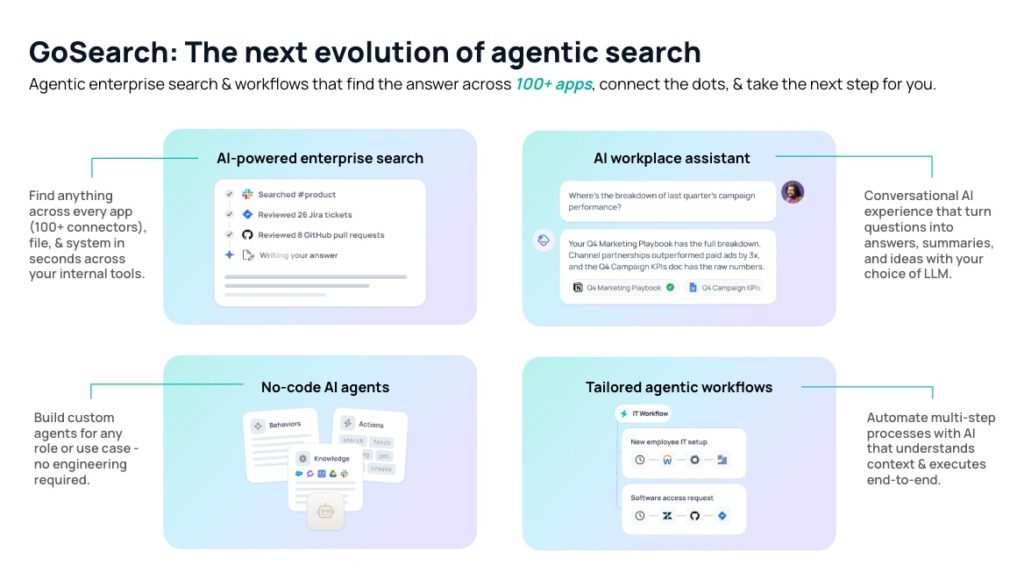
GoSearch is built on a different premise: enterprise search should be an operating layer that drives automation, not just discovery. Here’s the design philosophy:
- Semantic AI search that understands intent and context
- Permissions-aware retrieval so users see only what they can access
- Agentic workflows that execute actions autonomously based on search results
- No-code agent building so non-technical teams can create automation
- Deployed in weeks, not months
- Accessible to all employees, not just search engineers
- Built-in integration with your existing enterprise systems
The practical distinction is emphasis: Coveo is strongly associated with search, relevance, recommendations, and knowledge experiences, while GoSearch combines enterprise search with agents and workflows designed to help users complete actions.
Example use case: A support manager asks “find all customers with open billing issues and send them payment reminders.”
In this example, the outcome depends on the integrations and workflow capabilities configured in each platform. A search-focused deployment may require a separate workflow step, while a GoSearch workflow can be configured to retrieve eligible records, verify access, and initiate an approved notification process.
This is why organizations are moving toward agentic platforms. Automation drives ROI faster than improved search relevance.
The Competitive Landscape
Beyond Coveo and GoSearch, the market has evolved significantly. Here’s how other major players fit:
GoSearch
GoSearch goes beyond traditional enterprise search by combining AI-powered search, agents, and workflows in a single platform. Like Glean, it connects to 100+ workplace applications and provides secure, permission-aware answers grounded in company knowledge.
The advantage over Glean is flexibility and actionability. Organizations can choose between federated search and indexing, use their preferred AI models, build AI agents, and automate workflows across connected systems. The result is a platform that helps employees not only find answers, but also complete work.
G2 rating: 4.8/5
Deployment: Same day
Cost: A free plan is available, with Pro plans starting at $20 per user/month. Enterprise plans are available at a significantly lower cost than comparable offerings from Coveo and Glean, with packages starting at 35 users. As of August 2026, there are no LLM token fees, and onboarding, implementation, support, and training are included in Enterprise pricing with no additional service costs.
Best for: Organizations that want AI-powered search, agents, and workflows in a single platform without the complexity and cost of traditional enterprise search solutions.
Glean
Glean sits between Coveo and GoSearch architecturally. It’s AI-native workplace search that automatically learns from employee behavior across 100+ connected apps. The advantage over Coveo is simplicity: Glean requires no relevance tuning. It just works. Hear real evaluation insights from prospects who have either been customers of Glean or have evaluated them.
G2 rating: 4.6/5
Deployment: 2 to 3 days (Varies by data sources, permissions, pilot scope, and rollout requirements)
Cost: Glean pricing is generally quote-based for enterprise deployments. Reported pricing can vary by user count, package, contract terms, implementation scope, and included features. This is based on customer feedback shared in calls as of August 2026.
Typically starts around $50 per user/month (though some prospects have reported pricing closer to $75 per user/month). Most deployments begin with a $50,000+ annual base package and scale significantly as organizations move toward enterprise-wide adoption. Implementation and onboarding fees generally start at 10% of the contract value.
Best for: Organizations frustrated with Coveo’s complexity. Companies with significant budgets.
Glean’s true cost extends far beyond per-user licensing. When infrastructure, AI add-ons, implementation, administration, POC requirements, and renewal increases are included, the total cost of ownership can reach 2–6x the base license price, making enterprise search a strategic budget decision rather than a simple software purchase.
Read the full total cost of ownership for the enterprise buyers’ guide to learn more.
Algolia
Algolia is the developer-first search API. If you need fast, accurate search with a great developer experience and published pricing, Algolia is excellent. It’s particularly strong for product discovery and site search. The trade-off: Algolia is more limited in scale and doesn’t have the enterprise integrations Coveo does.
G2 rating: 4.6/5
Deployment: Days
Cost: Starts at $51/month with free tier available
Best for: Teams that want fast, predictable search without enterprise complexity
Elasticsearch
The open-source choice. Elasticsearch gives you complete control and no per-query licensing. The cost is labor: you need dedicated engineers to implement, tune, and maintain the system. For organizations with data residency requirements, Elasticsearch is often the only option.
Deployment: Weeks to months
Best for: Teams with strong engineering resources
Elastic may appear cost-effective at first, but costs often grow with infrastructure, storage, compute, support, and operational overhead as deployments scale. Learn how Elastic pricing works, the hidden costs to consider, and how modern alternatives like GoSearch compare for enterprise search.
Read the full guide: Elastic Search Pricing & Alternatives FAQ
Bloomreach and Dynamic Yield
These platforms focus on e-commerce and customer experience personalization. They include search as part of a broader experience optimization suite. Strong for retailers but narrower in scope than Coveo for enterprise-wide search.
Microsoft Copilot
If you’re already deeply embedded in the Microsoft ecosystem, Graph Search provides AI-powered search integrated directly into Microsoft 365. The advantage is minimal additional tooling. The limitation is dependency on Microsoft’s stack.
Microsoft Copilot’s advertised price is only part of the cost—most organizations also need qualifying Microsoft 365 licenses, pushing the true per-user cost significantly higher. See the full pricing breakdown, hidden costs, and how it compares to alternatives like GoSearch.
Read the full guide: Microsoft Copilot Pricing: What It Really Costs in 2026
Making the Decision: Which Platform Actually Fits Your Needs
The right platform depends on three factors: your use case, your team’s technical depth, and your timeline to value.
Are you primarily solving for discovery or automation?
If the goal is “help people find information faster,” Coveo, Glean, or Algolia all work. If the goal is “automate knowledge work and reduce manual processes,” you need a platform built for agentic workflows. That’s where GoSearch’s design matters.
Do you have dedicated search engineers on staff?
If yes, Coveo or Elasticsearch might make sense. The time and skill investment pays off at scale. If no, you’ll either hire them (expensive) or choose a platform that doesn’t require them. Glean and GoSearch are both built for organizations that don’t want to maintain a search function.
What’s your timeline to deploy?
- Coveo: 3 to 6 months to live
- Glean: 2 to 3 days
- Algolia: Days
- GoSearch: A few hours
If you need a quick win, the timeline matters. If you have 6 months and the budget to match, Coveo’s depth might justify the investment.
Do you need automation or just search?
This is the dividing line. If you’re seeing 60 to 80 percent of your support requests as repetitive knowledge questions that could be automated, agentic search is a bigger ROI play than improved search relevance.
The True Cost of Coveo
Before committing to any enterprise search platform, understand the full cost structure. According to Vendr, the average annual contract value for Coveo is approximately $34,700, though actual costs can vary significantly based on factors such as indexed content volume, query usage, product modules, support requirements, and implementation services. Many mid-market organizations report annual spend between $30,000 and $150,000, while larger enterprise deployments can exceed $400,000 per year. As a result, organizations evaluating Coveo should consider not only licensing costs but also the potential operational overhead associated with deployment, customization, and ongoing search optimization.
Year One Investment
- Licensing: $10,000 to $50,000+ per month ($120,000 to $600,000+ annually)
- Implementation: $50,000 to $300,000 in professional services
- Training: $30,000 to $100,000 for internal team setup
- Hardware/infrastructure: $20,000 to $50,000
Total year one: $220,000 to $1,050,000+
Ongoing Annual Cost
- Licensing renewal (with typical 10 to 15 percent increase): $120,000 to $600,000+
- Dedicated search engineer (salary): $120,000 to $180,000
- Maintenance and optimization: $30,000 to $100,000
Total ongoing: $270,000 to $880,000+ per year
Over a 3-year contract, the total cost of ownership for Coveo typically runs $750,000 to $2,000,000+ depending on scale.
By contrast, GoSearch offers three straightforward plans: Free, Pro ($20 per user/month), and Enterprise, with packages starting at just 35 users.
Enterprise deployments are typically significantly more cost-effective than traditional enterprise search platforms due to GoSearch’s hybrid architecture and MCP-based approach, which reduces infrastructure and operational overhead.
There are no LLM token fees, implementation costs, onboarding charges, or hidden service fees. Organizations also don’t need a dedicated search engineer to manage the platform. The result is a fundamentally different pricing and deployment model that delivers enterprise search, AI agents, and workflows with a lower total cost of ownership.
Why Teams Stay With Coveo
This isn’t an argument that Coveo is bad. In specific contexts, Coveo makes sense:
- You have a large organization (1000+ employees) with complex federated search needs
- You’ve already implemented it and achieved clear ROI
- Your team has dedicated search engineers who optimize it continuously
- You need deep customization and control
For these organizations, Coveo delivers value that justifies the cost. The mistake is assuming Coveo is the default for every enterprise. For most organizations, it’s overkill.
Moving Forward
The shift from Enterprise Search 2.0 to 3.0 is real. Coveo is a strong platform for a narrowing use case: large enterprises that need sophisticated search relevance and can justify the cost. For everyone else, the market has moved on.
Modern enterprises ask a different question. Rather than “what’s the best search engine,” they ask “how do we automate routine knowledge work and free up our teams for higher-value activities?”
That shift in question leads to a shift in platform. And that’s why companies are evaluating alternatives to Coveo.
If you’re exploring options, think about whether you’re solving a search problem or an automation problem. The answer will guide you to the right platform.
Curious about GoSearch? You can sign up for our Free plan or contact sales to learn more and see if it is a fit for your organization’s needs.
Search across all your apps for instant AI answers with GoSearch
Schedule a demo
Frequently Asked Questions
Coveo is worth implementing if you have a large organization, a significant budget, and a dedicated search team. For smaller organizations or those without search expertise, the cost and complexity aren’t justified when simpler alternatives exist.
Algolia offers a free tier, with paid plans starting at $51 per month. For organizations evaluating AI-powered enterprise search, GoSearch provides a more accessible entry point than platforms with six-figure annual commitments.
GoSearch offers three plans: Free, Pro ($20 per user/month), and Enterprise, with packages starting at 35 users. Compared to traditional enterprise search vendors, GoSearch is typically around 40% more cost-effective on a per-user basis while also including AI search, agents, and workflows in a single platform.
Plan 4 to 12 weeks depending on complexity. You’ll need to re-index content, reconfigure connectors, and rebuild any custom logic. Most alternatives offer migration guides or professional services to help.
No. Coveo returns search results. It doesn’t automate actions. You’d need a separate automation platform to trigger workflows based on search results.
The answer varies best on your core needs. If you are looking for an all-in enterprise search solution with no-code agents, workflows and a workplace assistant, then the best alternative is GoSearch.