


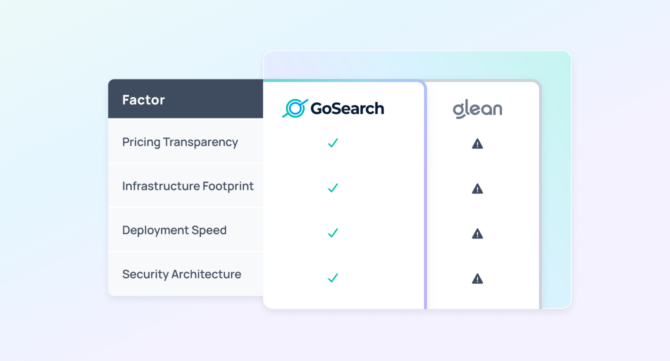

When evaluating Glean total cost of ownership, most enterprise buyers start with per-user pricing.
But license cost is only one part of the equation.
The full enterprise search total cost of ownership (TCO) includes:
- Per-user subscription pricing
- AI capabilities and compute usage
- Infrastructure and indexing overhead
- Implementation and onboarding
- Proof of concept (POC) costs
- Ongoing administration and governance
- Support, renewals, and contract minimums
When these layers are modeled together, total enterprise search spend can reach 2–6x the base license cost, depending on deployment scale, data volume, and architecture.
Key Takeaways
- Glean requires a 100-seat minimum and either a ~$70,000 paid POC or a signed contract before you can evaluate it. GoSearch offers a free plan.
- Infrastructure adds ~$10,000/month in BYOC deployments; a dedicated admin adds ~$140,000/year
- Renewal increases of 7–12% annually are typical unless a cap is negotiated upfront
- Total cost of ownership is commonly 2–6x the base license price
- GoSearch uses a hybrid indexed + federated model with transparent pricing and a free plan
Enterprise Search TCO Is Now a Strategic Decision
Procurement teams are no longer asking: “What is the per-user cost?”
They are asking: “What is the total cost of operating this platform over three years?”
This shift is happening because enterprise search is now a core layer of enterprise AI infrastructure — powering AI chat assistants, autonomous agents and workflows, and cross-system knowledge retrieval. When search architecture is expensive or inefficient, AI operating costs increase, infrastructure spend grows unpredictably, and adoption slows.
Glean Total Cost of Ownership: Cost Components
The table below outlines the primary cost layers buyers encounter in a Glean deployment, based on buyer-reported figures from G2, Gartner Peer Insights, and enterprise procurement discussions. Actual costs vary based on deployment size, negotiation, and infrastructure scope.
| Cost Component | Glean (buyer-reported) |
| Base license | ~$50-75+/user/month; 100-seat minimum |
| AI capabilities | ~$15/user/month add-on |
| Infrastructure (BYOC) | ~$10,000/month |
| Dedicated admin | ~$140,000/year FTE |
| POC access | ~$70,000 or withheld until contract |
| Renewal increases | 7–12% annually |
Figures are buyer-reported via G2, Gartner Peer Insights, and public procurement discussions as of Q2 2026. Individual costs will vary based on contract terms and deployment scope.
† POC availability varies by contract. Some buyers report paid POC engagements at approximately $70,000; others report that access is declined until a commercial agreement is in place.
When Glean Is the Right Choice
For large enterprises with 500+ seats, a dedicated IT team, and an annual budget that can absorb $700,000 or more in first-year spend, Glean can deliver value. Its connector library is comprehensive and its knowledge graph architecture produces contextual search quality at scale. But that value comes with significant conditions: a BYOC deployment that requires ongoing internal management, renewal increases that compound annually without a negotiated cap, and a cost structure that assumes substantial procurement leverage. Organizations that have all of those in place may find the TCO justifiable. Most don’t.
The economics become harder to justify for organizations with fewer than 500 seats, those without a dedicated search administrator, or those who need to validate value before committing budget. The 100-seat minimum means paying for unused licenses during early adoption. POC access adds further uncertainty: some buyers report paying approximately $70,000 for POC engagements; others report that access is denied until a commercial agreement is in place.
Understanding Glean’s Cost Layers (2026)
Per-User Licensing
Glean’s per-user pricing is not publicly disclosed. Based on buyer-reported data from G2, Gartner Peer Insights, and procurement forums, starting costs are commonly reported at ~$50-75+/user/month with a minimum of approximately 100 seats. Because pricing is custom and requires direct sales engagement, buyers typically cannot compare costs or forecast budgets without entering a vendor-led evaluation process.
AI Capabilities
AI features in Glean are not uniformly included in base plans. Buyers report AI capabilities priced as a separate add-on at approximately $15/user/month. Because Glean’s architecture continuously indexes and re-processes enterprise data to power AI retrieval, compute requirements — and associated costs — scale with data volume and query frequency, not just seat count. At 1,000 seats, AI add-ons alone add approximately $180,000 annually — a 30% increase over the base license before any infrastructure costs are applied.
Infrastructure
Infrastructure is consistently identified as the largest hidden cost driver in Glean deployments. In bring-your-own-cloud environments, organizations are responsible for provisioning and managing the compute, storage, and indexing pipelines that power Glean’s centralized index. Glean’s architecture continuously ingests and re-processes enterprise data — requiring sustained compute capacity regardless of query volume. Buyer-reported median infrastructure cost for mid-enterprise BYOC deployments is approximately $10,000/month ($120,000/year), scaling with data source count, indexing frequency, and ML processing workloads.
Implementation and Administration
Glean deployments typically require multi-week implementation timelines due to indexing setup, connector configuration, and infrastructure provisioning. Buyers commonly report that a dedicated internal administrator is recommended — or effectively required — to manage ongoing governance, indexing performance, security configuration, and system health. That resource represents approximately $140,000/year in fully-loaded FTE cost. POC access adds further friction: some buyers report paid POC engagements at approximately $70,000; others report that access is withheld until a commercial agreement is signed.
Contract Structure
Glean’s contract structure introduces compounding cost risk that is difficult to model at procurement time. Custom pricing means no public benchmarks to negotiate against. Seat minimums of ~100 users create a $60,000+/year floor even for early-stage deployments. Renewal increases of 7–12% annually are typical—a term many buyers are unaware they can negotiate before signing. Support fees of approximately 10% of ACV are commonly reported as non-negotiable. Each of these elements is manageable in isolation; together they make long-term cost predictability difficult without significant procurement experience.
Architecture and Its Impact on TCO
Full-Index Platforms (Example: Glean)
Glean centralizes enterprise knowledge by ingesting and indexing content across connected systems into a unified knowledge graph. This enables strong contextual discovery but continuously requires:
- Large-scale data ingestion and re-indexing pipelines
- Storage of replicated enterprise data
- Ongoing compute for embedding generation and AI processing
- Dedicated infrastructure management in BYOC deployments
These requirements scale with data volume and integration count — not just user count — making cost less predictable over time.
Hybrid Search Platforms (Example: GoSearch)
GoSearch combines selective indexing of shared knowledge with real-time federated retrieval of live data. This reduces duplicate storage, lowers infrastructure overhead, and enables faster deployment while maintaining live permissions. Organizations typically experience lower cloud costs, reduced operational overhead, and same-day to one-week deployment timelines.
GoSearch vs Glean: Platform Snapshot
| Feature | GoSearch | Glean |
| Architecture | Hybrid (indexed + federated) | Fully indexed |
| Data access | Real-time + indexed | Indexed with sync cycles |
| Pricing | Transparent, published | Custom / not public |
| Starting cost | 40-50% less than Glean | ~$50-75+/user/month (reported) |
| AI capabilities | Included | ~$15/user/month add-on |
| Free plan | Yes | No |
| Infrastructure cost | Minimal | ~$10,000/month (BYOC) |
| Deployment timeline | Days | Multi-week |
| Dedicated admin | Not required | Recommended (~$140K FTE) |
| Renewal increases | None standard | 7–12% annually (reported) |
What Enterprise Buyers Should Know Before Signing
Enterprise search pricing is rarely what it appears at first quote. For most organizations, Glean’s full cost stack — licensing, infrastructure, administration, AI add-ons, and compounding renewals — reaches well beyond the base license price, often before a single production query runs. For buyers with the budget, internal resources, and procurement leverage to manage that complexity, the economics can work. For everyone else, the evaluation criteria should start with total cost, not feature lists.
GoSearch is free to try — no costly POC, and no sales process required to get started. Try GoSearch for free and see how hybrid enterprise search performs against your real data and workflows.
All Glean pricing figures are buyer-reported, drawn from G2, Gartner Peer Insights, and enterprise procurement discussions as of Q2 2026. Glean does not publish pricing publicly. GoSearch pricing reflects published tiers. Individual costs will vary based on contract terms, deployment scope, and usage.
Search across all your apps for instant AI answers with GoSearch
Schedule a demo
Frequently Asked Questions: Glean Pricing and TCO
Glean’s reported starting price of $50-75+/user/month, combined with a typical 100-seat minimum, puts the minimum annual contract at roughly $60,000. POC access adds further uncertainty: some buyers report paid engagements at approximately $70,000, while others report that access is declined until a commercial agreement is in place. In mid-enterprise BYOC deployments, infrastructure alone runs approximately $10,000/month ($120,000/year), and a dedicated admin resource adds roughly $140,000 in annual FTE cost. When all layers are combined, buyer-reported 3-year TCO for 1,000-seat deployments frequently exceeds $2,500,000.
Glean’s cost is driven by four compounding factors: a ~$50-75+/user base license with a 100-seat minimum; AI add-ons priced at approximately $15/user/month additional; infrastructure costs of ~$10,000/month in BYOC environments; and annual renewal increases of 7–12% that compound over multi-year contracts. A support fee of approximately 10% of ACV is also commonly reported as non-negotiable. These factors make Glean’s total cost structurally higher than platforms that publish pricing and include AI in base tiers.
Yes. In bring-your-own-cloud deployments, organizations are responsible for provisioning and managing the compute, storage, and networking resources needed to support Glean’s indexing pipelines, machine learning workloads, and search performance. Buyer-reported median infrastructure cost for mid-enterprise environments is approximately $10,000/month, or $120,000/year, separate from licensing fees. This figure scales with data volume and indexing frequency.
No. Glean does not publish pricing on its website. All evaluations require direct sales engagement. Based on publicly available buyer reports from G2, Gartner Peer Insights, and procurement forums, starting costs are commonly reported at $50-75+/user/month with a minimum of approximately 100 seats — putting the minimum annual contract value at roughly $60,000 before AI add-ons, infrastructure, or support fees.
Yes. GoSearch offers a free plan with no credit card required, allowing teams to evaluate enterprise search capabilities before committing budget. Glean does not offer a public free plan. POC access varies by contract: some buyers report paid POC engagements at approximately $70,000; others report that POC access is declined until a commercial agreement is already in place. Either outcome means significant spend or commitment before a team can validate the platform in a production environment.
GoSearch’s hybrid architecture reduces infrastructure and compute requirements significantly compared to Glean’s full-index model. At approximately 40-50% less than Glean with AI included and no POC barrier, GoSearch lets organizations start small, validate value, and scale without the contract and infrastructure commitments that drive Glean’s TCO. When evaluating the two platforms, organizations should model infrastructure requirements (especially in BYOC scenarios), POC and implementation cost, the need for a dedicated administrator, annual renewal structure, and AI add-on pricing. Those inputs typically reveal a 3–4x cost difference at 1,000 seats, before accounting for implementation timelines.

![Selecting the Best Enterprise Search Software [Features + Vendors]](https://images.gosearch.ai/blog/content/uploads/2023/10/17234328/Blog-Header-3-370x184.png)