Need a little productivity boost? Join our monthly newsletter and we'll go/link you to the latest tips and trends in tech!
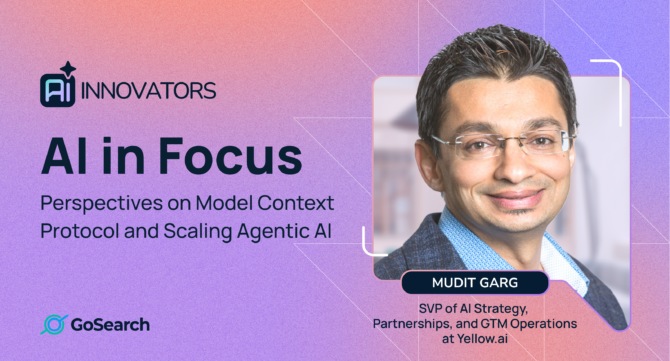
Welcome back to AI Innovators, our bi-weekly Q&A interview series in which we speak with forward-thinking leaders shaping the future of artificial intelligence. In this edition, we sit down with Mudit Garg, SVP of AI Strategy, Partnerships, and Go-to-Market at Yellow.ai, a fast-growing company at the forefront of agentic AI.
From navigating IPOs to leading AI adoption at scale, Mudit shares lessons from the field, thoughts on interoperability standards like Model Context Protocol (MCP), scaling Agentic AI, and insights on how agent-based architectures are redefining the customer experience.
Spotlight on Mudit Garg, SVP of AI and GTM at Yellow.ai
Can you share your role, background, and what sparked your interest in AI?
Mudit Garg: I’m the Senior Vice President of AI Strategy, Partnerships, and Go-to-Market Operations at Yellow.ai. My role is twofold: one part is focused on driving revenue through strategic partnerships and identifying new routes to market. The other, closer to my heart, is about bringing operational discipline across sales, marketing, and customer teams—so we can consistently execute our financial and strategic goals.
My journey has taken me through IPOs, acquisitions, and high-growth environments. I’ve worked at large enterprises like SAP, McAfee, and Deloitte, as well as at smaller, scrappy startups like 8×8 and D2L, which we eventually took public. Today, I’m fortunate to be at Yellow—a Series C company scaling fast in one of the most exciting areas of tech.
What drew me to AI is the same thing that’s driven me throughout my career: I’m an operator and builder at heart. I live by a simple philosophy—if you’re not learning, you’re sliding. The world is moving fast, and what got you here won’t get you there. That constant push to grow, compete, and raise the bar keeps me motivated, and AI is the perfect space for that mindset.
What do you like to do in your spare time?
Mudit Garg: Sports, hands down. I play and watch cricket. Anything with a racket—squash, racquetball, tennis, badminton, ping-pong, even pickleball. I also invest time in fitness, both physical and mental. And I’m a huge caffeine fan. Ginger tea, coffee, matcha—count me in.
If you weren’t working in AI, what would you be doing?
I’d love to be a happiness coach. I think the world needs more of it – helping people through mentorship, fitness, and personal growth. We only get one life, and for me, spreading happiness would be a meaningful way to make it count.
You mentioned AI in your role. How does it tie into go-to-market and product strategy at Yellow?
Mudit Garg: AI is central to everything we do at Yellow. Our core focus is building agentic AI – smart, action-oriented agents, for customer support and experience. It’s embedded across our product and GTM strategy.
We use a multi-LLM architecture and design agents that are not just responsive, but proactive, able to take actions like paying a bill, resetting a password, or upgrading a subscription. Whether it’s via phone, chat, or email, these agents are available 24/7, delivering human-like support at scale.
It’s not just about answering questions, it’s about resolving issues. That’s the true power of agentic AI. We layer in memory, orchestration, and retrieval-augmented generation (RAG) to create a seamless, intelligent customer experience.
Today, we serve over 600 customers, support 100+ languages, and handle 16 billion conversations, proof that our approach is working.
What is the biggest challenge when scaling AI agents? Is there an audit process to ensure they are effective and improving?
Mudit Garg: The biggest challenge is what I call the AI paradox—leaders want rapid innovation and ROI, but real transformation takes time. We saw this with the shift from on-prem to SaaS, and now we’re seeing it again as companies move from SaaS to AI agents.
Organizations struggle with how to start: build vs. buy, short-term wins vs. long-term AI maturity. The second challenge is change management—people fear AI will replace jobs, or don’t know where to start. That’s why we guide customers to use cases where AI adds clear value, like code generation or customer support.
Third, the most critical piece is data access and quality. Without clean, connected data, agents can’t be effective. Tools like the Model Context Protocol (MCP) and Agent-to-Agent (A2A) help, but success depends on integrating deeply with existing, often fragmented systems, like CRMs or data lakes, to enable useful AI outcomes.
We address these by helping companies prioritize use cases, build trust, and implement strong operating procedures that evolve with scale.
“Agentic AI truly transforms the world by building autonomous agents that think, adapt, and work side by side with people, creating a seamless integration between human and artificial intelligence.”
— Mudit Garg, SVP of AI Strategy, Partnerships, and GTM Operations @ Yellow.AI
As more tools restrict API access to their data. How do you think that will impact companies that don’t control those endpoints?
Mudit Garg: Great question. It ties back to the classic innovator’s dilemma. We’re seeing two types of players emerge: the incumbents, like extensive CRM or database providers, who already control massive amounts of data, and the disruptors—startups—who are building new ways to extract value from it.
The challenge is that no single vendor can power the AI future alone, because most enterprises run on complex, distributed systems. That’s why standardization is key.
We’re starting to see open protocols like MCP and Google’s Agent-to-Agent architecture help level the playing field. These frameworks make it clear that data access needs to be open and interoperable. Soon, companies will be running more AI agents than SaaS tools, and those agents will need seamless, real-time access across platforms to deliver value.
At Yellow, our approach reflects that reality. We integrate with over 100 systems with full bidirectional read-write capabilities—so agents don’t just pull data; they take action. Whether it’s ordering food or replacing a propane tank, agents can actually do things on the user’s behalf. That only works if vendors embrace open architectures and shared data protocols.
MCP is a strong and decisive step in the right direction—and I believe it’s only a matter of time before more large vendors adopt and expand on this approach.
Several times, you’ve mentioned MCP, Model Context Protocol, and A2A, Agent-to-Agent. Can you explain what MCP is and why it matters to organizations?
Mudit Garg: Absolutely. MCP, or Model Context Protocol, is essentially a universal translator for AI agents. It’s an open standard designed to enable interoperability across different systems and agents, like the secret sauce that allows AI to scale effectively within enterprise ecosystems.
Here’s the challenge: every AI agent needs access to data and systems to be useful. But if each vendor builds their own way of connecting and pulling data, it quickly becomes chaos, especially in complex enterprises where multiple agents are in play.
That’s where MCP comes in. It provides a simple, standardized server-client architecture for agents to read, write, and share data. So instead of reinventing the wheel for each integration, agents can talk to each other and access the right context through a common language.
This levels the playing field. It makes deploying AI agents from different vendors easier and gets them working together seamlessly. And from a user’s perspective, that means faster, smarter, more connected AI experiences. I believe MCP is on track to become the de facto standard for how AI agents exchange context and data going forward.
Does context handling vary across models like Anthropic, Mistral, or Claude—or does MCP help standardize that?
Mudit Garg: That’s exactly what MCP solves. It creates a standard, open-source way to handle context, so it doesn’t really matter which model you’re using. The beauty of MCP is that it allows AI agents to work seamlessly across different LLMs and applications.
As more vendors adopt it, which I think will happen quickly, it’ll become the norm. That means you can build agents that operate across a mix of tools and models, and they’ll just work. That’s the real power of standardization.
It seems like MCP also levels the playing field for startups that don’t have the resources to build custom APIs for every tool. Do you agree?
Mudit Garg: Absolutely. MCP helps both startups and large companies by standardizing how agents connect to enterprise systems. At Yellow.ai, we work with mid-market and enterprise customers, who typically run 30 to 50 applications. It’s a complex environment.
With so many different models emerging—some better at reasoning, others at transactions—you need AI agents that can work across multiple LLMs and diverse systems. That’s where flexible protocols like MCP really shine.
This shift will accelerate innovation, especially for startups. And honestly, the energy in the space is incredible. CIOs and execs are excited—some nervous, too—but we’re clearly at a significant inflection point. AI will fundamentally reshape enterprise use cases faster than most people expect.
“The Model Context Protocol is a game changer for interoperability, providing a level playing field for AI agents to access, share, and read data uniformly across diverse ecosystems.”
— Mudit Garg, SVP of AI Strategy, Partnerships, and GTM Operations @ Yellow.AI
What are your thoughts on robotic AI and its impact on the workforce?
Mudit Garg: Great question. The term I prefer is agentic AI, and yes, I believe it will absolutely transform the world. We’ve moved past simple automation. What’s emerging now are intelligent, autonomous agents that can think, adapt, and collaborate alongside humans.
So what does that mean for our jobs? It doesn’t necessarily mean fewer jobs – it means different jobs. I’ve seen this firsthand from my time in edtech: upskilling and reskilling are key. In the future, everyone will likely work with both human and virtual teammates. The AI agents will start by handling simple tasks, but over time, they’ll take on more complexity, freeing us to focus on higher-value work.
And today’s AI is no longer cold or robotic—it can understand context, show empathy, and even build memory. At Yellow.ai, we call this human-like interaction. These agents aren’t static scripts; they can learn from human interactions in real time and continuously improve.
I saw a quote from Salesforce’s CEO saying this is the last generation to manage people; in the future, we’ll manage both humans and AI. Do you agree?
Mudit Garg: Absolutely. That’s the core of what we call agentic architecture. Think of an agent that starts simple—accessing a knowledge base or documents. But now imagine it also knows who you are, understands your past interactions from your CRM, and retains short- and long-term memory.
These agents can handle complex tasks, self-learn, and adapt. If they fail to solve an issue, they hand it off to a human, but crucially, they learn from that handoff. Next time, they solve it themselves. That’s real-time learning in action.
It might look simple from the outside, but under the hood, it’s a complex system optimized for performance, context, observability, and accuracy. It’s like an iceberg—you only see the tip.
The future of leadership isn’t just managing people—it’s managing people and AI. Agentic systems will learn, adapt, and grow alongside us, transforming how work gets done beneath the surface of every interaction.”
— Mudit Garg, SVP of AI Strategy, Partnerships, and GTM Operations @ Yellow.AI
Final question: With AI impacting entry-level roles, especially for new grads, what skills should people focus on to succeed in the tech world?
Mudit Garg: Number one: embrace AI. Be self-sufficient and curious. Ask “why” to get to the “wow.” Whether you’re writing code, building content, or selling software, there are AI tools that can amplify your output.
Also, get comfortable with data literacy. It’s no longer just for engineers. As AI bridges the gap between business and tech, understanding and interpreting data becomes essential across every function—sales, marketing, support, and engineering.
Start broad, learn fast, think big, and, above all, keep learning. The future belongs to those who grow with it.
Closing Thoughts
Mudit’s approach to building scalable, context-aware AI agents echoes what we’ve seen firsthand at GoSearch. As enterprise leaders grapple with fragmented systems and siloed data, GoSearch provides the connective tissue between tools, making AI deployment faster, more intelligent, and more actionable. Whether you’re building your first AI agent or scaling up hundreds across departments, GoSearch helps unify and accelerate your efforts:
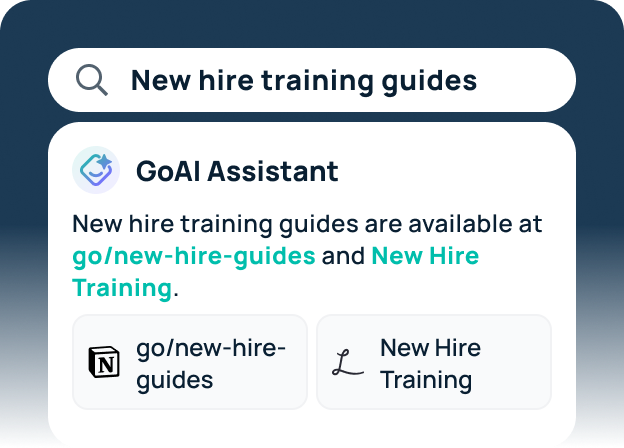
Search across all your systems with full-context visibility—CRMs, knowledge bases, ticketing systems, and more.
Integrate with LLM-powered copilots or agents using our secure, low-latency APIs, which are perfect for agentic use cases like support automation or sales enablement.
Enable real-time, read-write access to systems your agents rely on—without waiting on IT or partner APIs.
Ready to see how GoSearch can power your workplace productivity? Book a demo today!
Search across all your apps for instant AI answers with GoSearch
Brandon Most is Head of Marketing at GoLinks, GoSearch, and GoProfiles, where he helps enterprise teams navigate the AI landscape and deploy tools that actually improve how work gets done. With nearly 20 years of SaaS marketing experience, he connects buyers with solutions that deliver measurable impact — and advises the boards and executive teams of several venture-backed startups.
Two-time founder Rohit Chikballapur on why production-ready AI is about verification, not perfection, the own-vs-rent framework, and why distribution beats building.