


Retrieval-Augmented Generation (RAG) is one of the most important technologies powering modern enterprise AI. By combining information retrieval with large language models, RAG enables AI assistants and enterprise search platforms to generate accurate answers based on trusted company knowledge.
In this guide, we’ll explain how RAG works, explore enterprise RAG architecture, compare RAG to traditional search and fine-tuning, and highlight real-world use cases across IT, engineering, sales, HR, and customer support teams.
Quick Answer: What Is Retrieval-Augmented Generation (RAG)?
Retrieval-Augmented Generation (RAG) is an AI architecture that combines information retrieval with generative AI. Before generating a response, a RAG system searches relevant knowledge sources—such as company documents, Slack conversations, wikis, CRM records, and cloud storage—to retrieve the most relevant information. The large language model then uses that retrieved information to generate an accurate, context-aware answer.
For enterprises, RAG enables AI assistants and enterprise search platforms to provide grounded answers based on company knowledge while reducing hallucinations and improving trust.
Key Takeaways
- RAG combines retrieval systems with generative AI.
- RAG grounds AI responses in trusted enterprise data.
- Enterprise RAG connects tools like Slack, Google Drive, Jira, Salesforce, and Confluence.
- RAG reduces hallucinations and improves answer accuracy.
- Modern enterprise search platforms extend RAG with hybrid retrieval, agent workflows, permissions awareness, and citations.
- RAG is becoming a foundational architecture for enterprise AI assistants and AI search platforms.
Finding the correct information at the right time is a pressing challenge for companies, as SaaS sprawl increases and the amount of data grows. Retrieval-Augmented Generation, or RAG search, is an AI-driven approach that solves this problem by combining advanced search with AI models’ generative capabilities.
As organizations move toward more intelligent workflows and data-driven decisions, RAG search offers a powerful tool to enhance knowledge management, improve operational efficiency, and foster better decision-making.
What is RAG Search?
Retrieval-Augmented Generation (RAG) is an AI methodology that enhances traditional information retrieval by pairing it with generative AI. Unlike standalone search engines or generative AI systems alone, RAG offers the best of both worlds. It retrieves relevant information from trusted sources and generates a natural language response, grounded in the retrieved data.
This dual approach provides more accurate and context-aware answers compared to conventional systems.
Critical components of RAG search include:
- Retrieval: The AI fetches relevant documents or data points from a pre-defined knowledge base or database using vector similarity or semantic search techniques.
- Generation: A generative AI model, such as OpenAI’s ChatGPT, synthesizes a coherent, human-like response based on the retrieved information.
RAG search ensures that the AI can handle complex queries, generate nuanced answers, and ground its responses in factual data, reducing inaccuracies or hallucinations.
How Modern RAG Retrieval Works
Early RAG systems primarily relied on vector databases and semantic search. Modern enterprise RAG architectures use multiple retrieval methods simultaneously to improve accuracy and relevance.
Common retrieval techniques include:
- Vector search
- Keyword search
- Hybrid search
- Metadata filtering
- Knowledge graphs
- Permissions-aware retrieval
- Re-ranking models
By combining multiple retrieval approaches, organizations can improve search accuracy while ensuring information remains secure and accessible.
Why RAG Matters for Enterprise AI
Large language models are trained on public information and historical datasets. While they excel at reasoning and language generation, they do not automatically understand an organization’s internal knowledge.
Without access to company-specific information, AI assistants cannot accurately answer questions about customers, products, policies, projects, support tickets, or internal processes.
RAG solves this challenge by connecting AI systems to enterprise knowledge sources and retrieving relevant information at the moment a question is asked. This allows organizations to deploy AI assistants that are accurate, secure, and grounded in current business knowledge.
As organizations adopt enterprise AI, RAG has emerged as one of the most important technologies for connecting AI models to the information employees need to do their jobs effectively.
How Does RAG Search Work?
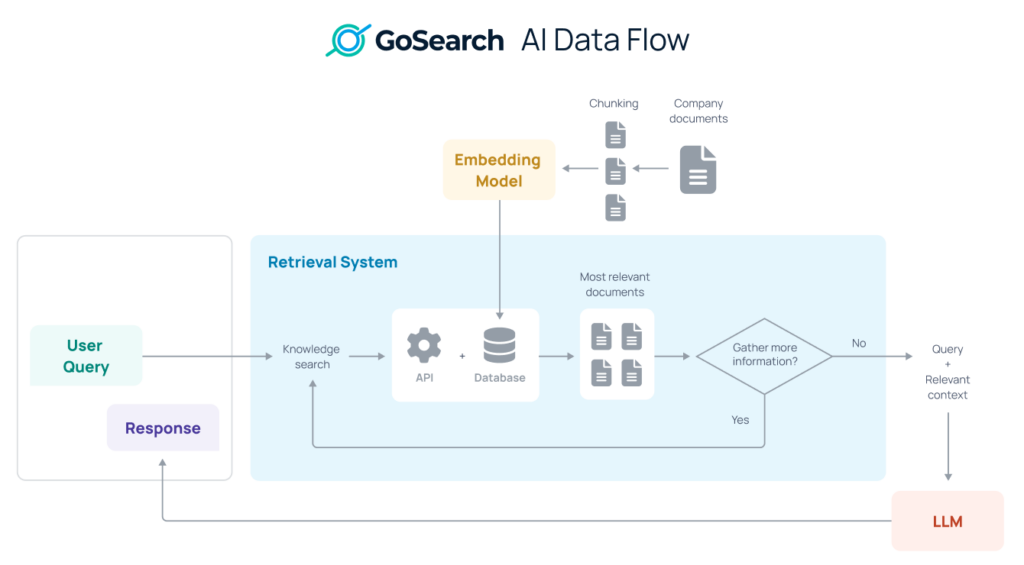
RAG search operates in two phases, leveraging advanced AI technologies for each step:
1. Retrieval Phase
When a user poses a query, the system:
- Transforms the query into vector embeddings, representing the text’s semantic meaning.
- Searches a database or knowledge base using similarity metrics for the most contextually relevant documents.
- Selects top-ranked documents or data points to feed into the next phase.
This retrieval process relies on semantic search rather than simple keyword matching, allowing it to understand intent and context better.
2. Generation Phase
Once the documents are retrieved, the generative AI:
- Takes these documents as input to craft a response.
- Uses contextual information from the query and the documents to generate a response in natural language.
The result is a conversational, accurate, and context-aware response tailored to the user’s needs.
Enterprise RAG Architecture
A modern enterprise RAG system typically follows six steps:
1. Query Understanding
The system analyzes the user’s question and determines intent, context, and relevant concepts.
2. Knowledge Retrieval
Relevant content is retrieved from connected applications, documents, databases, and workplace systems.
3. Permissions Enforcement
Security permissions are applied to ensure users only access information they are authorized to see.
4. Re-Ranking
Retrieved content is ranked based on relevance, context, freshness, and authority.
5. AI Generation
The language model generates a response using the retrieved information as context.
6. Citations and Sources
The system presents references to the underlying sources so users can verify information and build trust.
Value of RAG to Enterprises
RAG search holds immense potential for organizations looking to streamline operations, enhance employee productivity, and deliver superior customer experiences.
1. Enhanced Knowledge Access
RAG enables employees to access precise information quickly, eliminating the need to search through extensive documentation. Whether retrieving compliance details, IT solutions, or HR policies, RAG ensures teams have the answers they need at their fingertips.
2. Improved Customer Support
Companies can provide personalized and context-aware support by integrating RAG into customer service platforms. Customers receive quick, accurate responses, which improves satisfaction and reduces the support team workload.
3. Increased Productivity
Automating information retrieval reduces time spent searching for data, enabling teams to focus on strategic tasks. For example, a marketing team could instantly find data on campaign performance or customer demographics without manual effort.
4. Actionable Insights
RAG search enables decision-makers to receive actionable, reliable insights by grounding generative outputs in real-time or pre-validated data. This helps in crafting data-driven strategies across departments.
5. Scalability and Adaptability
Enterprise RAG Examples and Use Cases
RAG for IT Teams
IT teams use RAG to search technical documentation, incident reports, troubleshooting guides, and security policies across multiple systems.
RAG for Engineering Teams
Engineers can retrieve information from GitHub, Jira, Confluence, and technical documentation to quickly find answers and reduce context switching.
RAG for Sales Teams
Sales teams use RAG to surface customer information, case studies, competitive intelligence, and proposal content from across the organization.
RAG for HR Teams
HR teams use RAG to answer employee questions about benefits, policies, onboarding processes, organizational structures, and training resources.
RAG for Customer Support
Support teams can quickly retrieve troubleshooting information, product documentation, and historical customer interactions to improve response times.
RAG vs Other Enterprise AI Approaches
RAG vs Fine-Tuning
Organizations often compare retrieval-augmented generation and fine-tuning when building AI solutions.
| RAG | Fine-Tuning |
|---|---|
| Uses live company data | Uses training data |
| Updates instantly | Requires retraining |
| Supports citations | Limited source transparency |
| Lower maintenance | Higher maintenance |
| Ideal for knowledge retrieval | Ideal for behavior customization |
For most enterprise knowledge and search use cases, RAG provides a more scalable and maintainable approach because it can access current information without retraining the model.
RAG vs Traditional Enterprise Search
| Traditional Search | RAG Search |
|---|---|
| Returns documents | Returns answers |
| Keyword-focused | Semantic and contextual |
| User reads sources | AI synthesizes information |
| Limited reasoning | AI-powered reasoning |
| Search only | Search plus generation |
RAG vs AI Chatbots
Traditional chatbots often rely on preconfigured responses and limited datasets.
RAG-powered AI assistants can dynamically retrieve information from enterprise systems, making responses more accurate, personalized, and relevant to current business information.
GoSearch: Unlocking the Power of RAG for Enterprises
At the forefront of implementing RAG is GoSearch, an advanced AI-driven search solution tailored to enterprise needs. GoSearch integrates retrieval-augmented generation to offer businesses a seamless and efficient search experience. Here’s how it delivers value:
1. Unified Knowledge Repository
GoSearch connects disparate data sources, such as intranets, CRM systems, and cloud storage, into a unified knowledge base. Employees can surface accurate answers without navigating multiple platforms.
2. Context-Aware Results
Using RAG search, GoSearch delivers relevant responses that are also enriched with context. It provides synthesized answers that directly address user queries instead of simply listing documents.
3. Enhanced Decision-Making
With GoSearch, organizations can extract actionable insights from unstructured data, enabling leaders to make informed decisions.
4. Scalability Across Teams
From assisting IT teams in troubleshooting to empowering HR with instant access to company policies, GoSearch scales to fit the needs of diverse departments.
What’s Next for RAG Search?
The future of RAG is bright, with several exciting advancements on the horizon:
1. Integration with Real-Time Data
RAG systems will soon incorporate real-time data sources, allowing businesses to respond to dynamic changes. This is particularly useful for industries like finance, where up-to-the-minute information is crucial.
2. Enhanced Personalization
As AI becomes more adept at understanding user preferences, RAG will deliver highly personalized results tailored to individual needs, further improving user satisfaction.
3. Industry-Specific Applications
RAG will evolve to offer specialized solutions for industries like healthcare (medical document retrieval), education (personalized learning resources), and e-commerce (tailored product recommendations).
4. Improved AI Explainability
Future RAG models will likely include better mechanisms to explain how a response was generated and what data sources were used, increasing trust and transparency.
5. Hybrid Cloud Implementations
Enterprises will have the flexibility to deploy RAG systems in hybrid environments, ensuring data privacy and compliance with industry regulations.
Challenges and Limitations of RAG
While RAG offers significant benefits, organizations should consider several implementation challenges.
Data Quality
AI responses are only as reliable as the information available in connected knowledge sources.
Permissions and Security
Enterprise RAG systems must ensure users only access information they are authorized to view.
Retrieval Accuracy
Finding the most relevant information across thousands of documents and applications remains a technical challenge.
Information Freshness
Organizations need systems that can access current information rather than relying solely on indexed content.
Trust and Transparency
Employees increasingly expect citations and source references that allow them to verify AI-generated answers.
Addressing these challenges is essential for building enterprise AI systems that employees trust and adopt.
Why Enterprises Should Embrace RAG Search
Retrieval-Augmented Generation, or RAG search, stands out as a game-changer in a data-driven world. By combining the accuracy of retrieval-based systems with the conversational power of generative AI, RAG offers unparalleled benefits for enterprises.
Tools like GoSearch make adopting RAG seamless and scalable, empowering organizations to enhance productivity, improve customer experiences, and drive innovation. As RAG search evolves, its potential to transform industries will only grow, making now the perfect time for enterprises to invest in RAG-powered solutions.
Whether you’re looking to streamline workflows, foster collaboration, or make better-informed decisions, RAG search is the key to unlocking a more innovative, efficient future.
Search across all your apps for instant AI answers with GoSearch
Schedule a demo
The Future of RAG and Enterprise Search
RAG is rapidly evolving from a standalone AI technique into a foundational component of enterprise AI platforms.
As organizations adopt AI agents, workflow automation, Model Context Protocol (MCP), and multimodal AI systems, retrieval will remain critical for providing accurate and trustworthy answers.
Future enterprise AI platforms will increasingly combine RAG, agentic workflows, real-time retrieval, and reasoning capabilities to help employees find information, automate work, and make better decisions.
FAQs
1. What is RAG?
Retrieval-Augmented Generation (RAG) is a technique that combines information retrieval systems with generative AI models to deliver accurate, context-aware answers. It works by first retrieving relevant documents from a knowledge base and then using a generative AI model (like ChatGPT) to synthesize a natural language response grounded in the retrieved data. This ensures responses are both informative and accurate, minimizing AI hallucinations.
2. How does RAG improve traditional search systems?
RAG enhances traditional search systems by pairing keyword or semantic retrieval with AI’s generative capabilities. Instead of simply listing documents or links, RAG delivers synthesized, conversational responses that directly address user queries. This improves user experience by providing contextually relevant answers, saving time and reducing the cognitive load of processing raw data.
3. What are the main use cases of RAG in enterprises?
RAG has diverse applications, including:
- Enterprise Knowledge Management: Efficiently retrieve and synthesize insights from internal knowledge bases, wikis, or documentation.
- Customer Support & Chatbots: Power chatbots to answer complex customer queries using real-time retrieval from FAQs, ticket histories, or support databases.
- Content Generation: Automatically generate reports, proposals, or presentations enriched with relevant, real-time data.
- Data-Driven Decision Support: Provide decision-makers with contextualized, synthesized insights from structured and unstructured data sources.
- Employee Onboarding and Training: Provide new employees with personalized, on-demand access to company resources, training materials, and process guides.
4. How does RAG ensure accuracy in AI-generated responses?
RAG ensures accuracy by grounding the generative model’s output in data retrieved from verified sources. The retrieval step narrows the AI’s input to a set of high-relevance documents, minimizing the chances of hallucinations (incorrect or made-up information). Additionally, many RAG systems include mechanisms to cite sources, further boosting trust and transparency.
5. What’s the difference between RAG and traditional generative AI?
Traditional generative AI generates responses solely based on training data, which can lead to inaccuracies or hallucinations. Conversely, RAG retrieves real-time or pre-validated data from external knowledge bases before generating a response. This grounding step ensures that RAG outputs are contextually accurate and up-to-date, making it more reliable for applications where factual accuracy is critical.