


As enterprise teams adopt AI-powered search and RAG systems, a common question comes up:
Is a context graph or knowledge graph a security risk because it stores human-readable data, compared to vector embeddings that are just numbers?
It’s a reasonable concern—but also a misleading one.
The short answer: context graphs and knowledge graphs are not inherently more risky than vector embeddings. In fact, when designed correctly, they often provide stronger security, governance, and control than vector-only systems.
Let’s break down why.
The Myth: “Numbers Are Safer Than Words”
A common assumption is that vector embeddings are safer because they’re numerical and not directly readable, while knowledge graphs or context graphs store explicit facts and relationships.
But numeric does not mean anonymous or secure.
Research and real-world deployments have shown that embeddings can:
- Leak personally identifiable information (PII)
- Be reverse-engineered or inferred
- Reveal sensitive context through semantic similarity
Vectors are opaque, not protected.
Where Knowledge Graphs and Context Graphs Actually Introduce Risk (and How to Avoid It)
A context or knowledge graph can introduce a security risk only when poorly implemented. Common pitfalls include:
- Storing raw sensitive content unnecessarily
- Lacking fine-grained access controls
- Allowing unrestricted graph traversal
- Weak tenant isolation or auditing
These are design failures—not graph failures.
A well-architected context graph supports:
- Node-, edge-, and attribute-level permissions
- Role-based and attribute-based access control (RBAC / ABAC)
- Encryption at rest and in transit
- Explicit data provenance and lineage
When done right, the graph becomes a security asset, not a liability.
The Hidden Security Risks of Vector-Only Systems
Vector databases introduce a different—and often underestimated—set of risks:
- Implicit Data Exposure: You don’t always know what sensitive data was embedded in the first place.
- Over-Retrieval: Semantic similarity can surface content users shouldn’t have access to if permissions aren’t enforced before retrieval.
- Poor Auditability: It’s difficult to answer what sensitive data exists and why results were returned.
- Prompt Leakage Amplification: Retrieved context can be unintentionally exposed through LLM responses if not carefully filtered.
Vectors optimize relevance—but they do not enforce governance.
Enterprise Search Considerations
When designing enterprise search with AI:
- Context Graphs & Knowledge Graphs:
- Provide structured understanding and reasoning.
- Enforce permissions at granular levels.
- Enable auditability and compliance with regulations like SOC 2, ISO 27001, and GDPR.
- Vector Stores:
- Deliver fast, semantic recall.
- Must be combined with a governance layer to prevent sensitive data leakage.
- Hybrid Approach:
- Use the graph for policy, access control, and context reasoning.
- Use vectors for relevance and semantic matching.
- Retrieval is filtered through the graph before vector results are returned.
This ensures enterprise teams get both relevance and compliance without compromise.
Diagram: How Context Graphs and Vector Embeddings Work Together
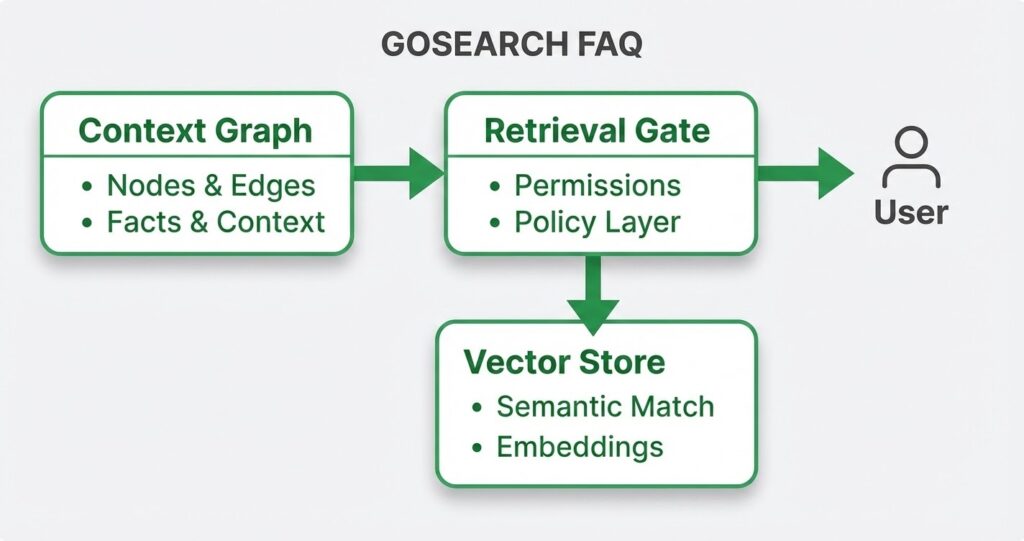
The graph ensures security and context, vectors ensure fast, relevant search.
How GoSearch Approaches Secure Context Retrieval
GoSearch is built with this hybrid philosophy at its core.
- Context-aware retrieval that respects enterprise permissions
- Structured understanding of knowledge, not just embeddings
- Fine-grained access control across connected tools
- Governance-first design for enterprise environments
Instead of choosing between graphs or vectors, GoSearch uses each where it’s strongest—so teams get fast, accurate answers without creating new security blind spots.
Final Takeaway
Context graphs and knowledge graphs are not inherently more dangerous than vector embeddings.
Security risk comes from:
- Poor access control
- Storing unnecessary raw data
- Weak governance and auditing
—not from whether information is stored as text, structure, or numbers.
For enterprises serious about AI adoption, the future isn’t vector-only or graph-only. It’s secure, governed, context-aware systems that combine both—by design.