


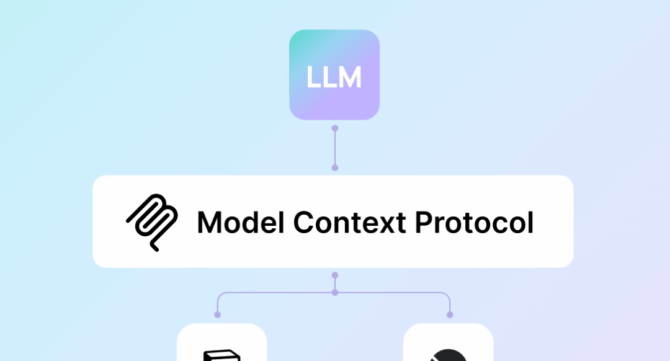
What is Model Context Protocol (MCP)?
Model Context Protocol, or MCP, is an open standard created by Anthropic that defines how large language models and AI agents securely connect to external data sources and software systems.
MCP gives AI a consistent way to understand what tools, files, APIs, and applications it can access, and how to use them safely. Instead of relying on custom integrations for every system, MCP provides a shared framework that allows models to retrieve information, take actions, and work with real-time context across enterprise environments.
For organizations building with AI, MCP makes it easier to connect applications, scale automation, and keep data access governed by existing security policies.
Why MCP matters for enterprise AI
Modern AI agents depend on accurate, up-to-date context to perform real work. Without a common protocol, enterprises face fragmented integrations, inconsistent data formats, and limited interoperability between tools.
MCP addresses these challenges by standardizing how context is exchanged across systems. This enables:
- Unified access to enterprise data
- Consistent communication between AI agents
- Support for complex, multi-agent workflows
- Faster deployment of AI-powered search and automation
The result is more reliable AI across search, support, operations, and knowledge management.
Why MCP is gaining industry adoption
MCP is gaining traction because it simplifies how AI integrations are built and maintained.
Developers can create an MCP integration once and use it across any model or application that supports the protocol. This reduces engineering effort and speeds up innovation. Growing ecosystems of MCP clients, servers, and marketplaces are making it easier for teams to adopt MCP without heavy infrastructure work.
As AI agents move from experimentation to production, MCP provides the foundation for scalable, secure interoperability.
Has external data access for AI existed before MCP?
Yes, but earlier approaches were typically proprietary and inconsistent.
Some agent frameworks allowed models to access tools and data, but each platform implemented its own method. MCP introduces a universal protocol that works across models, vendors, and applications. This creates broader compatibility and reduces vendor lock-in.
How does MCP work?
MCP uses a client server architecture.
The AI application acts as a client that sends structured context requests. MCP servers respond with standardized data or actions, following shared schemas and security rules. This allows multiple AI agents and models to interact with enterprise systems in a consistent, predictable way.
In practice, MCP enables AI to retrieve documents, update records, trigger workflows, and reason over live business data across tools like CRMs, ticketing systems, and knowledge bases.
Core components of MCP
MCP typically includes three layers:
Host application
Manages interactions between users, models, and MCP services. Examples include developer tools, desktop assistants, and AI workspaces.
Client
Maintains connections between the host and MCP servers.
Server
Exposes standardized data sources and actions such as file access, database queries, or workflow triggers using secure transports like JSON-RPC.
What problems does MCP solve?
Enterprises adopting AI often struggle with:
- Manual integrations between every tool and model
- Incomplete or outdated AI responses
- Scaling challenges as more agents are introduced
MCP solves these by creating a shared language for context exchange. This makes it easier to improve AI accuracy, scale automation across teams, and reduce engineering overhead.
What capabilities do MCP servers provide?
MCP servers typically offer three core capabilities.
Resources such as files, databases, or logs that AI can reference.
Tools that allow AI to take action, like creating tickets or updating records.
Prompts that provide reusable task templates to accelerate workflows.
Together, these capabilities turn AI from a passive assistant into an active participant in enterprise systems.
Is MCP secure?
MCP security depends on proper implementation and governance.
Hosts control which tools and servers are enabled. Clients communicate with servers using secure transports. Servers enforce access rules to protect sensitive resources. Organizations should only deploy MCP servers from trusted sources and follow enterprise security best practices for authentication, authorization, and monitoring.
How MCP enforces security in practice
MCP hosts often require explicit user approval before enabling tools or actions. Some applications allow fine-grained control over which actions can run automatically and which require confirmation. This ensures transparency and prevents unintended access.
For transport security, MCP commonly uses:
- Local communication when client and server run on the same machine
- Secure network communication over encrypted protocols with authentication and authorization
These controls help protect data integrity and prevent unauthorized access.
What risks should organizations consider?
The primary risk is introducing untrusted MCP servers.
Because MCP enables deep system access, organizations must carefully manage which servers are installed and who can configure them. As the ecosystem matures, certification programs and curated marketplaces are expected to improve trust and safety.
Regular audits, access reviews, and security monitoring remain essential.
Key benefits of MCP for organizations
Teams that adopt MCP gain:
- Faster deployment of AI applications
- Higher accuracy in AI-powered search and automation
- Better collaboration between agents through shared context
- A scalable architecture aligned with enterprise IT standards
These benefits make MCP foundational for modern, context-aware AI platforms.
How MCP differs from traditional APIs
Traditional integrations require building custom APIs for every system and every use case.
MCP acts as a universal layer between AI and enterprise software. Instead of writing separate integrations, organizations implement a single protocol that works across tools, models, and vendors. This reduces complexity and ensures interoperability as AI ecosystems evolve.
How MCP supports multiple AI models
MCP is model-agnostic.
Whether teams use Claude, Gemini, OpenAI models, or others, MCP provides a consistent way to structure context and actions. This allows different models and agents to work together without rewriting integrations.
Does MCP benefit startups and smaller teams?
Yes. MCP removes the need for small teams to build and maintain dozens of custom integrations. With MCP, startups gain access to the same scalable framework used by large enterprises, enabling faster development of AI-powered workflows and products.
Limitations of MCP today
As an emerging standard, MCP still faces challenges.
Adoption is not yet universal across all SaaS platforms. Schema governance requires coordination between vendors. Some types of unstructured content are still evolving in MCP support.
Even so, adoption is accelerating, and enterprise platforms like GoSearch are bringing MCP into real-world production use.
How GoSearch uses MCP
GoSearch uses MCP connectors to power secure, real-time AI across the workplace.
GoSearch indexes company-wide resources so teams can search shared knowledge quickly and reliably. For personal connectors, GoSearch uses real-time federated search so private content remains visible only to the individual user. MCP connectors extend this foundation by enabling AI agents to access tools and take action across systems without custom integrations.
With MCP support, GoSearch enables:
- Real-time access to enterprise systems
- Permission-aware AI search and automation
- Context-aware agents that reflect user roles and tasks
- Secure workflows that meet enterprise compliance standards
This allows GoSearch to go beyond traditional search and deliver AI-powered discovery, automation, and decision support across the organization.