
Most enterprise AI platforms lock you into one model provider’s strengths and blind spots. GoSearch takes the opposite approach. Teams choose from leading LLMs inside a single search and agent layer, so the model fits the task instead of the other way around.
GoSearch now supports Grok 4.7, xAI’s newest frontier model for coding, long-running agents, and professional knowledge work. It builds on Grok 4.6, the model that brought xAI to GoSearch, and it joins options from Anthropic, Google, and OpenAI. This post covers what changed in Grok 4.7, how it compares with the other models in GoSearch, and when to use it.
Quick answer: Grok 4.7 is xAI’s newest frontier model, released September 21, 2026 as an upgrade to Grok 4.6. It uses a larger base model and a longer training run focused on tasks that take hours to finish. It scores 46 on the Artificial Analysis Intelligence Index, up two points from Grok 4.6, with its biggest gains in agentic coding and professional knowledge work. In GoSearch, it fits long-running coding, research, and document-building tasks. GPT-5.6 Sol, Claude Sonnet 5, and Gemini 3.1 Pro remain stronger fits when a task needs a larger context window, so most teams will use Grok 4.7 alongside them.
What is Grok 4.7?
Grok 4.7 is xAI’s most capable model for coding and knowledge work. xAI built it on a new, larger base model and trained it with a longer reinforcement learning run on harder tasks, weighted toward problems that take many hours to complete. The model verifies its own work more carefully and manages longer context better than Grok 4.6.
The model takes text and image input and returns text. It has a 500,000-token context window and four reasoning effort levels: low, medium, high, and extra-high, with high as the default, according to the xAI model documentation. xAI holds API pricing at $2 per million input tokens and $6 per million output tokens, the same as Grok 4.6.
How is Grok 4.7 different from Grok 4.6?
xAI trained Grok 4.7 to work longer on difficult tasks and to check its output before it finishes. It also trained the model to understand the Grok Bot harness natively, which improves conversational tasks and general knowledge work. xAI says Grok 4.7 is better at creating documents and presentations, and it ships with an entirely new safeguard stack.
The gains show up across xAI’s published benchmarks:
| Benchmark | Grok 4.6 | Grok 4.7 |
| CursorBench 4.0 (longer-running coding tasks) | 40.4% | 46.3% |
| DeepSWE v1.1 (software engineering) | 65.2% | 71.0% |
| Terminal-Bench 4.0 (multi-hour terminal work) | 20.3% | 37.6% |
| EEBench (electrical engineering) | 53.0% | 64.0% |
| AA Briefcase v1.1 (multi-hour office work) | 1,546 Elo | 1,657 Elo |
| Harvey Legal Agent Benchmark | 15.8% | 19.6% |
| HealthBench Professional (clinical reasoning) | 48.5% | 56.7% |
Independent testing shows a more measured picture. Artificial Analysis scores Grok 4.7 at 46 on its Intelligence Index, two points above Grok 4.6. Most of the gain comes from agentic knowledge work. On GDPval-AA, Grok 4.7 reaches 1,695 Elo, up from 1,605. Paired with the Grok Build harness, it scores 56 on the Artificial Analysis Coding Agent Index, up from 47.
Outside agentic work, Artificial Analysis finds Grok 4.7 broadly matches Grok 4.6. The model also thinks longer. It uses about 81,000 output tokens per Intelligence Index task, compared with 36,000 for Grok 4.6 at high effort. Harness choice matters too. Artificial Analysis measured about 26% on Terminal-Bench 4.0 with a standardized harness, well below the 37.6% xAI reports from its own setup.
How does Grok 4.7 compare to the other models in GoSearch?
Grok 4.7 joins three other frontier-tier models in GoSearch. Each one leads on a different dimension, so the right choice depends on the task.
| Model | Provider | Context window | Best for |
| Grok 4.7 | xAI | 500K tokens | Long-running coding, research, and document tasks |
| GPT-5.6 Sol | OpenAI | 1.05M tokens | Frontier reasoning, computer use, and complex professional work |
| Claude Sonnet 5 | Anthropic | 1M tokens | Near-frontier coding and agentic work at production scale |
| Gemini 3.1 Pro | 1M tokens | Reasoning over very large documents, with audio and video input |
Against GPT-5.6 Sol. xAI’s launch benchmarks compare Grok 4.7 with GPT-5.6 Sol at max effort. Grok 4.7 leads on CursorBench 4.0 at 46.3% against 41.7%. It also leads on electrical engineering, multi-hour office work, and legal tasks. The two score about even on Terminal-Bench 4.0, at 37.6% and 37.3%. GPT-5.6 Sol leads on DeepSWE, 72.7% to 71.0%, and on clinical reasoning, 60.5% to 56.7%. On the Artificial Analysis Intelligence Index, Grok 4.7 sits one point behind GPT-5.6 Sol. GPT-5.6 Sol also has roughly twice the context window.
Against Claude Sonnet 5. Both models target coding and long-running agent work, so the practical gap is context and cost per task. Sonnet 5 holds 1M tokens against Grok 4.7’s 500K. xAI places Grok 4.7 at the frontier of price and performance on CursorBench 4.0. Yahoo Tech’s review of the same chart notes that Grok 4.7 costs more per task than Claude Sonnet 5. Grok 4.7’s higher token usage contributes to that result.
Against Gemini 3.1 Pro. xAI does not publish a direct head-to-head with Gemini 3.1 Pro, so the clearest difference is input range. Gemini 3.1 Pro accepts a 1,048,576-token input of text, images, video, audio, and PDFs. Grok 4.7 accepts text and images with half the window.
When should you use Grok 4.7 in GoSearch?
Reach for Grok 4.7 when a task runs long and needs to stay on track across many steps. Good fits include:
- Multi-step coding tasks, such as navigating an existing codebase, planning a change, and implementing it across several files
- Research that moves from gathering information to a finished document or presentation, an area where xAI reports clear gains over Grok 4.6
- High-volume agent workflows that run many iterations and need to stay coherent across each one
- Professional analysis in areas where xAI reports leading results, such as legal agent work and electrical engineering
Lean on the other models in GoSearch when the task calls for their strengths instead. Gemini 3.1 Pro suits tasks that involve audio or video input. GPT-5.6 Sol and Gemini 3.1 Pro both offer roughly twice Grok 4.7’s context window for work that depends on holding very large source material in a single pass. Claude Sonnet 5 matches Grok 4.7’s agentic focus with a 1M-token window. No single model works as a universal default, which is why GoSearch supports all four.
How do you use Grok 4.7 in GoSearch?
GoSearch’s hybrid connector architecture pairs any supported model, including Grok 4.7, with real-time federated retrieval across your connected systems. Grok 4.7 answers questions and completes agent tasks with current data from your connectors instead of a stale snapshot from an earlier sync.
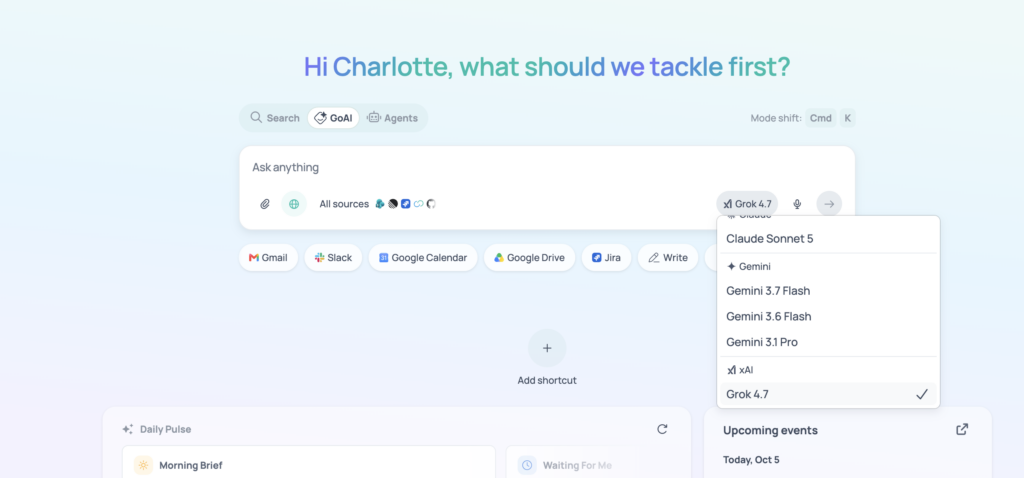
You can use Grok 4.7 three ways:
- In search and chat. Select Grok 4.7 from the model picker in GoSearch’s AI chat assistant for a single question or conversation.
- In agents. Set Grok 4.7 as the default model for a specific agent in the no-code agent builder. An engineering agent that pulls context from connected repositories and tickets, or a research agent that turns company knowledge into a briefing deck, are natural starting points.
- In workflows. Let a workflow route a step to Grok 4.7 while other steps run on different models and agents.
GoSearch runs on Zero Data Retention agreements with its model providers, so switching to Grok 4.7 does not change how your company’s data is handled.
Getting started
Grok 4.7 is available now through the GoSearch model selector in search, chat, and the no-code agent builder. Existing agents and workflows keep their current model until you change it, so adopting Grok 4.7 is opt-in. To test it, run the same query or agent task through Grok 4.7 and your current default, then compare the output inside GoSearch before you switch anything over.
Grok 4.7 gives GoSearch customers a stronger option for coding, research, and iterative agent work, with measurable gains over Grok 4.6. It works best next to Claude, GPT, and Gemini rather than in place of them. Book a demo to see Grok 4.7 alongside GoSearch’s other models on your own workflows.
Search across all your apps for instant AI answers with GoSearch
Schedule a demo
Frequently Asked Questions
Grok 4.7 uses a larger base model and a longer reinforcement learning run focused on multi-hour tasks. It checks its own work more carefully and manages longer context better. On xAI’s benchmarks, it gains about six points on CursorBench 4.0 and 17 points on Terminal-Bench 4.0. Artificial Analysis measures a smaller two-point gain on its Intelligence Index. API pricing stays the same, so the upgrade changes output quality and token usage rather than the price per token.
Not across the board. On xAI’s published benchmarks, Grok 4.7 leads GPT-5.6 Sol on CursorBench 4.0, electrical engineering, multi-hour office work, and legal tasks. GPT-5.6 Sol leads on DeepSWE and clinical reasoning, and the two score about even on Terminal-Bench 4.0. GPT-5.6 Sol also offers a larger context window, at about 1.05M tokens against 500K. The better pick in GoSearch depends on the specific task.
Grok 4.7 suits long-running work that spans many steps. Good fits include multi-step coding across a codebase, research that ends in a finished document or presentation, and agent workflows that run many iterations. It accepts text and image input within a 500K-token window. For tasks that need to hold very large source sets in one pass, or that involve audio and video, another model in GoSearch is the better choice.
Using Grok 4.7 does not change how GoSearch handles your data. GoSearch runs Zero Data Retention agreements with its model providers, including xAI. Your connected data still flows through GoSearch’s real-time federated retrieval, and the model provider does not store it for training or other purposes. Switching models changes which model writes the answer, not your connectors, permissions, or data setup.
Yes. GoSearch retrieves your company’s data in real time instead of relying on each model’s memory, so switching from Grok 4.7 to Claude, GPT, or Gemini does not require rebuilding context. Every model draws on the same connected data through GoSearch, which keeps the search and retrieval layer consistent. You can run the same query through two models and compare the answers before you change the default for an agent.