


Most enterprise AI platforms lock you into one model provider’s strengths and blind spots. GoSearch has always taken the opposite approach, giving teams a choice of leading LLMs inside a single search and agent layer so the model fits the task instead of the other way around.
That lineup just grew. GoSearch now supports Grok 4.6, xAI’s frontier model built for long-running agents, coding, and complex research work. It’s the first xAI model in GoSearch, joining existing options from Anthropic, Google, and OpenAI. This post covers what Grok 4.6 does well, how it stacks up against the other models already in GoSearch, and when it’s the right pick for your workflow.
Quick answer: Grok 4.6 is xAI’s latest frontier model, released August 12, 2026, and built for long-running agentic work such as multi-step coding, research, and visual or interactive projects. Inside GoSearch, it’s best suited for tasks that need to persist across many steps, like navigating an unfamiliar codebase or turning a broad research question into a finished document. For deep single-shot reasoning or the largest possible context window, GoSearch’s existing Claude, GPT, and Gemini models remain better fits, so most teams will use Grok 4.6 alongside them rather than as a full replacement.
What is Grok 4.6?
Grok 4.6 is xAI’s newest frontier model, released on August 12, 2026 as an upgrade to Grok 4.5. It’s built specifically for long-running agent work, the kind of task that unfolds over many steps instead of a single prompt and response. That includes analyzing a large set of documents, working through an unfamiliar codebase, or carrying a broad product idea through research, drafting, and revision.
The model takes text and image input and returns text output, with a 500,000-token context window and four selectable reasoning effort levels: low, medium, high, and extra-high. On the Artificial Analysis Intelligence Index, xAI reports a score of 61, a meaningful jump from Grok 4.5 and roughly on par with OpenAI’s GPT-5.6 Sol. xAI positions the release around cost efficiency as much as raw capability, since Grok 4.6 holds the same API pricing as its predecessor while scoring higher across most benchmarks.
How does it work inside GoSearch?
GoSearch’s hybrid connector architecture pairs any supported model, including Grok 4.6, with real-time federated retrieval across your connected systems instead of a static, indexed snapshot. That means Grok 4.6 answers questions and completes agent tasks using current data from your connectors, not a stale copy pulled at some earlier sync time.
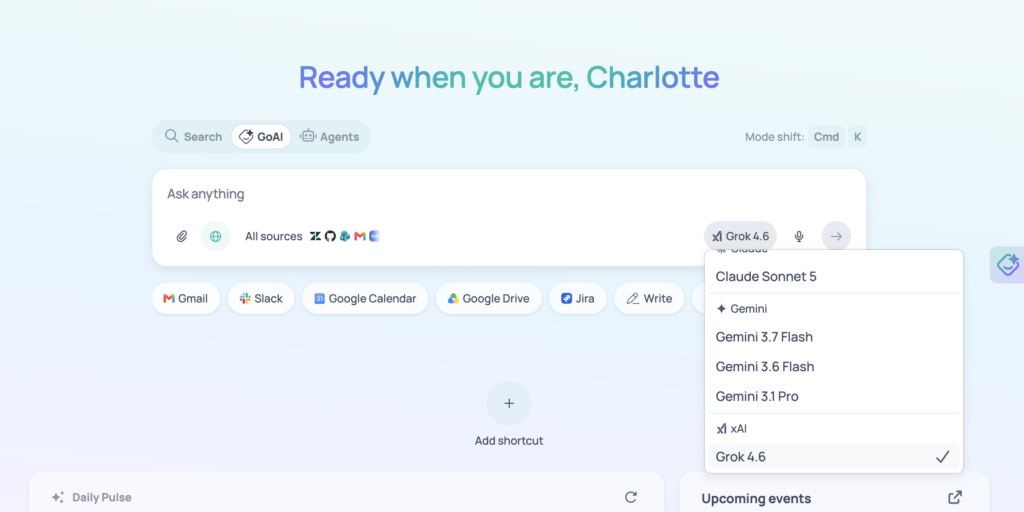
Because GoSearch runs on Zero Data Retention agreements with its model providers, switching to Grok 4.6 for a query or an agent workflow doesn’t change how your company’s data is handled. You can select it from GoSearch’s model picker for a single search, set it as the default for a specific agent, or let GoSearch route a task to it automatically as part of a broader workflow that chains multiple models and agents together.
How does Grok 4.6 compare to the other models in GoSearch?
Grok 4.6 joins three other frontier-tier models already available in GoSearch. Each one leads on a different dimension, so the right choice depends on the task rather than a single “best” model.
| Model | Provider | Best for | Context window | Reasoning effort |
|---|---|---|---|---|
| Grok 4.6 | xAI | Long-running coding, research, and visual agent tasks | 500K tokens | Low, medium, high, extra-high |
| GPT-5.6 Sol | OpenAI | Frontier reasoning, computer use, and complex professional work | 1.05M tokens | None, low, medium, high, extra-high, max |
| Claude Sonnet 5 | Anthropic | Near-frontier coding and agentic work at production scale | 1M tokens | Low, medium, high, extra-high |
| Gemini 3.1 Pro | Deep reasoning over very large documents and datasets | 2M tokens | Standard, Deep Think |
Grok 4.6 lands in the same intelligence tier as GPT-5.6 Sol on third-party benchmarks, which is its clearest advantage as a model. Its 500K context window is the smallest of the four, though, so it’s not the model to reach for when a task requires holding an entire multi-hundred-page document set in a single pass. That’s where Gemini 3.1 Pro’s 2M-token window or GPT-5.6 Sol’s 1.05M-token window has more headroom.
When should you use Grok 4.6 in GoSearch?
Reach for Grok 4.6 when a task runs long and needs to stay on track across many steps rather than resolve in one exchange. Good fits include:
- Multi-step coding tasks, such as navigating an existing codebase, planning a change, and implementing it across several files
- Research tasks that move from gathering information to producing a finished write-up or artifact
- High-volume agent workflows that run many iterations and need to stay coherent across each one
- Interactive or visual project generation, where the model needs to build and revise something over multiple turns
Lean on the other models in GoSearch’s lineup when the task calls for their specific strengths instead. Gemini 3.1 Pro is the better choice for research that depends on holding very large source material in context at once. Claude Sonnet 5 has an edge on sustained, tool-heavy agent sessions where reliability across a long session matters most. GPT-5.6 Sol is a strong fit for computer-use tasks and the widest context window among the models with roughly comparable benchmark scores. None of these differences are large enough to make any one model a universal default, which is the reason GoSearch supports all four rather than picking one for you.
Getting started
Grok 4.6 is available now to GoSearch customers through the model selector in search, chat, and the no-code agent builder. Existing agents and workflows keep their current model assignment until you change it, so adopting Grok 4.6 is opt-in rather than a forced migration. Teams that want to test it against their current default can run the same query or agent task through both models and compare the output directly inside GoSearch before switching anything over.
Grok 4.6 gives GoSearch customers a fourth frontier-tier option, and the first from xAI, for long-running agent work. It’s not a replacement for Claude, GPT, or Gemini inside GoSearch, since each still leads on its own dimension, whether that’s context window size, tool-heavy reliability, or reasoning depth. What it adds is a competitive option for coding, research, and iterative agent tasks where sustained multi-step performance matters more than the largest possible context window.
Book a demo to see Grok 4.6 alongside GoSearch’s other models for your own workflows.
Search across all your apps for instant AI answers with GoSearch
Schedule a demo
Frequently Asked Questions
Yes. GoSearch added Grok 4.6 to its model lineup as the first model from xAI, joining existing options from Anthropic, Google, and OpenAI. You can select it from the model picker for individual searches and chats, or assign it as the default model for a specific agent inside GoSearch’s no-code agent builder. Switching models doesn’t require any change to your connectors or data setup.
Not universally. The two models score close to each other on third-party intelligence benchmarks, but each has a different strength. Grok 4.6 is built for long-running, multi-step agent work, while GPT-5.6 Sol has a larger context window and an edge on computer-use tasks. Neither model is a clear win across every scenario, so the better fit in GoSearch depends on the specific task rather than one model outperforming the other overall.
Grok 4.6 is best suited for long-running agent work, including multi-step coding tasks, research projects that move from information gathering to a finished write-up, and iterative visual or interactive project generation. It’s a strong choice when a task needs to stay on track and produce reliable output across many steps.
GoSearch runs Zero Data Retention agreements with its model providers, including xAI, so using Grok 4.6 doesn’t change how your company’s data is retained or handled compared to any other model in the lineup. Your connected data still flows through GoSearch’s real-time federated retrieval rather than being stored by the underlying model provider for training or other purposes.
Yes. Because GoSearch retrieves your company’s data in real time rather than relying on each model’s own memory, switching from Grok 4.6 to Claude, GPT, or Gemini for a different task doesn’t require rebuilding context. Each model draws on the same connected data through GoSearch, so the underlying search and retrieval layer stays consistent no matter which model you choose for a given query or agent.