


Organizations want flexibility when deploying AI across workflows, knowledge systems, and agents. Therefore, GoSearch now supports Claude Sonnet 4.6 and Claude Sonnet 4.6 Thinking as flagship and reasoning models within its enterprise AI platform. Teams can toggle between models for individual chats, power AI agents with advanced reasoning, and set Claude Sonnet 4.6 as the default model for their workspace.
Because GoSearch takes a model agnostic approach, organizations gain access to leading and latest large language models from multiple providers. This flexibility helps teams choose the right model for each task while maintaining secure enterprise deployment and consistent workflows.
This blog explains what Claude Sonnet 4.6 offers, how model flexibility works in GoSearch, and why this release strengthens enterprise AI adoption.
Key Takeaways
- Claude Sonnet 4.6 and 4.6 Thinking are now available in GoSearch for enterprise AI workflows.
- Users can toggle between models for individual chats in GoAI, which enables task-specific optimization.
- Organizations can set Claude Sonnet 4.6 as the default workspace model for consistent performance.
- Teams can power AI agents with Sonnet 4.6 for advanced automation and reasoning.
- GoSearch remains model agnostic, which gives enterprises access to leading and latest LLMs from multiple providers.
What Is Claude Sonnet 4.6?
Claude Sonnet 4.6 is an advanced AI model designed for enterprise performance, structured outputs, and long-context understanding. It supports complex analysis, knowledge discovery, and workflow automation. Because of these capabilities, it works well for enterprise search, research, and decision support.
Within GoSearch, Claude Sonnet 4.6 helps teams:
- Analyze enterprise documents and knowledge sources
- Generate structured summaries and insights
- Answer complex business questions
- Support AI-driven workflows
- Improve decision quality across teams
As a result, organizations gain faster insights with stronger accuracy and context.
What Is Claude Sonnet 4.6 Thinking?
Claude Sonnet 4.6 Thinking focuses on step-by-step reasoning and multi-stage analysis. It supports complex tasks that require structured logic and deeper evaluation. Therefore, teams can use it for advanced research, technical problem solving, and strategic planning.
Common use cases include:
- Multi-step analysis and planning
- Technical and engineering workflows
- Complex research tasks
- Knowledge synthesis across systems
- High-value enterprise decision support
Because reasoning improves clarity and reliability, organizations increase confidence in AI-driven outcomes.
Model Flexibility in GoSearch
Enterprise teams rarely rely on a single AI model for every task. Instead, they need flexibility to choose the best model for different workflows. GoSearch provides model choice at every level of the enterprise AI experience.
Toggle Models for Individual Chats, Agents and Workflows in GoAI
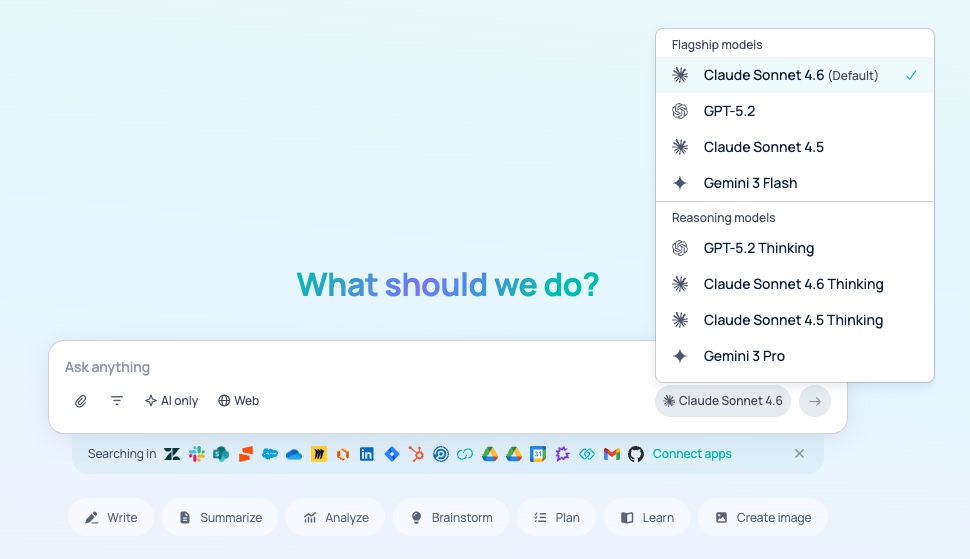
Users can switch between available models for each conversation – along with our AI Agents and Workflows. This flexibility allows teams to select the model that best fits the task, whether they need speed, reasoning depth, or structured outputs. Employees optimize AI performance without changing tools.
Set Claude Sonnet 4.6 as Your Default Workspace Model
Organizations can configure Claude Sonnet 4.6 as the default model for GoAI across their workspace. This configuration ensures consistent performance and standardized AI experiences across teams.
Power AI Agents with Sonnet 4.6
Teams can use Claude Sonnet 4.6 to run AI agents that execute tasks across enterprise applications. Because the model supports strong reasoning and structured outputs, agents perform complex workflows with greater reliability.
A Model Agnostic Enterprise AI Platform
GoSearch supports leading large language models from multiple providers. This model agnostic architecture gives organizations flexibility, reduces vendor dependency, and ensures access to the latest AI capabilities as they emerge.
Why Model Agnostic AI Matters for Enterprises
Organizations invest heavily in AI infrastructure and workflows. However, the AI landscape evolves quickly. Therefore, model flexibility helps enterprises adapt without disruption.
Future-Proof AI Strategy
Teams adopt new models as technology advances. This capability protects long-term AI investments.
Task-Specific Optimization
Different workflows require different model strengths. Teams select the best model for reasoning, speed, or knowledge analysis.
Reduced Vendor Lock-In
Organizations maintain control over their AI strategy by using multiple providers.
Faster Innovation
Access to leading models accelerates experimentation and innovation across teams.
Because of these advantages, model agnostic platforms help organizations scale AI with confidence.
How Claude Sonnet 4.6 Works Inside GoSearch
Enterprise Knowledge Analysis
The model analyzes data across connected enterprise systems and generates contextual responses. As a result, teams receive answers grounded in organizational knowledge.
Conversational Enterprise Search
Users ask questions in natural language and receive structured responses. This experience improves knowledge access and reduces search time.
AI Agents and Workflow Automation
Claude Sonnet 4.6 supports agents that execute actions across applications. Teams automate repetitive work and accelerate outcomes.
Secure Deployment and Governance
GoSearch provides enterprise-grade security controls and governance policies. Organizations maintain control over data and AI usage.
Use Cases for Claude Sonnet 4.6 in GoSearch
Enterprise Research and Knowledge Discovery
Teams analyze internal documentation and data to generate insights.
IT and Engineering Workflows
Technical teams troubleshoot issues, analyze systems, and automate processes.
Sales and Customer Operations
Teams generate summaries, analyze customer data, and support engagement strategies.
Strategic Planning and Analysis
Leaders evaluate complex information and generate structured recommendations.
Because these use cases span the organization, enterprises improve efficiency across the business.
Getting Started with Claude Sonnet 4.6 in GoSearch
Organizations can enable Claude Sonnet 4.6 and 4.6 Thinking directly in GoSearch. Teams can toggle models in GoAI chats, configure workspace defaults, and deploy AI agents powered by advanced reasoning. Sign up for GoSearch Free to get started today.
FAQ: Claude Sonnet 4.6 in GoSearch
What is Claude Sonnet 4.6 and how does it work in GoSearch?
Claude Sonnet 4.6 is an advanced large language model developed by Anthropic that delivers strong reasoning, structured outputs, and long-context understanding for enterprise use cases. In GoSearch, the model integrates directly with enterprise knowledge sources, workflows, and AI agents.
Teams use Claude Sonnet 4.6 to analyze internal data, generate summaries, answer complex business questions, and automate tasks across connected applications. Because the model operates within enterprise search and AI workflows, organizations receive contextual responses grounded in company knowledge rather than generic outputs. This integration improves accuracy, productivity, and decision making across teams.
What is Claude Sonnet 4.6 Thinking and when should enterprises use it?
Claude Sonnet 4.6 Thinking is a reasoning-focused version of the model designed for multi-step analysis, structured problem solving, and complex enterprise workflows. It evaluates information step by step, which improves clarity and reliability for high-value decisions.
Enterprises typically use Claude Sonnet 4.6 Thinking for strategic planning, technical analysis, research tasks, and complex knowledge synthesis across systems. Because the model emphasizes deeper reasoning, it works well for scenarios where logic, accuracy, and structured evaluation matter more than speed alone.
How do you switch between AI models in GoSearch?
GoSearch allows users to toggle between available AI models directly within GoAI for individual chats. Users simply select the model they want to use for a specific conversation or task.
This flexibility helps teams choose the best model based on their needs, whether they require deeper reasoning, faster responses, or specialized capabilities. As a result, organizations optimize AI performance for different workflows without switching platforms or tools.
Can organizations set Claude Sonnet 4.6 as the default AI model in GoSearch?
Yes. Workspace administrators can configure Claude Sonnet 4.6 as the default model for GoAI across their organization. This configuration ensures consistent AI performance and standardized experiences for all users.
Setting a default model in GoSearch also simplifies deployment, reduces configuration complexity, and helps teams maintain consistent output quality across enterprise workflows.
Can Claude Sonnet 4.6 power AI agents and automation workflows?
Yes. Organizations can use Claude Sonnet 4.6 to run AI agents that execute tasks across enterprise systems and applications with GoSearch. These agents analyze information, generate insights, and automate workflows using advanced reasoning capabilities.
Because the model supports structured outputs and complex logic, AI agents can complete multi-step tasks more reliably. This capability improves operational efficiency, reduces manual work, and accelerates business processes.
What does a model agnostic enterprise AI platform mean?
A model agnostic platform supports multiple AI models from different providers instead of relying on a single vendor. GoSearch follows this approach by providing access to leading and latest large language models within one platform.
This architecture allows organizations to choose the best model for each task, adopt new technologies as they emerge, and reduce vendor dependency. As a result, enterprises build a flexible and future-ready AI strategy.
Why is model flexibility important for enterprise AI adoption?
Model flexibility helps organizations adapt to rapidly evolving AI capabilities without rebuilding workflows or infrastructure. Different models offer strengths in reasoning, speed, and knowledge analysis, so teams benefit from selecting the best option for each use case.
Because enterprises can switch models, set defaults, and deploy AI agents using different models, they improve performance, reduce risk, and scale AI adoption more effectively across the organization.
Is Claude Sonnet 4.6 secure for enterprise deployment in GoSearch?
GoSearch provides enterprise-grade security, governance controls, and access management features that support safe AI deployment. Organizations maintain control over data access, model usage, and workflow execution.
This secure architecture allows enterprises to use advanced AI models while protecting sensitive information and meeting compliance requirements.
How can organizations start using Claude Sonnet 4.6 in GoSearch?
Organizations can enable Claude Sonnet 4.6 and Claude Sonnet 4.6 Thinking within their GoSearch environment. Teams can then toggle models for chats, configure workspace defaults, and deploy AI agents powered by the model.
Many organizations begin by requesting a demo or signing up for free to evaluate capabilities and identify the best workflows for deployment.
Personal access to agentic enterprise search, free with GoSearch.
Sign up