

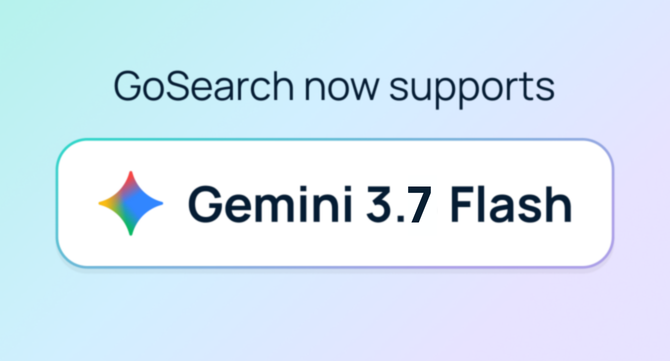

Quick answer: Yes, Gemini 3.7 Flash is live in GoSearch now. Select it from the model picker on any new or existing agent, or route individual prompts to it in AI chat. No setup, migration, or reconfiguration required.
TL;DR
- Google released Gemini 3.7 Flash just three weeks after 3.6 Flash, and it’s a real capability jump, not a minor patch.
- Big gains on coding (FrontierCode, DeepSWE), document comprehension (GDP.pdf), and multi-step workflow automation (AutomationBench).
- Launch pricing is $0.75/1M input and $3.75/1M output tokens, half of 3.6 Flash’s launch price, through the end of 2026.
- Best for coding/diagnostic agents, document-heavy Q&A, multi-step automation, and web/UI generation. Still route deep, ambiguous reasoning to Gemini 3 Pro or GPT-5.1 Thinking.
- Available now in GoSearch alongside existing OpenAI, Anthropic, and Gemini model options.
Three weeks. That’s how long Gemini 3.6 Flash lasted as Google’s newest Flash model before Gemini 3.7 Flash showed up to replace it. If you blinked, you missed the announcement window entirely, but not the model itself: it’s live in GoSearch today, ready to select on any agent, chat, or workflow, no setup required.
The fast turnaround might suggest a minor patch. It isn’t. Where 3.6 Flash was about doing the same work more cheaply, 3.7 Flash is about doing more work, better, and it happens to cost less too. Google is positioning it as the most capable Flash-tier model it has shipped, and for once the benchmarks make that case without a lot of squinting.
Reddit Users Are Surprised by Gemini 3.7 Flash
Early reactions from the GeminiAI community suggest that Gemini 3.7 Flash may be a bigger upgrade than some users expected. The original poster said they were “genuinely shocked at the jump in quality,” specifically calling out the model’s speed, sharpness, and improved ability to handle nuance. Other users echoed those impressions, highlighting faster performance, better writing, and stronger results for coding and script auditing. One user said the model had become accurate enough at finding bugs that they trusted it to implement fixes itself.
The reaction isn’t universally positive. Some commenters questioned its pricing and overall value, while others said it was too early to judge the model’s capabilities. Still, the discussion points to an important shift: users increasingly expect fast, lightweight AI models to deliver not just speed and low cost, but reasoning, writing quality, and practical performance that can compete with larger models.
Verbatim Reddit statements
“I just switched over to Gemini 3.7 Flash for some daily tasks and was genuinely shocked at the jump in quality.”
“It’s fast, sharp, and handles nuance way better than earlier iterations.”
“I noticed it’s WAY faster than the older flash models, I’m really surprised and excited for the new pro model”
“I prefer it’s writing style over 3.6 but quality/ability I can’t comment yet.”
“For my scripting usage? It’s been awesome so far.”
“it’s been much more accurate at finding bugs, enough so that I had it go ahead and implement fixes.”
The takeaway
The most interesting signal isn’t simply that users think Gemini 3.7 Flash is “better.” It’s that users are reporting improvements in the areas that matter for everyday AI adoption: speed, quality, nuance, writing, and the ability to reliably complete real work.
The numbers that matter
Google’s own comparisons put 3.7 Flash well ahead of 3.6 Flash on the tasks GoSearch customers actually run agents against:
| Area | Benchmark | 3.6 Flash | 3.7 Flash |
|---|---|---|---|
| Coding | FrontierCode 1.1 Main | 34.4% | 43.6% |
| Software engineering | DeepSWE v1.1 | 49.0% | 65.3% |
| Web development | WebDev Arena (Elo) | 1538 | 1588 |
| Document comprehension | GDP.pdf | 22.0% | 34.0% |
| Workflow automation | AutomationBench | 17.0% | 30.4% |
The document comprehension jump is the one worth sitting with if you’re running search or Q&A agents against contracts, reports, or long internal docs. Nearly doubling accuracy on a benchmark built for exactly that kind of complex document work is a bigger deal than another few points on a coding leaderboard.
Google also says the model is easier to work with day to day. It asks for clarification instead of guessing, adapts when it hits a roadblock mid-task, and puts more effort into planning before it acts. Translated out of press-release language: fewer agents that confidently do the wrong thing, fewer manual corrections.
The pricing story, explained
Here’s the part that actually changes how you’d deploy this. Gemini 3.7 Flash launches at $0.75 per million input tokens and $3.75 per million output tokens, an introductory rate that’s exactly half of what 3.6 Flash cost when it launched. It holds through the end of 2026, then steps up to $1.50 / $7.50 in January.
Practically, that means an agent that was previously too expensive to run at 3.6 Flash quality can likely run at better-than-3.6-Flash quality for less money right now. It’s a window worth using while it’s open.
How to think about model selection
GoSearch lets you assign models per agent and per prompt, so nothing here forces an all-in switch. A few starting points based on what 3.7 Flash is actually good at:
Coding, debugging, and diagnostic agents are the clearest win. This is the exact area 3.7 Flash improved the most, and it’s cheaper than what you were likely already paying.
Document-heavy research and Q&A agents, particularly anything chewing through long PDFs, contracts, or reports, should move up here too given the GDP.pdf result.
Multi-step process automation, ticket triage, status updates, structured extraction, benefits from the model’s stronger planning behavior and the AutomationBench gains.
Reserve Gemini 3 Pro or GPT-5.1 Thinking for the genuinely ambiguous stuff: strategic judgment calls, long-horizon planning where the agent has to hold a lot of context and make a real decision, not just execute steps.
Keep your lightest-weight agents on lightweight models. If a task was fine on Gemini 3.5 Flash-Lite before, 3.7 Flash’s added intelligence isn’t buying you anything there.
When you should use Gemini 3.7 Flash
3.7 Flash is the right call when an agent’s work looks like one of these:
- Coding and diagnostic tasks. Debugging, issue triage, code review, and generation workflows, where the FrontierCode and DeepSWE gains translate directly into fewer wrong fixes and less rework.
- Document-heavy Q&A and research. Agents parsing long contracts, reports, or internal knowledge bases, where the GDP.pdf improvement means fewer missed details in complex documents.
- Multi-step business automation. Ticket routing, status updates, structured data extraction, and other workflows where the agent has to plan several steps ahead and call tools reliably.
- Web and UI generation. Building or modifying internal tools, dashboards, or landing pages from a prompt, screenshot, or design reference.
- High-volume agents where cost previously forced a tradeoff. If you were running a lighter model just to keep spend down, the introductory pricing may let you upgrade quality without upgrading cost.
It’s the wrong call for agents that need genuinely deep, ambiguous reasoning, think strategic planning or judgment calls with a lot of competing context. Those still belong on Gemini 3 Pro or GPT-5.1 Thinking. And it’s overkill for simple, high-frequency lookups that were already running fine on a lighter model like Gemini 3.5 Flash-Lite.
Benefits over Gemini 3.6 Flash
The upgrade isn’t marginal. Four things stand out:
Meaningfully better coding accuracy. First-pass code correctness climbs, with FrontierCode 1.1 Main scores up nearly 10 points (43.6% vs. 34.4%) and DeepSWE v1.1 up more than 16 points (65.3% vs. 49.0%). Fewer wrong answers means less time spent reviewing and correcting agent output.
Stronger document comprehension. GDP.pdf performance more than doubles, 34.0% versus 22.0%. For search and Q&A agents working against dense or lengthy documents, that’s the difference between surfacing the right detail and missing it.
Better follow-through on multi-step work. AutomationBench performance nearly doubles, 30.4% versus 17.0%, and Google reports the model takes fewer wrong turns mid-task, asking for clarification instead of guessing. That reduces the babysitting longer-running agents typically need.
Half the cost, at launch. 3.7 Flash’s introductory pricing, $0.75/1M input tokens and $3.75/1M output tokens, is half of what 3.6 Flash cost when it launched. Better performance at lower cost is a rare combination, and it’s only guaranteed through the end of 2026, so it’s worth taking advantage of the window now.
How Gemini 3.7 Flash compares to GPT and Claude models
Google’s own launch comparisons put 3.7 Flash up against Claude Sonnet 5 and GPT-5.6 Terra, and the honest read is that no single model wins across the board. Where you land depends on the workload.
Where Gemini 3.7 Flash leads:
- Web development. Highest Code Arena Elo of the three: 1588, versus 1541 for Claude Sonnet 5 and 1523 for GPT-5.6 Terra.
- Production code quality. Tops FrontierCode 1.1 Main at 43.6%, ahead of Claude Sonnet 5 (42.7%) and GPT-5.6 Terra (41.3%).
- Enterprise workflow automation. A clear leader on AutomationBench at 30.4%, well ahead of GPT-5.6 Terra (23.6%) and Claude Sonnet 5 (10.7%).
- Document comprehension. Leads on GDP.pdf at 34.0%, versus 28.0% for Claude Sonnet 5 and 24.7% for GPT-5.6 Terra.
Where it trails:
- Long-horizon software engineering. GPT-5.6 Terra leads DeepSWE v1.1 at 69.6%, with 3.7 Flash second at 65.3% and Claude Sonnet 5 behind at 54.0%.
- Agentic computer use. GPT-5.6 Terra leads OSWorld-2.0 (50.2% vs. 3.7 Flash’s 38.1%).
- Complex multi-step agentic reasoning. Claude Sonnet 5 leads Agent’s Last Exam at 33.3%, versus 26.3% for 3.7 Flash.
- Broad knowledge-work composite. On GDPVal-AA v2, Claude Sonnet 5 (1598) and GPT-5.6 Terra (1578) both outscore 3.7 Flash (1525).
The shape of it: Gemini 3.7 Flash is strongest on coding output quality, web generation, document parsing, and business process automation, exactly the areas most GoSearch agents run in production. It’s less competitive on the hardest agentic reasoning and broad knowledge-work benchmarks, where Claude Sonnet 5 and GPT-5.6 Terra still have an edge.
On price, 3.7 Flash’s introductory rate ($0.75/$3.75 per million tokens) undercuts both. Claude Sonnet 5 and GPT-5.6 Terra are priced well above that tier, so even where 3.7 Flash isn’t the top scorer, it’s frequently the better cost-to-performance option, which is the actual decision enterprises are making when they pick a model for high-volume agent work.
The practical takeaway for GoSearch users: this isn’t a reason to abandon Claude or GPT models in your stack. It’s a reason to route the right task to the right model. Coding, document Q&A, and automation agents are strong candidates for 3.7 Flash. Agents doing deep, ambiguous reasoning or broad knowledge-work synthesis may still perform better on Claude Sonnet 5 or GPT-5.1 Thinking, worth confirming with your own tests rather than a benchmark table alone.
How to use Gemini 3.7 Flash in GoSearch
Getting an agent onto 3.7 Flash takes a few clicks, not a rebuild.
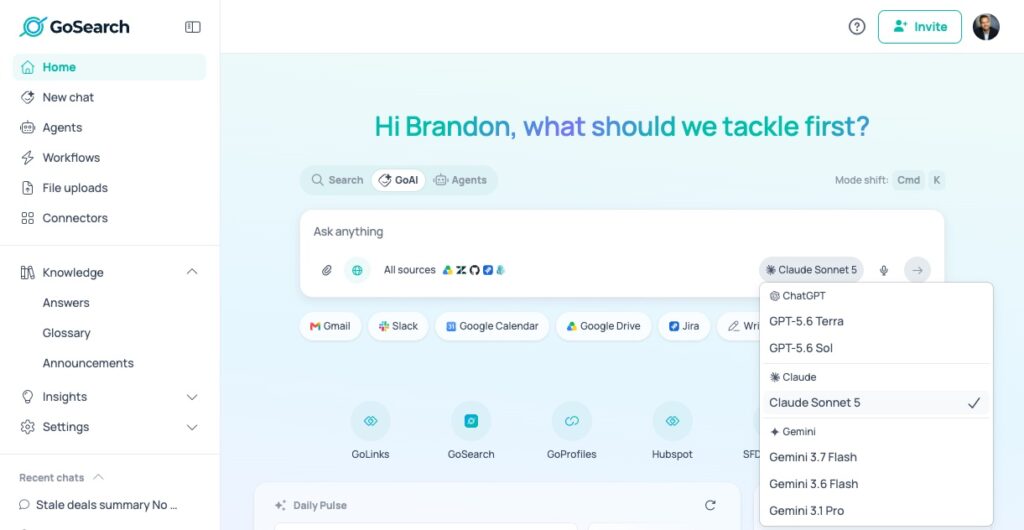
For a new agent, open the no-code agent builder and select Gemini 3.7 Flash from the model dropdown alongside the OpenAI, Anthropic, and other Gemini options. Configure the agent as normal; the model choice doesn’t change how you set instructions, connect data sources, or define tools.
For an existing agent currently running 3.6 Flash or an earlier Gemini model, go to the agent’s settings and swap the model selection. There’s no re-authentication, no reconfiguration of connected apps, and no need to rewrite prompts, though it’s worth reviewing outputs after the switch since a more capable model can behave slightly differently on edge cases.
Model selection also works at the prompt level in AI chat, so you can route an individual question to 3.7 Flash without changing your default model for everything else.
Try it before you trust it
The honest advice is the same advice we’d give for any model swap: don’t take the benchmark table’s word for it. Clone one of your busier agents, point the copy at 3.7 Flash, and run it side by side with whatever it’s currently using for a few days. Compare output quality and actual token spend, not just the headline pricing. Then decide.
Gemini 3.7 Flash is available now in GoSearch, alongside our existing OpenAI, Anthropic, and Gemini model options, for no-code agents, automated workflows, and AI chat. Sign up for free and test today!
Search across all your apps for instant AI answers with GoSearch
Schedule a demo