

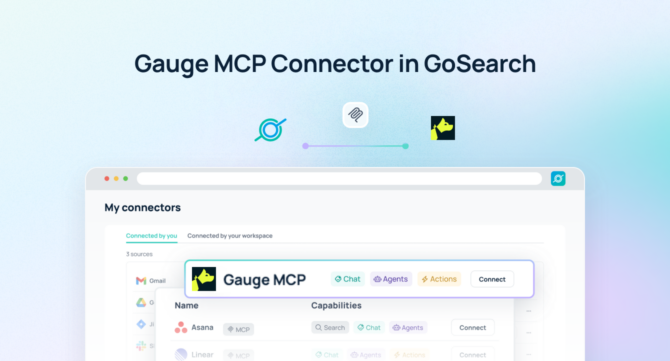

A Gauge MCP server connects AI agents to Gauge’s AI visibility, SEO, traffic, citation, prompt, and competitor data. When connected to GoSearch, marketers can use that data alongside company knowledge and other business systems to research opportunities, analyze performance, and build SEO and AEO workflows.
Quick Answer: The Gauge MCP server uses the Model Context Protocol (MCP) to give compatible AI clients access to Gauge data and tools. Gauge exposes 25 MCP tools covering AI visibility, prompts and topics, SEO and traffic, brands and competitors, and Ask Gauge. The connection uses Gauge’s MCP URL and OAuth authentication.
For marketing teams, the bigger opportunity is combining Gauge with the rest of the company’s knowledge. GoSearch can connect Gauge to the systems where your content, product information, customer insights, and internal knowledge already live.
That gives AI agents the context to answer questions like:
Which AI search topics are we losing to competitors, why are we losing them, and what content should we update?
TL;DR
- The Gauge MCP server connects AI agents to Gauge’s AI visibility and SEO intelligence.
- Gauge exposes 25 MCP tools covering AI visibility, prompts, topics, SEO, traffic, brands, pages, competitors, and Ask Gauge.
- Gauge connects through its MCP settings using an MCP URL and OAuth authentication.
- Marketers can query AI visibility, citations, prompts, competitors, organic keywords, GSC, GA4, and other Gauge data.
- SEO teams can combine traditional search performance with AI visibility to find content opportunities.
- AEO and GEO teams can analyze which prompts produce visibility, which competitors appear, and which sources AI systems cite.
- GoSearch can combine Gauge data with company knowledge and other connected systems to turn insights into broader AI workflows.
- The result is a marketing workflow that moves from data → insight → recommendation → action.
What Is a Gauge MCP Server?
The Gauge MCP server is a Model Context Protocol connection that allows AI applications to interact with Gauge.
MCP is an open standard for connecting AI models to external tools and data. Instead of manually exporting information from a platform, an MCP-enabled AI agent can call the platform directly when it needs information.
Gauge’s MCP implementation provides access to 25 tools across several areas:
- AI visibility: Visibility trends, AI performance, answers, and citations
- Topics and prompts: Topics, prompts, keywords, and answers
- SEO and traffic: Google Search Console, Google Analytics 4, organic keywords, and URL-level keyword data
- Brands and competitors: Brands, pages, domains, and competitor information
- Ask Gauge: Gauge’s AI-powered research capabilities
This makes Gauge more than a dashboard.
It becomes a source of marketing intelligence that AI agents can query as part of a larger workflow.
Why Connect Gauge to an AI Agent?
Marketing data is rarely useful in isolation.
Your AI visibility data might tell you that a competitor is appearing more often for a set of prompts. But to understand what to do about it, an AI agent may also need access to:
- Your existing blog content
- Product documentation
- Website pages
- Brand messaging
- Customer research
- Sales feedback
- Competitive intelligence
- Content calendars
- Product information
This is where the Gauge MCP server becomes particularly useful with GoSearch.
GoSearch can connect Gauge with the broader enterprise knowledge your team already uses.
Instead of asking:
How is our AI visibility?
You can ask:
Which topics are we losing visibility on, what competitors are being cited, and do we already have content that could be improved to address those gaps?
Gauge provides the performance data.
GoSearch provides the broader context.
AI connects the two.
Gauge MCP Server vs. Traditional Marketing Workflows
Without MCP, marketers often have to move information manually between tools.
A typical workflow might look like:
Gauge → export data → analyze spreadsheet → review GSC → search website → review competitors → create content brief
With the Gauge MCP server and GoSearch, the workflow can become:
Ask AI → query Gauge → search company knowledge → analyze → recommend next steps
That difference matters because the bottleneck in modern marketing is often not access to data.
It is connecting the data.
How the Gauge MCP Server Works
The Gauge MCP server exposes Gauge capabilities as tools that compatible AI clients can call.
When a user asks a question, the AI agent determines which information it needs and can call the relevant Gauge tools.
For example:
“Show me the AI prompts where our visibility dropped the most this month.”
The agent can retrieve the relevant Gauge data and summarize the results.
A more advanced question might be:
“Find the prompts where our competitors are cited but we aren’t. Then compare those topics against our existing website content and recommend five pages to update.”
Now the workflow can combine Gauge with other sources.
The Gauge MCP server provides the AI visibility and competitive data.
GoSearch can provide the company context needed to interpret that data.
Gauge MCP Server Use Cases for Marketing
1. Find AI Visibility Gaps
Marketing teams need to know where their brand appears in AI answers—and where it does not.
Ask:
“Which high-priority topics have low AI visibility for our brand?”
The agent can analyze prompts and visibility data to identify areas where your brand has an opportunity to become more visible.
Those gaps can become new priorities for:
- Content
- Product marketing
- Thought leadership
- PR
- Customer education
- Website optimization
2. Analyze Competitor Visibility
Ask:
“Where are our top competitors appearing in AI answers but we’re not?”
This helps marketing teams understand where competitors are building visibility with AI systems.
You can then ask:
“What topics have the largest competitive gap?”
Or:
“Which competitors are gaining the most visibility?”
Instead of manually reviewing competitor dashboards, marketers can investigate competitive trends through natural language.
3. Turn AI Visibility Into a Content Roadmap
AI visibility data becomes much more valuable when it leads to action.
For example:
“Identify 20 high-value prompts where we have low visibility. Group them by topic and recommend the content we should create or update.”
The agent can then use your existing company knowledge to determine whether the right response is a:
- Blog post
- Product page
- Comparison page
- FAQ
- Documentation page
- Use-case page
- Research report
4. Find Messaging Gaps
Ask:
“What questions are AI users asking about our category that our current messaging doesn’t address?”
This can help product marketing teams identify gaps between what the market wants to know and what the company currently communicates.
Gauge MCP Server Use Cases for SEO
The Gauge MCP server is also useful for traditional SEO.
Gauge exposes SEO and traffic capabilities, including Google Search Console, Google Analytics 4, organic keyword data, and URL-level keyword information.
That allows SEO teams to combine traditional search performance with AI visibility.
1. Find Pages Losing Organic Traffic
Ask:
“Which pages lost the most organic traffic over the last 90 days, and which keywords contributed to the decline?”
Instead of manually comparing reports, an AI agent can surface the pages that need attention.
2. Find SEO Pages With Low AI Visibility
One particularly useful workflow is finding pages that perform well in Google but poorly in AI answers.
Ask:
“Which pages rank well organically but have low AI visibility?”
These pages may represent an opportunity to improve content for AI search and answer engines.
3. Find AI-Visible Pages With Weak Organic Traffic
The opposite can also reveal useful opportunities.
Ask:
“Which pages are frequently cited in AI answers but receive relatively little organic traffic?”
These pages may contain valuable information that could be expanded or optimized for traditional search.
4. Prioritize Content Updates
Instead of creating content based on search volume alone, ask:
“Which existing pages should we update first based on organic traffic, keyword performance, AI visibility, and competitor visibility?”
This creates a more complete prioritization model.
Gauge MCP Server Use Cases for AEO and GEO
For teams focused on Answer Engine Optimization (AEO) and Generative Engine Optimization (GEO), the Gauge MCP server is especially useful.
AI visibility is not just about rankings.
It is about whether AI systems:
- Understand your brand
- Mention your brand
- Recommend your brand
- Cite your content
- Associate your company with the right topics
Gauge’s MCP tools provide access to AI answers and citations, along with prompt and visibility data.
1. Find Prompts Where Competitors Are Cited
Ask:
“Find our most important prompts where competitors are cited but our domain is not.”
This creates a direct list of AEO opportunities.
2. Understand Which Sources AI Systems Cite
Ask:
“Which pages and domains are being cited for our most important prompts?”
This can help your team understand what types of sources AI systems are using to answer questions in your category.
You can then investigate:
- What topics those pages cover
- How comprehensive they are
- Whether they contain original information
- How they structure answers
- What entities and concepts they connect
- Whether your existing content addresses the same questions
3. Identify Competitive Citation Gaps
Ask:
“Compare our citations against our three biggest competitors across our top AEO topics.”
Then:
“Which topics have the biggest citation gap?”
This turns competitive AEO analysis into a prioritized workflow.
4. Build an AEO Content Plan
Ask:
“Find 20 high-value prompts where we have low visibility and recommend content that could improve our coverage.”
The agent can then compare those opportunities against your existing content.
For example:
“We already have a page about enterprise AI search. How should we update it to better address the questions where competitors are currently being cited?”
That is a much more useful workflow than simply asking AI to “write an AEO blog.”
Gauge MCP Server Prompts for Marketing Teams
Here are practical prompts marketing teams can use once Gauge is connected to GoSearch.
AI Visibility
“How has our AI visibility changed over the last 30 days?”
“Which prompts gained the most visibility?”
“Which prompts lost the most visibility?”
“Which competitors are gaining visibility faster than us?”
AEO and GEO
“Find our top 20 prompts where competitors are cited but we aren’t.”
“Which sources are AI systems citing for our most important topics?”
“What topics have the biggest AI visibility gaps?”
“Which competitors are most visible for our priority topics?”
SEO
“Which pages lost the most organic traffic this quarter?”
“What keywords are driving the decline?”
“Which pages have strong organic rankings but weak AI visibility?”
“Which pages have strong AI visibility but weak organic traffic?”
Content Strategy
“Find content gaps based on our AI visibility and existing website.”
“Which existing pages should we update to improve our AI visibility?”
“Identify topics where competitors are consistently cited and we have little or no content.”
“Create a prioritized list of SEO and AEO content opportunities.”
Combining Gauge With Company Knowledge in GoSearch
The biggest opportunity is not simply asking AI questions about Gauge.
It is combining Gauge with everything else your marketing team knows.
Imagine asking:
“Analyze our AI visibility for enterprise AI search. Find the five biggest competitive gaps. Then review our existing content and product documentation and recommend which pages we should update.”
That question requires several sources of context.
Gauge provides:
- AI visibility
- Prompts
- Answers
- Citations
- Competitor data
- SEO data
- Traffic data
GoSearch provides access to:
- Company knowledge
- Product documentation
- Existing content
- Internal research
- Sales and customer context
- Other connected business systems
The AI agent can then connect those sources.
The result is a workflow that looks like:
Measure → Analyze → Research → Recommend → Create
That is where an MCP integration becomes more than another data connector.
How to Connect the Gauge MCP Server to GoSearch
Gauge provides its MCP connection through its settings.
According to Gauge, users can access the MCP integration from Settings → Integrations → MCP, retrieve the MCP URL, add it to a compatible AI client, and complete the OAuth authentication flow.
GoSearch supports custom MCP connectors, allowing organizations to connect MCP servers using a server URL and, when required, OAuth credentials. Once connected, MCP tools can be used alongside GoSearch’s federated search capabilities.
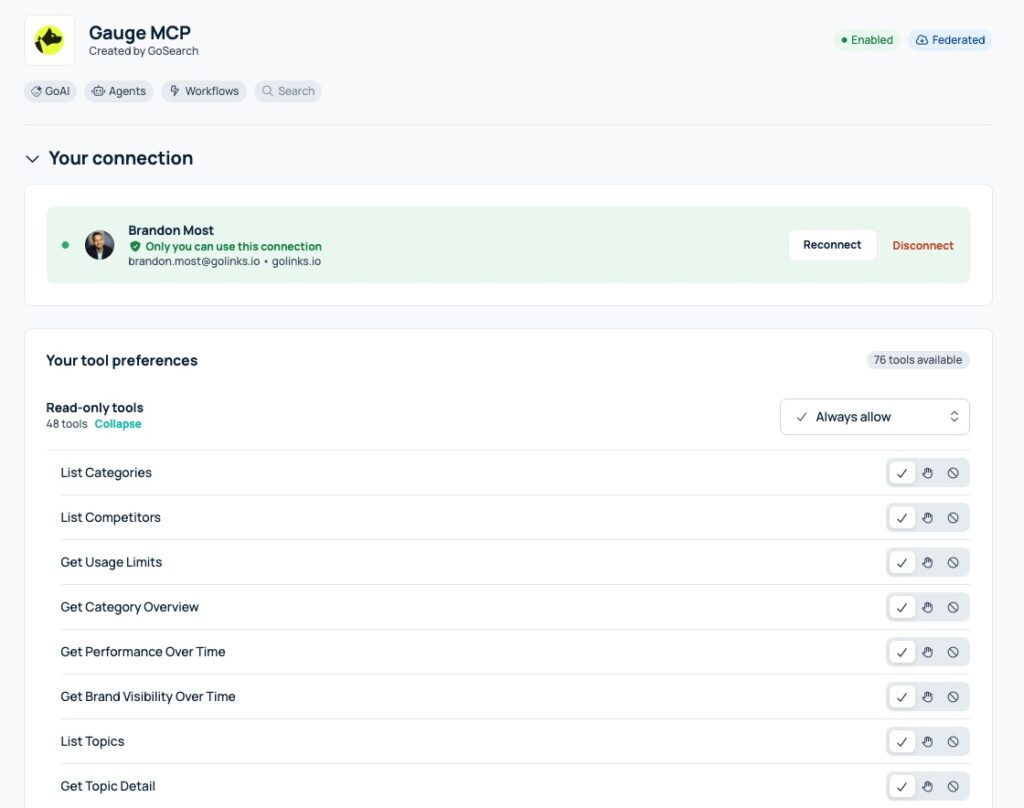
The basic workflow is:
1. Get the Gauge MCP URL
Open Gauge and navigate to its MCP integration settings.
2. Add the MCP connection to GoSearch
Add the Gauge MCP server as a custom MCP connector in GoSearch.
3. Authenticate
Complete the required OAuth authentication flow.
4. Start querying Gauge through GoSearch
Once connected, Gauge’s MCP tools become available to GoSearch agents and workflows.
Your marketing team can then query Gauge alongside the other knowledge and systems connected to GoSearch.
Why Use GoSearch With the Gauge MCP Server?
Gauge provides valuable intelligence about how your company performs across search and AI.
GoSearch adds the context around that intelligence.
That distinction matters.
A Gauge dashboard might tell you:
Competitor X is cited more often than us for “enterprise AI search.”
GoSearch can help answer:
Why?
And then:
What content do we already have about enterprise AI search?
And:
What does our product documentation say?
And:
What customer use cases support our positioning?
And finally:
Create an outline for the page we should publish.
This is the difference between AI-powered analytics and AI-powered marketing workflows.
Who Should Use the Gauge MCP Server?
SEO Teams
Use Gauge MCP to analyze organic performance, keywords, pages, GSC, GA4, and AI visibility in one workflow.
AEO and GEO Teams
Track AI visibility, prompts, answers, citations, and competitors to understand how your brand appears in AI search.
Content Teams
Turn search and AI visibility gaps into prioritized content briefs and updates.
Product Marketing Teams
Identify messaging gaps and understand the questions buyers are asking across search and AI.
Demand Generation Teams
Use competitive and AI visibility data to identify topics and categories where your company has an opportunity to build authority.
Marketing Operations
Connect Gauge with other marketing and business systems to automate recurring research and reporting.
Gauge MCP Server: From Visibility Data to Marketing Action
The Gauge MCP server gives AI agents access to the data marketers need to understand search and AI visibility.
For SEO teams, that means easier access to organic performance, keywords, pages, GSC, and GA4.
For AEO and GEO teams, it means access to AI visibility, prompts, answers, citations, and competitor intelligence.
For marketing teams, it creates a new way to turn those insights into content and strategy.
And when Gauge is connected to GoSearch, those insights can be combined with the company’s broader knowledge.
That means your AI agent doesn’t just know what is happening.
It can understand why it is happening, what your company already knows, what content exists, and what you should do next.
Gauge measures how your brand shows up across search and AI. GoSearch helps your team turn that intelligence into action.
Search across all your apps for instant AI answers with GoSearch
Schedule a demo
Gauge MCP Server FAQs
What is a Gauge MCP server?
A Gauge MCP server connects compatible AI applications to Gauge through the Model Context Protocol. It gives AI agents access to Gauge tools and data covering AI visibility, prompts, citations, SEO, traffic, competitors, and more.
What does the Gauge MCP server provide?
Gauge provides 25 MCP tools covering AI visibility, topics and prompts, SEO and traffic, brands and competitors, and Ask Gauge.
How do you connect to the Gauge MCP server?
Gauge provides its MCP URL through Settings → Integrations → MCP. Users can add the URL to a compatible AI client and complete OAuth authentication.
Can the Gauge MCP server be used for SEO?
Yes. Gauge’s MCP tools provide access to SEO and traffic data, including GSC, GA4, organic keywords, and URL-level keyword information.
Can the Gauge MCP server be used for AEO?
Yes. Gauge provides AI visibility, prompt, answer, and citation data that can help teams analyze how their brand appears in AI-generated answers.
What is Ask Gauge?
Ask Gauge is Gauge’s AI research capability, and it is also exposed through the MCP connection. This allows compatible AI clients to use Gauge’s research capabilities as part of an AI workflow.
Why connect Gauge to GoSearch?
Connecting Gauge to GoSearch lets AI agents combine Gauge’s AI visibility and SEO data with broader company knowledge. That makes it possible to move from analyzing marketing data to researching opportunities, creating recommendations, and executing workflows.