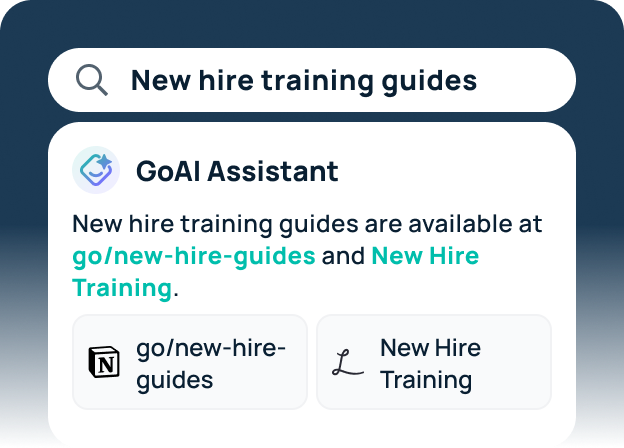



Quick answer: An enterprise context layer is the infrastructure that makes AI agents understand your company. It collects data from your CRM, communication tools, project management systems, and knowledge bases, organizes it with permissions built in, and surfaces it to agents in real time.
Every conversation about AI agents starts with the same promise: “Your AI will understand your company, know who can see what, and act on real-time data.” But most AI implementations fail on the execution. The agent hallucinates. It returns stale information. It bypasses permissions. Or teams spend 6 months building infrastructure instead of shipping agents in weeks.
The missing piece is an enterprise context layer.
This isn’t search. This isn’t a vector database. An enterprise context layer is the hidden infrastructure that separates toy AI demos from production agentic systems that your team actually trusts and uses.
What Is an Enterprise Context Layer?
An enterprise context layer is the infrastructure that makes an AI agent understand your company. Without one, an agent knows only what the public internet knows; with one, it knows your organization — and it sees only what each user is permitted to see.
Think of the difference between ChatGPT (trained on public internet data) and an agent that knows your customer’s deal history, your team’s org structure, your project status, and your compliance rules. An enterprise context layer closes that gap: it connects a general-purpose AI model to your company’s private, permissioned data.
Here’s a concrete example: A sales rep asks her AI assistant, “Who should I call today?” Without a context layer, ChatGPT guesses. With one, the agent accesses your CRM, your activity log, your win/loss patterns, and returns something like: “Call Acme (3x follow-up, budget approved, 2-day decision window).” Real context. Real answer.
Or a support agent asks, “Similar issues to this ticket?” Without a context layer, the model might hallucinate something plausible. With one, it queries your ticket history, finds three similar cases, and says: “Similar issue resolved in 24 hours by escalating to Engineering—link here.” Actual patterns. Actual solutions.
The timing matters. Agentic AI is moving from experimental to production. Teams are done with single-agent demos and want workflows where agents make decisions, take actions, and hand off to humans. But those workflows require data infrastructure, not just prompts.
The Real Cost of Not Having an Enterprise Context Layer
Most enterprises have two of the three pieces. They have search, so employees can browse for information. They have AI models like ChatGPT or Claude. What they’re missing is the bridge between them — the layer that feeds company data to those models with permissions intact. That missing bridge shows up as five costs.
The time cost is massive. McKinsey found that knowledge workers spend nearly 20 percent of the workweek — roughly a full day — looking for internal information or tracking down colleagues who can help with specific tasks. Every workflow that depends on manually assembled context pays that tax.
The compute cost scales with every agent. Agent tasks already consume 10-100x more tokens than a chat exchange, and imprecise context is the biggest driver of that waste. Token efficiency — how much useful output an agent produces per token — is set by the retrieval layer feeding it, not the model behind it.
The accuracy cost is silent. When AI agents don’t have context, they hallucinate. They return outdated information. They make recommendations without knowing your org structure or permission boundaries. Employees learn they can’t trust the answers — and once that trust is gone, adoption doesn’t recover.
The security cost is a leak waiting to happen. A generic search index bolted to an AI model doesn’t know who should see what. Without query-time permissions enforcement, that setup surfaces sensitive data for anyone who asks.
The speed-to-value cost is measured in quarters. Teams that consider building this themselves are looking at 2-4 engineers and 6-12 months of ETL pipelines, permission logic, monitoring, and maintenance. By the time it’s done, priorities have shifted and the integration is brittle.
What Actually Belongs in a Production Enterprise Context Layer
Not everything. You’re not building a data lake or replacing your data warehouse. You’re building the surface area for AI agents.
Federated connectors are non-negotiable. Your data lives in 50+ places: Salesforce, Slack, Jira, GitHub, Google Drive, ServiceNow, Notion, your data warehouse, internal wikis. An enterprise context layer has to query all of them in parallel and merge results on the fly. Federated, not siloed. Siloed search (index Salesforce separately, index Slack separately) creates staleness and gaps.
Query-time permissions enforcement is the difference between a tool and a liability. Not index-time (slow, brittle, breaks when org changes). Query-time. Every time an agent requests data, the system verifies: “Can this user see this?” before returning it. This works with SSO systems, dynamic roles, and real-time attribute changes.
Structured data extraction because AI agents need fields, not just documents. Customer name, deal stage, contract end date, owner, risk level. A context layer transforms unstructured content (emails, Slack threads, documents) into queryable fields via parsing, metadata extraction, and LLM-powered enrichment.
Read/write connectors because agentic workflows aren’t just about reading. Agents need to “Update the deal status to Won,” “Mark the task as complete,” “Create a Slack thread with this outcome.” Most search tools are read-only. Context layers are read/write.
Monitoring and audit trails because compliance teams will ask. Who accessed what, when, and why? A production context layer logs all queries and actions for audit, debugging, and security investigation.
Real-time or near-real-time sync. If your context layer is stale (updated daily or weekly), your agents will act on outdated information. Minutes-level staleness is acceptable. Hours is not.
Enterprise Context Layer vs. Enterprise Search: Different Problems
| Aspect | Search | Enterprise Context Layer |
|---|---|---|
| Primary Use | People finding information | Agents making decisions |
| Query Driver | Keywords | AI reasoning + business logic |
| Output Format | Ranked documents | Structured data + metadata + permissions |
| Freshness | Hours or days acceptable | Seconds or minutes |
| Integration | Content indexing | Read/write connectors, workflows |
You can have both. Enterprise search helps employees browse and discover. An enterprise context layer helps agents act with accuracy and governance. In fact, an enterprise context layer includes search as its retrieval foundation and extends it — adding permissions, structure, and read/write connectors that agents can act on. Search is the floor; agents are the ceiling.
The mistake most organizations make: building a better search tool and calling it a context layer. Better search is useful. A context layer is different. It’s built for machine reasoning, not human browsing. Different architecture, different requirements, different ROI.
Why This Matters for Your Four Biggest Use Cases
Here’s what an enterprise context layer changes for the four teams that feel the gap most:
Sales teams. Without a context layer, “who should I prioritize?” means manually checking the CRM, recent emails, Slack threads, and deal history — 30-45 minutes a day of context assembly instead of selling. With one, an agent pulls the current pipeline, recent activity, win/loss patterns, and quota status in seconds, and the deal context is reliable and current.
Support teams. Without a context layer, the same rep answers the same customer question five days apart because there’s no quick way to see ticket history and resolution patterns — customers get frustrated and team morale sinks. With one, an agent instantly surfaces ticket history, similar issues, and how they were resolved, so answers arrive in seconds instead of another round of searching.
Product teams. Without a context layer, “how many support tickets mention Feature X? When did we ship it? Who owns it?” means hours of manual searching across Jira, Slack, the wiki, and email. With one, a single agent query returns the related Jira stories, linked Slack threads, ship date, and current owner in seconds.
Finance and compliance. Without a context layer, “who accessed customer PII in Q4?” kicks off a weeks-long investigation because there’s no audit log. With one, every query is logged with user identity, timestamp, and data accessed — the answer takes minutes.
The Real Comparison: DIY vs. Buy
Every team scoping an enterprise context layer hits this decision. Here’s what each path actually looks like:
The DIY Path (6-12 Months)
Building it yourself means constructing ETL pipelines to extract from your CRM, email, project management tools, and wikis; normalizing schemas; indexing everything; writing custom permission logic; setting up monitoring — and then maintaining all of it as source systems change.
Cost: 2-4 FTE engineers, dedicated infrastructure spend, plus ongoing maintenance headcount.
Timeline: 6-12 months to a production-ready integration layer — and that’s the narrow scope. A full custom enterprise search build runs 12-24 months including development, testing, and deployment.
Reality: DIY attempts tend to end up siloed — one team builds a context layer for search, another for the CRM, another for Slack, and none of them talk to each other. The result is multiple fragmented “context layers” and a growing maintenance burden.
The Buy Path (12-16 Weeks)
Buying means deploying a purpose-built enterprise context layer platform — prebuilt connectors, query-time permissions, and audit logging out of the box — and configuring it for your stack.
Cost: Platform subscription plus part-time configuration work. No dedicated infrastructure team, no ETL pipelines to maintain.
Timeline: 12-16 weeks to production following the phased rollout below, with core connectors live in days.
Reality: The platform absorbs connector and permission maintenance as your source systems change, so the layer doesn’t go brittle the way DIY builds do. Your engineers build agents, not plumbing.
What To Look for in a Context Layer Platform
Connectivity matters more than connector count. Vendors will tell you they support 100+ apps. What matters is: Does Jira integration take 10 minutes or 2 weeks? Does it support real-time sync or batch-only? Can you build custom connectors easily?
Look for standard formats (MCP, REST, GraphQL webhooks) rather than proprietary SDK requirements. Standard formats mean you’re not locked in.
Permissions should be query-time, not index-time. Index-time enforcement (baking permissions into the index) is slow and breaks when org changes. Query-time enforcement (checking permissions for every request) is the production approach.
Can it handle role-based access control (RBAC), attribute-based access control (ABAC), and field-level permissions? Does it work with your SSO provider (Okta, Azure AD, Google Workspace)?
Performance is non-negotiable. Can it query multiple sources in parallel and return results in under 2 seconds? Does it support full-text search, semantic search (vector embeddings), and structured field queries?
Read/write capability separates enterprise context layers from search tools. Can it execute actions (create Slack messages, update CRM, assign tasks) in addition to retrieval? This matters for true agentic workflows.
Governance and audit. Can compliance teams pull reports on who accessed what? Are queries logged with user identity, timestamp, and data accessed? Is data encrypted in transit and at rest?
Context Layer vs. RAG, Vector Databases, and Knowledge Graphs (What’s Actually Different?)
This gets confusing because related concepts have overlapping names.
RAG (Retrieval-Augmented Generation) is a technique. You retrieve documents, embed them in a prompt, send them to an LLM. Useful pattern. But it’s not a context layer—it’s how you use one.
Vector databases (Pinecone, Weaviate, Milvus) are great for semantic search: “Find documents similar to this query in meaning.” Powerful for unstructured content. But they’re limited for agentic workflows because they don’t enforce permissions, don’t handle structured data well, are append-only (not read/write), and don’t connect to multiple sources.
Knowledge graphs model relationships between entities. Great for discovering connections. But they focus on structure, not on getting the right data to an agent fast with permissions enforced.
In a production setup, you might use all three. A vector database inside your context layer for semantic search. A knowledge graph inside your context layer for relationship discovery. But the enterprise context layer is the encompassing infrastructure.
Common Mistakes (And How to Avoid Them)
Mistake 1: Indexing everything. Every email, every Slack message, every document version. This creates noise, staleness, and performance problems.
Better: Index high-value data (CRM records, active projects, recent decisions). For historical data, provide direct connectors for keyword search without indexing everything.
Mistake 2: Batch sync only. Daily batch updates mean 12-24 hour staleness. Agents can’t rely on this.
Better: Real-time or near-real-time sync via webhooks, streaming, or <5 minute latency.
Mistake 3: Naive permission implementation. “Admins see everything, regular users see public.” Reality is more complex: Sales rep A sees deals owned by her team plus deals explicitly shared with her. Engineer B sees code she wrote plus open-source repos. Finance sees budgets, headcount, and actual spend.
Better: Query-time permissions enforcement that works with your SSO provider and supports dynamic rules.
Mistake 4: Making it a central source of truth. The context layer becomes a bottleneck. When underlying systems change, you’re stuck.
Better: Context layer is a view layer that federates to your source systems, not a central database. Better freshness, less operational overhead.
Mistake 5: Building agents before the context layer is solid. Teams spin up AI agents (GPT-4 + prompt) before their data infrastructure is production-ready. Result: hallucinations, stale answers, employees who don’t trust the system.
Better: Build the enterprise context layer first (connectors, permissions, monitoring). Then layer AI agents on top.
The ROI Case
Time savings: McKinsey found knowledge workers spend nearly 20 percent of the workweek looking for internal information. An enterprise context layer that cuts even half of that search time frees up hundreds of hours per employee per year.
Sales productivity: Reps who query the context layer instead of manually assembling deal context save 30+ minutes per deal. At 20 deals per month, that’s 10+ hours per month per rep back on selling — with current context instead of stale notes.
Support efficiency: Instant access to ticket history and similar-issue patterns compounds across every ticket. Model N’s global support team saw a 47% increase in productivity after deploying GoSearch as its knowledge layer.
Engineering velocity: Product teams with instant cross-system answers ship faster because questions that took hours of manual searching resolve in seconds.
Compliance and risk: Audit trails turn investigations that took weeks into queries that take minutes. Permissions enforcement prevents data breaches.
The Implementation Path (12-16 Weeks)
Weeks 1-2: Audit which data sources employees search across most. Identify permission requirements. Define success metrics (latency, freshness, accuracy, audit coverage).
Weeks 3-6: Deploy or integrate a platform. Connect 3-5 core sources (CRM, communication, project management, wiki, identity). Set up query-time permissions.
Weeks 7-10: Add 5-10 secondary sources. Build custom connectors if needed. Implement real-time sync. Set up monitoring and audit logging.
Weeks 11-12: Connect the enterprise context layer to your AI agent platform. Test end-to-end workflows.
Weeks 13-16: Pilot with a team. Gather feedback. Optimize freshness and permission rules. Scale to the broader organization.
Agentic AI Starts with an Enterprise Context Layer
An enterprise context layer is the foundation for agentic AI that actually works: it gets agents your company’s data, policies, and org structure without hallucination or security violations. It is not a replacement for search or a vector database — it is the infrastructure that makes agentic workflows possible at scale.
If you’re building agentic AI, start with the context layer. Everything else — the agents, the workflows, the value — is built on top of it.
GoSearch: The Enterprise Context Layer Built for Agentic AI
GoSearch is the enterprise context layer built for agentic AI. It connects to 100+ enterprise systems including Salesforce, Slack, Jira, Google Drive, ServiceNow, and Notion, then makes that data available to AI agents with permissions enforced at query time, not baked into a stale index.
Search is the floor. Agents are the ceiling. GoSearch starts with fast, accurate enterprise search that every employee can use on day one, no technical training required. On top of that foundation, GoSearch adds agentic workflows: agents that don’t just retrieve information but take action, updating records, completing tasks, and triggering workflows across your stack.
What separates GoSearch from a typical search tool:
- Fast enterprise integration. Most core connectors are live in minutes, not weeks. Teams get from signup to a working deployment in days.
- Permissions-aware retrieval. Every query checks what a user can see in real time. No stale permission snapshots, no data leak risk when org structures change.
- Read/write MCP connectors. GoSearch agents can write back to your systems, not just read from them. Update a deal stage, close a ticket, post to Slack, all from a single agent query.
- Responsive support. Implementation teams get direct access to a support team that actually responds, not a ticket queue.
Want to see how this works in practice? Get a demo of GoSearch or explore how read/write MCP connectors enable production agentic workflows.
Search across all your apps for instant AI answers with GoSearch
Schedule a demo