


Quick answer: Token efficiency is how much useful output an AI agent produces per token it consumes. A token-efficient system retrieves the exact information an agent needs, in the fewest tokens possible, without sacrificing accuracy — and retrieval quality, not model choice, is what determines it.
Analysis of production workloads shows agentic tasks consume 10 to 100 times more tokens than a single chat exchange—code review agents burn roughly 50,000 tokens per review, multi-agent research pipelines run 500,000 per report. A precise, permission-aware enterprise search layer cuts that consumption, reduces latency, and lowers cost for every agent and workflow. Enterprise search is the floor; agents are the ceiling: agents can only be as efficient as the context layer feeding them.
What Is Token Efficiency?
Token efficiency is the ratio of useful signal to total tokens an AI system consumes. A high-efficiency system retrieves the three paragraphs that answer a question. A low-efficiency system retrieves five full documents and asks the model to find the answer buried inside them.
Every AI agent action costs tokens. Every tool call, every document retrieved, every step in a multi-step workflow adds to a context window that has to be read, processed, and paid for.
No one notices the waste in a single query. But at enterprise scale—across thousands of employees running agentic workflows daily—it compounds into a real cost and performance problem. Precise retrieval—pulling only the relevant chunks rather than full documents—can cut token usage by 60-80% in production RAG deployments. Poorly tuned retrieval runs the equation in reverse: fetching more chunks than needed, say ten instead of two, can inflate input tokens by three to four times.
Why Token Efficiency Is an Enterprise Search Problem, Not a Model Problem
Most conversations about AI cost focus on model choice: which LLM is cheapest per token, which one is fastest. That misses where the waste actually happens.
Agents don’t fail or run slow because the model is weak. They fail because the retrieval feeding them is imprecise. When an agent’s search layer returns loosely relevant chunks instead of exact answers, the model has to:
- Read more irrelevant context to find the useful part
- Make follow-up tool calls to fill in gaps
- Sometimes hallucinate when the right context never surfaces at all
Each of these adds tokens. None of them add value. In production RAG pipelines, retrieval overhead alone can push average query cost to four to six times that of a direct question—before agent self-correction even enters the picture. When an agent’s output fails validation and it retries with the full conversation history resent as context, a few correction cycles can burn many times the tokens of one clean pass. The enterprise context layer—the system connecting agents to a company’s actual knowledge and tools—determines token efficiency more than model selection does.
How Agentic Workflows Multiply Token Inefficiency
A bloated context window is cheap in a chatbot query. In a multi-step agentic workflow, it’s expensive.
Agentic workflows chain retrieval, reasoning, and action across several steps—find the policy, check the approval chain, draft the response, notify the requester. Imprecise retrieval at step one doesn’t stay contained: it carries into every downstream step, often re-retrieved multiple times as the agent tries to self-correct.
Enterprise search sits underneath every serious agent deployment for a practical reason: an agent’s reasoning can only match the token efficiency, accuracy, and speed of the layer that feeds it context in the first place.
This is also why falling token prices haven’t translated into falling AI bills for most enterprises. Blended per-token pricing has dropped significantly over the past year, but total spend keeps rising for many organizations because workflow volume and per-task token consumption are growing faster than price per token is falling. The lever that actually controls the bill is token efficiency — how much unnecessary context an agent processes per task — not which model sits behind it.
What a Token-Efficient Retrieval Layer Looks Like
A token-efficient retrieval layer has four characteristics:
- Precise, ranked retrieval that returns the specific passage or answer, not the whole source document
- Permission-aware indexing so agents don’t retrieve — and don’t pay tokens to filter out — content a user or agent shouldn’t see
- Native connectors across the tools where enterprise knowledge actually lives, so agents aren’t burning tool calls hunting across disconnected systems
- Structured, agent-ready outputs instead of raw unstructured dumps that force the model to do extra parsing work
How GoSearch Cuts Token Waste in Agentic Workflows
GoSearch is built to solve exactly this problem. Rather than functioning as a standalone search box, it works as the enterprise context layer underneath agents and automated workflows—connected to a company’s tools, documents, and systems.
Retrieval approach determines token impact:
| Retrieval Approach | Typical Result | Token Impact |
|---|---|---|
| Broad keyword search across all sources | Long list of loosely related documents | High: model reads excess context to find the answer |
| Unstructured RAG over a general vector store | Chunked text without permission or freshness awareness | Medium-high: extra filtering and re-retrieval steps |
| GoSearch enterprise context layer | Precise, permission-aware answer with source, in one pass | Low: fewer follow-up calls, less wasted context |
Three things drive that difference. GoSearch connects natively to the systems where enterprise knowledge already lives, so agents aren’t burning tool calls hunting across disconnected sources. It enforces permissions at the retrieval layer, so agents never fetch content they’d have to filter back out. And it’s fast to stand up across an organization’s existing tool stack—a context layer that takes months to connect delays every token saving it was supposed to deliver.
Every one of the industry patterns above — over-fetching, unfiltered retrieval, retry loops triggered by bad context — gets worse the more tools an agent has to search across separately and the less precise each individual retrieval is. A context layer built to return the right answer in one pass, from every connected source, is the direct lever against all three.
Enterprise search is easy to underestimate because it looks like the least visible part of an AI stack. In practice, enterprise search decides whether every agent and workflow built on top of it runs with high token efficiency or wastes tokens correcting for what it should have found the first time.
Scoping an agent deployment? See what this looks like against your own tools and document sources — get a GoSearch demo.
Search across all your apps for instant AI answers with GoSearch
Schedule a demo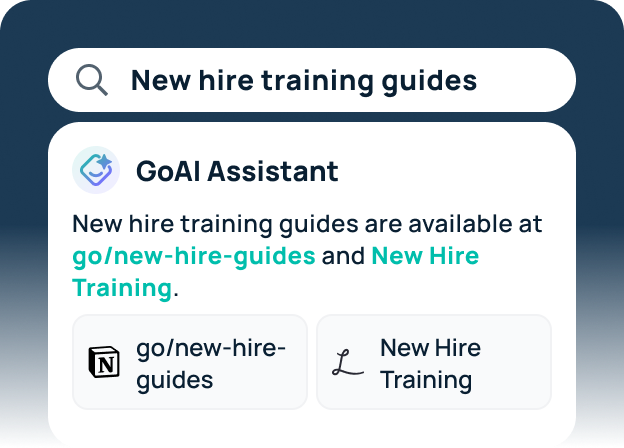
FAQ: Token Efficiency, Enterprise Search, and AI Agents
Token efficiency is how well an AI agent converts the tokens it consumes into useful output. High token efficiency means an agent retrieves and reasons over only the context it actually needs.
Latency was once the main constraint on application performance; in agentic AI systems, token consumption now plays that role. Every unnecessary token an agent processes adds both processing time and cost, so token efficiency governs how fast a workflow completes and what it costs to run — the way raw latency once governed how usable an application felt.
Agents rely on retrieval to get context before they reason or act. If enterprise search returns imprecise or irrelevant results, agents burn extra tokens filtering, re-querying, or working around bad context, which slows workflows and raises cost.
Enterprise search finds information. An enterprise context layer goes further by connecting that information to agents and automated workflows with permissions, structure, and connectors built in. Search is the foundation; the context layer is what agents run on.
Yes. Agentic tasks consume 10 to 100 times more tokens than a single chat exchange — roughly 50,000 tokens for a code review agent to 500,000 for a multi-agent research pipeline in production workloads. Precise retrieval that fetches only relevant chunks instead of full documents can cut token usage by 60 to 80 percent, while over-fetching can inflate costs 3 to 4 times. At enterprise scale, across every employee and every workflow run daily, that difference compounds directly into AI spend.
GoSearch retrieves precise, permission-aware answers directly from connected enterprise systems, reducing the extra tool calls and re-retrieval steps that agents typically need when working with broader, less precise search layers.