


If you’re budgeting for Microsoft Copilot, the add-on price tells you only part of the story. Most Copilot plans require a qualifying Microsoft 365 license. Your real per-user cost depends on the Copilot tier and the base license you already own — and, if you’re buying at scale, on discounts Microsoft is rolling out this fall.
Based on the prices in this guide:
- Microsoft Copilot Free: $0.
- Copilot Pro: $20 per user per month for individual use.
- Microsoft 365 Copilot Business: $21 per user per month with an annual commitment, or $25.20 per user per month with monthly billing. Microsoft currently discounts this to $18 per user per month through December 31, 2026.
- Microsoft 365 Copilot Enterprise: $30 per user per month with an annual commitment.
- Copilot Studio: starts at $200 per month per tenant for 25,000 messages.
- New bundled SKUs: combine a base license and Copilot Business for less than buying them separately.
- Reported enterprise volume discounts: 30% for 1,000–9,999 seats and 50% for 10,000+ seats, starting as early as October 2026.
For organizations that need Microsoft 365 Copilot Business, the combined license and Copilot cost runs $32 to $43 per user per month, depending on whether you buy a bundle or stack licenses separately. For Microsoft 365 Copilot Enterprise, the combined cost runs $69 to $90 per user per month before implementation, training, and administration costs — or significantly less if your organization qualifies for the reported volume discounts.
Confirm current pricing, licensing eligibility, and contract terms with Microsoft before you make a purchasing decision. Microsoft changed several of these figures in the past three months, and more changes are coming in October.
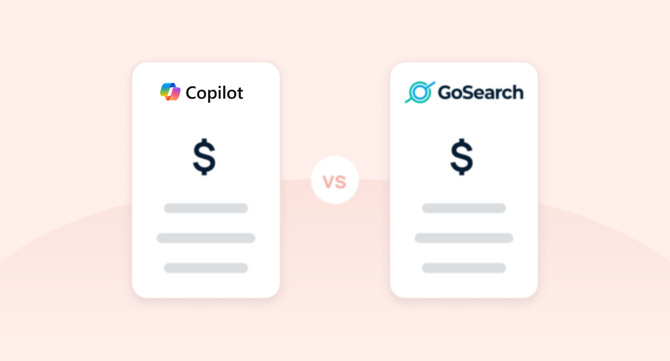
This guide covers every Microsoft Copilot pricing tier, the base license requirements that affect your real budget, the discounts Microsoft is rolling out now, where Copilot has limitations for non-Microsoft tool stacks, and how GoSearch compares on price and capability.
What Is Microsoft Copilot?
Microsoft Copilot is a family of AI products, not one plan. Different Copilot products target different users, applications, and licensing environments.
For business and enterprise buyers, Microsoft 365 Copilot is the product you’ll evaluate most often. It assists with work in:
- Word
- Excel
- PowerPoint
- Outlook
- Teams
- SharePoint
Microsoft 365 Copilot uses Microsoft Graph to ground responses in organizational data the user can already access. Your experience depends on your Microsoft 365 license, your Copilot plan, your administrator’s configuration, and your organization’s data and permissions setup.
Most buyers make one mistake: they compare only the Copilot add-on price. A complete estimate needs to account for:
- The Copilot product you’re buying.
- The required Microsoft 365 base license.
- Whether you need to upgrade existing licenses.
- Your number of assigned users, and whether that number qualifies for a volume discount.
- Annual versus monthly billing.
- Implementation, governance, training, and adoption costs.
Microsoft Copilot pricing at a glance
| Product | Intended user | Copilot price | Base license required | Estimated combined cost |
|---|---|---|---|---|
| Microsoft Copilot Free | Individual consumers, basic chat users | $0 | None | $0 |
| Copilot Pro | Individuals on M365 Personal or Family | $20/user/month | M365 Personal or Family | $20/user/month plus the subscription |
| Microsoft 365 Copilot Business | Small and midsize business users, up to 300 seats | $21/user/month annual ($18 promo through Dec 31, 2026); $25.20/user/month monthly | Qualifying M365 business license | $32–$43/user/month, using the examples below |
| Microsoft 365 Copilot Enterprise | Enterprise users | $30/user/month annual | Qualifying enterprise license, such as E3 or E5 | $69–$90/user/month before volume discounts |
| Copilot Studio | Organizations building custom agents | Starts at $200/month per tenant | Separate purchase | Tenant-level cost plus usage charges |
These combined-cost figures don’t include implementation, training, support, change management, taxes, regional adjustments, or the volume discounts covered below.
Microsoft Copilot Pricing Tiers (2026)
Microsoft Copilot Free pricing
Microsoft Copilot Free gives basic conversational access at no cost. Don’t treat it as equivalent to Microsoft 365 Copilot for business use — it skips organizational data grounding, M365 app integration, and admin controls entirely.
Price: $0
Best for: Individuals evaluating basic Copilot chat capabilities.
Don’t use this price for: Enterprise budgeting, M365 application deployment, or multi-user administration.
Copilot Pro (Individual)
Copilot Pro serves individuals who already hold a qualifying Microsoft 365 Personal or Family subscription. It brings Copilot into supported Microsoft applications for personal use.
Price: $20 per user per month
Additional requirement: A Microsoft 365 Personal or Family subscription.
Keep Copilot Pro separate from Microsoft 365 Copilot Business and Enterprise in your analysis. The individual subscription doesn’t substitute for an organization-managed deployment with enterprise administration and centralized governance.
Microsoft 365 Copilot Business pricing
Microsoft 365 Copilot Business serves organizations with up to 300 seats on a qualifying Microsoft 365 business plan.
Copilot price:
- $21 per user per month with an annual commitment (standard rate).
- $18 per user per month promotional rate through December 31, 2026, for existing M365 customers.
- $25.20 per user per month with monthly billing.
Microsoft cut this rate from $30 per user per month on December 1, 2025, then added the further promotional discount in mid-2026. Confirm your eligibility and the current rate with Microsoft before purchasing.
Example qualifying base licenses (current pricing):
- Microsoft 365 Business Standard: $14 per user per month.
- Microsoft 365 Business Premium: $22 per user per month.
Illustrative combined cost, stacking licenses separately:
- Business Standard plus Copilot: $14 + $21 = $35 per user per month.
- Business Premium plus Copilot: $22 + $21 = $43 per user per month.
Or buy the bundle instead. Microsoft now sells pre-bundled SKUs that beat stacking a base license and Copilot separately:
- Business Standard + Copilot bundle: $23.50 per user per month — saves $11.50 versus stacking.
- Business Premium + Copilot bundle: $32 per user per month — saves $11 versus stacking.
- Business Basic + Copilot bundle: $27 per user per month.
If you haven’t purchased Microsoft 365 yet, ask about the bundle before you add Copilot as a separate line item.
Microsoft 365 Copilot Enterprise
Microsoft 365 Copilot Enterprise serves organizations on qualifying enterprise Microsoft 365 plans, with no seat cap.
Copilot price: $30 per user per month with an annual commitment.
Example qualifying base licenses (current pricing, effective July 1, 2026):
- Microsoft 365 E3: $39 per user per month.
- Microsoft 365 E5: $60 per user per month.
Illustrative combined cost:
- Microsoft 365 E3 plus Copilot: $39 + $30 = $69 per user per month.
- Microsoft 365 E5 plus Copilot: $60 + $30 = $90 per user per month.
Microsoft raised both base license prices on July 1, 2026 — E3 by 8.3% and E5 by 5.3% — and removed Enterprise Agreement volume discounts in November 2025. For large enterprises on standard terms, total cost went up this year, not down.
But if you’re buying at volume, that may be about to change. According to reporting from The Information (via Benzinga and other outlets, September 22–23, 2026), Microsoft has told its sales team it will authorize discounts of 30% for customers committing to 1,000–9,999 seats and 50% for 10,000+ seats. This reportedly takes effect as early as October 2026 and expands an existing 30% discount that already applied to 1,000–9,999 seat purchases through September 30, 2026. The discounts reportedly pair with a shift toward usage-based billing on certain features inside a revamped Copilot app. Microsoft hasn’t published these specific terms yet, so verify them directly before you budget against them.
Enterprise buyers should also budget for identity configuration, data governance, user provisioning, adoption programs, training, and ongoing administration.
New: bundled SKUs and the E7 Frontier Suite
Microsoft added several new SKUs alongside the July 2026 price changes:
- Business Basic + Copilot: $27/user/month.
- Business Standard + Copilot: $23.50/user/month.
- Business Premium + Copilot: $32/user/month.
- Microsoft 365 E7 Frontier Suite: $99/user/month, bundling E5, Copilot, Agent 365, and Entra Suite into one SKU.
The Frontier Suite targets organizations that want AI, productivity, and security licensing in a single purchase rather than three separate line items.
Copilot Studio
Copilot Studio is a separate Microsoft product for building and managing custom AI agents. Don’t assume it comes included with every Microsoft 365 Copilot license.
Starting price: $200 per month per tenant, for 25,000 messages.
Before you estimate total cost, confirm:
- Whether your intended scenario requires Copilot Studio.
- Whether pricing is tenant-based, usage-based, or both.
- Which users or agents the plan covers.
- Whether additional message, session, connector, or capacity charges apply.
- Whether you need separate development, testing, and production environments.
Model Microsoft 365 Copilot seats and Copilot Studio costs as separate line items for a reliable estimate.
Microsoft Copilot cost for 100 users
For a 100-user organization on the Microsoft 365 E3 example, the combined annual cost runs approximately $82,800 — up from last year’s roughly $79,200, due to the July 2026 E3 price increase. That’s before implementation and adoption expenses, and before any volume discount you might qualify for.
| Scenario | Base license | Copilot add-on | Combined monthly cost per user | 100-user monthly cost | 100-user annual cost |
|---|---|---|---|---|---|
| SMB: Business Standard (bundle) | — | — | $23.50 | $2,350 | $28,200 |
| SMB: Business Standard (stacked) | $14 | $21 | $35 | $3,500 | $42,000 |
| SMB: Business Premium (bundle) | — | — | $32 | $3,200 | $38,400 |
| Enterprise: Microsoft 365 E3 | $39 | $30 | $69 | $6,900 | $82,800 |
| Enterprise: Microsoft 365 E5 | $60 | $30 | $90 | $9,000 | $108,000 |
These figures exclude implementation, governance, training, support, taxes, and negotiated discounts. A 100-seat deployment likely won’t qualify for the reported 1,000+ seat volume discounts — those apply at much larger scale.
How to calculate your Microsoft Copilot budget
Follow these steps to estimate your first-year subscription cost.
Step 1: Count intended Microsoft Copilot users
Separate users by role instead of assigning licenses to everyone automatically. Start with teams that have clear use cases and an adoption plan.
Step 2: Identify each user’s current Microsoft 365 license
Record whether users have Business Standard, Business Premium, E3, E5, a legacy Office 365 plan, or no qualifying license at all.
Step 3: Confirm eligibility, including for volume discounts
Verify that each base license qualifies for the Copilot product you want. If you’re committing to 1,000 or more seats, ask Microsoft directly whether you qualify for the reported 30% or 50% discount, and get the terms in writing.
Step 4: Calculate the subscription cost
Annual subscription cost equals the number of users, times the sum of monthly base license and monthly Copilot add-on, times 12 months. Then subtract any confirmed volume discount.
Step 5: Add non-license costs
Include implementation, data governance, training, user support, administration, security review, and any usage-based charges tied to the reported billing shift.
Step 6: Model adoption scenarios
Build at least three scenarios: a small pilot with defined use cases, a targeted rollout for high-value departments, and a broad deployment across most eligible employees. A staged rollout helps you measure value before committing to a large license count — especially now that larger commitments carry bigger discounts but also bigger risk if adoption lags.
What Microsoft Copilot Does Well
Microsoft Copilot performs best when employees already work primarily inside Microsoft 365 and the relevant information lives in Microsoft applications.
Common use cases include:
- Summarizing long email threads in Outlook.
- Preparing meeting recaps from Teams conversations.
- Drafting first versions in Word and PowerPoint.
- Analyzing spreadsheet data in Excel with natural-language questions.
- Finding relevant SharePoint or OneDrive content.
- Helping users prepare for meetings and follow up on decisions.
The strongest fit is a Microsoft-first organization, where Teams, Outlook, SharePoint, Word, Excel, and PowerPoint anchor daily work.
The business case gets harder when employees depend equally on non-Microsoft tools. In that situation, evaluate how much critical knowledge Copilot can actually access without custom configuration, then weigh that against the full license stack cost.
Where Microsoft Copilot Has Limitations
It performs best inside the Microsoft ecosystem
Microsoft Copilot centers its native experience on Microsoft 365 applications and Microsoft Graph. If your organization relies heavily on Slack, Jira, Confluence, GitHub, Salesforce, Notion, or Google Drive, verify how those systems connect and how permissions map.
A connector gives you access to a system, but that doesn’t guarantee complete coverage. Check:
- Which objects the connector indexes.
- How quickly changes appear.
- Whether attachments and comments come through.
- How the connector maps permissions.
- Whether it supports write actions.
- Who owns connector maintenance.
Third-party connectors often need extra configuration
Third-party connectors can require IT configuration, identity mapping, permissions testing, and ongoing maintenance. A connector that supports Jira Cloud, for example, may not cover Jira Server or Jira Data Center. Test the actual applications and permission groups that matter to your organization before you buy.
It mainly assists users inside their own work surfaces
Copilot excels at individual tasks like drafting, summarizing, and analyzing content inside supported apps. That’s different from an enterprise-wide workflow, where an agent needs to pull context from several systems, reason over it, and take action across them.
Compare these two tasks:
- Assistive task: Summarize a Teams meeting.
- Cross-system workflow: Find the meeting decision, check the related Jira issue, review the latest Slack discussion, draft a project update, and open a follow-up task.
The second task needs broader integration, permissions, and action capabilities than a Microsoft 365 assistant alone provides.
License ownership doesn’t guarantee adoption
A Copilot license is an input cost, not an outcome. Track activated users, weekly and monthly active users, use by department, and time saved. Let pilot results guide the size and scope of your broader deployment — a discipline that matters more, not less, if a volume discount tempts you into a larger seat commitment before you’ve proven adoption.
Questions to ask before buying Microsoft Copilot
- Which exact Microsoft 365 base licenses qualify for the plan we want?
- Do our current licenses need an upgrade?
- Does our seat count qualify for the reported 30% or 50% volume discount, and can Microsoft confirm the terms in writing?
- If a volume discount applies, which features shift to usage-based billing, and at what rates?
- Is the quoted Copilot price annual-commitment pricing or month-to-month?
- Should we buy a bundled SKU or stack a base license and Copilot separately?
- What features come included in the quoted Copilot plan?
- How are third-party connectors priced and maintained?
- What implementation and administration work does our IT team need to plan for?
- What audit, compliance, and data-residency controls apply?
- What happens to Copilot-created content when a user leaves the organization?
- What are the renewal terms and price-adjustment provisions?
GoSearch Pricing at a Glance
GoSearch offers three plans, and none require a prerequisite license stack.
| Plan | Price | Best For |
|---|---|---|
| Free | $0 | Small teams evaluating agentic search |
| Pro | $20/user/month | Growing teams that need cross-tool search across their full stack |
| Enterprise | Custom | Organizations with advanced security, compliance, and scale requirements |
At the Pro tier, a 100-seat team pays $2,000/month. The equivalent M365 E3 + Copilot Enterprise stack costs $6,900/month for the same 100 seats. That gap compounds significantly at enterprise scale, even before you account for Copilot Studio or implementation costs.
Microsoft Copilot vs. GoSearch
Microsoft Copilot and GoSearch solve overlapping but different problems. Microsoft Copilot works as an AI productivity layer for Microsoft 365 applications. GoSearch searches and reasons across a broader enterprise stack, including systems outside a single productivity suite.
| Evaluation area | Microsoft 365 Copilot | GoSearch |
|---|---|---|
| Primary use case | AI assistance inside Microsoft 365 | Enterprise search, AI agents, and cross-system workflows |
| Base license | Qualifying Microsoft 365 license generally required | No Microsoft 365 prerequisite |
| Microsoft 365 coverage | Strong | Strong; Supported as part of a broader connected stack |
| Non-Microsoft coverage | Depends on connectors and configuration | Strong; Designed for connected enterprise applications |
| Search model | Grounded in Microsoft Graph and connected sources | Federated search across connected sources |
| Workflow actions | Strongest within Microsoft’s ecosystem | Built for multi-system search and action |
| Pricing model | Add-on plus base license, plus reported volume discounts at 1,000+ seats | Flat per-seat |
| Best fit | Microsoft-first organizations | Organizations with knowledge spread across multiple systems |
Pricing verification note: Microsoft’s licensing, eligibility, and billing terms change frequently — most recently on July 1, 2026, with further volume-discount changes reportedly coming in October 2026. The figures in this article reflect data as of October 2026. Verify current terms against Microsoft’s official pricing pages before you purchase.
If your goal is to draft an email in Outlook or summarize a Teams meeting, Microsoft Copilot may serve you more directly. If your goal is to answer questions across Jira, Slack, GitHub, Salesforce, Google Drive, and Microsoft 365, then act on the answer, evaluate a platform built for that broader environment.
Example: comparing a 100-user deployment
Suppose your 100-user organization compares Microsoft 365 Copilot Enterprise with a cross-system enterprise search platform.
For the Microsoft 365 E3 example:
- Microsoft 365 E3: $39 per user per month.
- Microsoft 365 Copilot Enterprise: $30 per user per month.
- Combined subscription estimate: $69 per user per month.
- 100-user monthly estimate: $6,900.
- 100-user annual estimate: $82,800.
A fair comparison uses the same assumptions for both platforms: the same number of licensed users, comparable security and compliance requirements, the same required data sources, and the same contract period. Don’t compare a Copilot add-on price against an alternative platform’s total price — compare the full cost of achieving your intended outcome.
Why You Should Look at GoSearch
GoSearch solves the problem Copilot doesn’t fully address: most enterprise knowledge doesn’t live in Microsoft.
Engineering, product, and sales teams keep critical context in Jira, GitHub, Slack, Confluence, Google Drive, Salesforce, and other tools. GoSearch connects to all of them through an MCP-native architecture that maintains real-time, permissions-aware indexing across your full stack.
One search bar for everything
GoSearch doesn’t require you to standardize on a single vendor. Whether you run Google Workspace, Slack, Jira, Confluence, or a hybrid of Microsoft and non-Microsoft tools, GoSearch indexes across all of them. Employees search once and get results from everywhere.
Agentic, not just assistive
GoSearch doesn’t just layer a productivity assistant onto your existing apps. It reasons across systems, surfaces context, connects signals, and takes action across tools from a single prompt. That’s the difference between “summarize this document” and “show me what the team decided on the Acme integration and open a Jira ticket to follow up.”
Permissions-aware retrieval across every tool
GoSearch surfaces only content each user can already access, across every connected system — not just within one vendor’s permissions model. Engineers don’t see HR docs. Sales reps don’t see source code.
Security built for enterprise requirements
GoSearch holds SOC 2 Type II certification, runs with zero data retention, and uses a hybrid architecture that keeps sensitive data where it belongs. For IT and security teams with strict compliance requirements, this counts as a prerequisite, not a feature.
Connectors that work out of the box
GoSearch sets up connectors faster than most alternatives, and the support team responds quickly instead of routing you through a slow ticket queue. Organizations report faster time-to-value because the connector experience skips months of IT overhead.
No prerequisite license stack, and no volume threshold for fair pricing
Microsoft Copilot Enterprise costs $30/user/month on top of an E3 or E5 license you may need to upgrade into first — and the deepest discounts reportedly go only to organizations committing to 1,000 or more seats. GoSearch charges the same flat per-seat rate whether you’re onboarding 10 people or 10,000. Your investment goes directly into the search platform, and the value applies across every tool your team already uses.
Final verdict
Microsoft Copilot works well for organizations whose employees primarily work in Teams, Outlook, Word, Excel, PowerPoint, and SharePoint.
The key budgeting point: the Copilot add-on rarely represents your full price, and that price is shifting fast in 2026. Based on the examples in this guide:
- Microsoft 365 Copilot Business plus a qualifying business license runs $32–$43 per user per month, depending on whether you buy the bundle.
- Microsoft 365 Copilot Enterprise plus E3 or E5 runs $69–$90 per user per month before any volume discount.
- Organizations committing to 1,000+ seats may see 30–50% lower seat prices starting in October 2026, paired with new usage-based charges on some features.
Microsoft Copilot may serve you less directly if your critical knowledge and workflows span Slack, Jira, GitHub, Confluence, Salesforce, Google Drive, Notion, or other non-Microsoft systems. In that environment, compare the complete Microsoft licensing stack and connector effort against a platform built to work across your full environment.
Search across all your apps for instant AI answers with GoSearch
Schedule a demo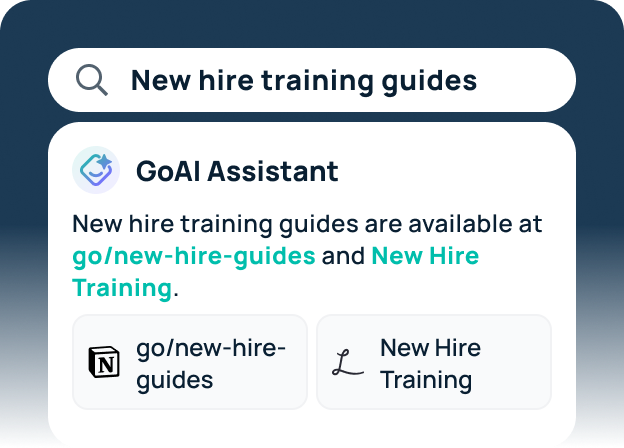
Frequently Asked Questions About Microsoft Copilot Pricing
The add-on costs $21/user/month for Business or $30/user/month for Enterprise. Each user also needs a qualifying M365 base license. All-in costs typically run $32 to $90/user/month, depending on your base license and whether you buy a bundle. Volume buyers may pay significantly less starting in October 2026.
The Business tier is available month-to-month at $25.20/user/month. The Enterprise tier requires an annual commitment at $30/user/month.
Not natively. Copilot’s data grounding covers M365 services through Microsoft Graph. Third-party connectors exist for some tools, but Jira Server and Data Center aren’t supported, and each connector needs IT setup.
GoSearch offers a Free plan, a Pro plan at $20/user/month, and an Enterprise plan. No Microsoft or Google base license is required. Learn more at gosearch.ai/sales.
Teams running mixed stacks that span Google, Slack, Jira, and Salesforce alongside Microsoft tools get one search layer instead of several. Engineering and product organizations that need cross-system context get it without custom connector work. Organizations that already piloted Copilot and found adoption plateauing, because employees can’t find information outside M365, get a platform built for that gap.
Yes, in two ways. Business-tier customers with 300 seats or fewer pay $18/user/month through December 31, 2026, down from $21. Enterprise buyers committing to 1,000 or more seats may see discounts of 30% to 50% starting as early as October 2026, according to reporting from The Information — though Microsoft hasn’t confirmed these terms on its own pricing pages yet.