


Cowork is one answer to a specific problem: you have files, a goal, and no time for prompting every step to get from one to the other. It is not the only answer. ChatGPT Work does the same job differently, and tools like Cursor, Gemini Agent, and Notion Agent each make a different bet on where that work should happen.
This guide covers what Claude Cowork actually does, when to reach for it, how it stacks up against ChatGPT Work and other alternatives, and where it fits alongside a company-wide platform like GoSearch.
Quick answer: Claude Cowork is Anthropic’s agentic system for multi-step knowledge work. It takes a goal, works across files and folders, and returns a finished document, spreadsheet, or report. It’s best for repetitive, multi-step tasks like organizing files or turning scattered notes into a report.
The closest general-purpose alternative is ChatGPT Work. Other alternatives include Microsoft Copilot Cowork, which is built into Microsoft 365; OpenWork and OpenClaw, which offer more open and customizable agent experiences; Perplexity Computer, which focuses on cloud-based research and end-to-end projects; and Cursor, which is designed primarily for coding.
Claude Cowork vs. GoSearch: Cowork is centered on an individual’s files and desktop environment, while GoSearch agents and workflows work across shared, permission-aware company apps. GoSearch can combine real-time context from multiple workplace systems to complete tasks grounded in company knowledge.
What Is Claude Cowork?
Claude Cowork is an Anthropic-built system that carries out multi-step knowledge work on a user’s behalf, covering things like research synthesis, document preparation, and file management. Anthropic built it after noticing that non-technical teams, like marketing and support, were bypassing Claude’s chat interface for Claude Code because Code could handle complex, multi-step work that a single prompt could not. Cowork brings that same underlying agent architecture to roles whose primary function isn’t coding.
Give Cowork a goal instead of a prompt, and it plans its own steps, works across the files and applications you grant it access to, and returns a deliverable instead of a reply. Anthropic says the tool is aimed at work that is demanding but repeatable, and that tedious tasks people tend to skip, like combing through a folder of feedback, actually get done because Cowork does the combing.
Anthropic points to four common workflows for the tool:
- Organizing local files. Point it at a messy folder of drafts, downloads, and attachments and ask it to sort, rename, or deduplicate.
- Preparing documents from source files. Hand off a set of notes, transcripts, or exports and it produces a structured first draft.
- Synthesizing research. Give it a question and a set of sources, and it returns a summary ready for review.
- Extracting data from unstructured files. It reads contracts, reports, or records and returns the relevant information in a structured format.
According to Anthropic’s Cowork setup guide, Cowork can only read and write files in the folders and connectors you explicitly grant. Sessions run in an isolated environment separate from your own computer and network, and permission settings let you require Claude to show its plan and wait for approval before anything significant happens.
When Should You Use Claude Cowork?
Cowork is built for the tasks that sit between “too tedious to do by hand” and “too straightforward to justify a developer.” Anthropic pitches it toward researchers, analysts, operations teams, legal professionals, and finance teams: roles who handle documents, data, and files every day and would rather spend their time on judgment calls than on assembly work.
In practice, that means reaching for Cowork when:
- The task spans multiple files or sources and would otherwise mean manual copy-paste between them.
- The output is a deliverable (a report, a deck outline, a cleaned spreadsheet), not an answer to a single question.
- The work is repetitive enough that you have skipped doing it properly before.
- You want to hand off the task and check back later rather than direct every step.
Reach for standard Claude chat instead when the task is a single question, a quick draft, or something you want to think through interactively. Cowork is not built for that mode, and using it for simple asks just adds friction.
How Does Claude Cowork Compare to ChatGPT Work?
OpenAI’s answer to Cowork is ChatGPT Work, which launched on GPT-5.6 a few months after Cowork’s general release. Both take an outcome instead of a prompt, work independently for extended periods, and hand back finished files. The difference shows up in where each one operates and what it can touch.
| Claude Cowork | ChatGPT Work | |
|---|---|---|
| Where it runs | Desktop app natively, with web and mobile in beta | Cloud-native, rolling out across desktop, web, and mobile |
| Local file access | Reads and writes files in folders you grant on your own machine | Primarily works through connected cloud apps, not local folders |
| Connector approach | Anthropic-vetted MCP connectors, plus Microsoft 365 read/write | Larger third-party connector catalog reported at launch |
| Features | Plugins built on Claude Skills, scheduled recurring tasks, mid-task steering | Built-in image generation, Sites for publishing live shareable outputs |
| Plan requirement | Requires a paid Claude plan | Available on desktop across all plans, including free |
Where Claude Cowork wins:
Cowork’s advantage is depth in your own environment. Because it works directly in local folders and files, it fits workflows where the source material already lives on your computer, a shared drive, or Microsoft 365, and where you want the same agent to keep working in place rather than uploading files into a separate cloud sandbox.
Where ChatGPT Work wins:
If your team’s work already lives entirely in connected cloud apps rather than local files, ChatGPT Work’s larger connector catalog and native image generation can mean less setup. Teams that need to publish a live, shareable output also get a feature Cowork does not currently offer: Sites. Neither tool is universally better. The right pick depends on whether your work lives on premise, in the cloud, or, more often, in both.
What Are Other Claude Cowork Alternatives?
ChatGPT Work is one of the closest general-purpose alternatives to Claude Cowork, but several other tools take a similar agentic approach with a different focus:
- Microsoft Copilot Cowork. Built into Microsoft 365, Copilot Cowork can handle multi-step tasks across Outlook, Teams, Word, Excel, PowerPoint, and other Microsoft services. It is a natural alternative for organizations already standardized on Microsoft 365.
- OpenClaw. An open-source AI agent that can run on your own hardware and connect to messaging apps, browsers, files, APIs, and other tools. It is a better fit for technical users who want more control and customization than a managed desktop assistant.
- OpenWork. An open-source desktop agent designed as an alternative to Cowork. It gives users more control over the models and tools their agent uses while keeping the desktop-based workflow that makes Cowork useful.
- Perplexity Computer. A cloud-based agent designed to handle larger, research-heavy projects and return finished outputs. It is a good alternative when the goal is less about working with local files and more about delegating an end-to-end project.
- Cursor. An AI-native code editor with agents, subagents, and MCP support. It is a better fit than Cowork for developers whose work primarily lives in a codebase rather than documents and spreadsheets.
The biggest difference between these tools is where the agent gets its context and where it operates. Cowork and OpenWork focus on work from a user’s desktop, Copilot Cowork is deeply embedded in Microsoft 365, Cursor is built around codebases, and OpenClaw gives technical users more control over their own agent environment.
GoSearch takes a different approach. Instead of centering the agent on one person’s desktop, it gives agents access to shared, permission-aware context across the systems your company already uses. Search, GoAI, agents, and workflows can work across connected apps and company knowledge.
That makes GoSearch a better fit when the work needs to be grounded in company-wide information, rather than files or data that primarily belong to one person. A GoSearch agent can, for example, pull context from multiple workplace systems and turn it into a finished document or other output.
Cowork still makes sense for personal, one-off tasks where the files and context live primarily on an individual’s machine. But if the goal is to give a team access to agents that can work from shared company knowledge, a company-wide platform like GoSearch is a better fit.
Can You Use Claude Cowork Alongside GoSearch?
Yes. GoSearch already has its own agentic layer: GoSearch agents can take action directly inside connected apps, like creating a ticket, updating a record, or posting a summary in Slack, and GoSearch workflows run multi-step automations on a schedule or trigger without a person prompting each step. For company-facing tasks grounded in shared systems, GoSearch alone often covers the job without needing Cowork.
Where the two differ is scope and surface. Cowork operates on an individual’s desktop: the local files, folders, and drafts sitting on their own machine, and it is built to turn that messy personal source material into a polished document, spreadsheet, or deck. GoSearch operates across a company’s connected SaaS stack, unifying and acting on 100-plus apps like Slack, Notion, Salesforce, and Jira, and its agents and workflows are built once and shared across a team rather than tied to a single person’s session. For a full platform comparison, see GoSearch vs. Claude Enterprise.
GoSearch’s MCP server can be added as a connector inside Claude, so a Cowork session pulls real-time, verified company context, a policy from Notion, a deal history from Salesforce, a support pattern from Zendesk, directly into whatever document it is producing on a person’s desktop, instead of that person manually tracking the information down first. Because GoSearch is multi-LLM, the same connector setup works whether the AI doing the work is Claude, ChatGPT, Gemini, or a GoSearch-built agent, so the context layer does not lock a company into one vendor’s roadmap.
GoSearch handles the always-on, company-wide search, agents, and workflows that touch shared business systems, including document work grounded in that shared data. Cowork is what an individual reaches for when the job is local and personal, optionally enriched with the company context GoSearch supplies.
Getting Started
If your team’s knowledge is scattered across dozens of tools and you want that context available to Cowork, Claude chat, GoSearch agents, or any other AI your employees use, connecting GoSearch is the faster way to get there than manually assembling folders for every task.
See how GoSearch connects your company’s knowledge to the AI tools your team already uses. Get a demo to learn more.
Search across all your apps for instant AI answers with GoSearch
Schedule a demo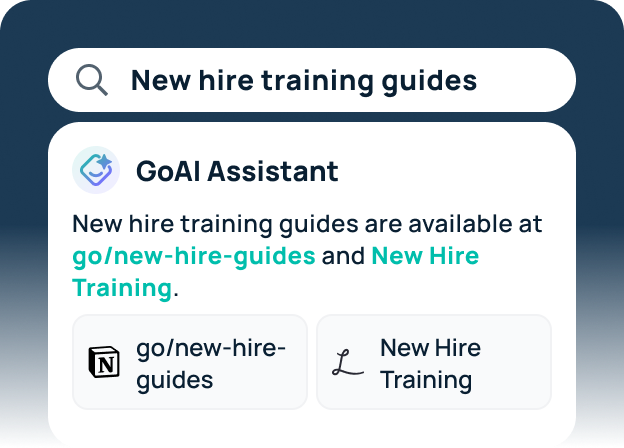
Frequently Asked Questions
Claude Cowork is available on all paid Claude plans through the Claude desktop app, with web and mobile access rolling out in beta. It is not limited to a single subscription tier the way it was at its initial research preview launch, so most paying Claude users can access it today.
No, though they share the same underlying agent architecture. Claude Code is built for software engineering: writing, debugging, and shipping code. Claude Cowork applies that same multi-step, plan-and-execute approach to non-technical knowledge work, like organizing files, drafting reports, and synthesizing research, with no coding background required.
Not necessarily. The two overlap in what they promise but differ in where they operate. Cowork has an edge for tasks rooted in local files and Microsoft 365. ChatGPT Work has an edge for teams already centered on cloud-connected apps. Many teams end up using both, matching each tool to where the relevant work already lives.
ChatGPT Work is the closest direct competitor. Beyond that, Microsoft Copilot Cowork is built into Microsoft 365 and licensed from the same underlying technology as Claude Cowork, OpenWork and OpenClaw are open-source and self-hosted, Perplexity Computer routes tasks across multiple AI models for research and end-to-end projects, and Cursor fits developer-heavy work. Teams that need company-facing document work grounded in shared data may not need Cowork at all, since a platform like GoSearch can already do that with its own agents.
No. Cowork can only read and write files in the folders and connectors you grant it, and actions like deletion require approval. It has no visibility into systems, drives, or apps outside what you have explicitly connected for that session.
GoSearch already runs its own agents and workflows that take action across connected apps, so it does not depend on Cowork to get work done. The two complement each other because GoSearch’s MCP connector can feed real-time company context, like CRM records or wiki pages, straight into a Cowork session, and because GoSearch’s automation extends to other AI models Cowork does not touch.