


Copilot is useful inside Microsoft 365 — but most enterprises run mixed stacks. Here’s how GoSearch, ChatGPT Enterprise, and Claude Enterprise stack up as alternatives that work across your entire tech stack.
In this article
- Why enterprises are looking beyond Copilot
- Best 4 alternatives ranked and reviewed
- Head-to-head comparison table
- Ecosystem alignment guide
- Frequently asked questions
Microsoft 365 Copilot had a rough 2025. Despite Microsoft’s ambitions, only about 15 million of 450 million M365 subscribers purchased Copilot licenses — a 3.3% conversion rate — and Gartner found just 6% of pilot customers moved to broader deployment. The reason isn’t that Copilot is bad. It’s that Copilot is an assistant for individuals working inside Microsoft apps, not a platform for enterprise knowledge and workflow automation across mixed stacks.
But deployment alone doesn’t guarantee impact. Across enterprise buying conversations, a recurring theme emerged: availability ≠ adoption. Many organizations reported that even after licensing Copilot, sustained usage lagged because employees weren’t sure when to use it, where it fit into daily workflows, or how to connect it to existing processes.
Another pattern emerged: teams increasingly viewed embedded AI features as incremental productivity tools rather than strategic operating layers. Buyers weren’t necessarily replacing Copilot — they were looking for platforms that could centralize knowledge, reduce context switching, and deliver measurable workflow adoption across the business.
If your organization runs Salesforce, Slack, Jira, Google Workspace, Confluence, or any combination of non-Microsoft tools, you’ve likely felt the ceiling. This guide ranks the four strongest Microsoft Copilot alternatives for enterprise teams in 2026, based on search and action capability, ecosystem breadth, security posture, and total cost of ownership.
Best 4 Microsoft Copilot alternatives
GoSearch — Agentic Enterprise AI Search
Best for: mixed-stack enterprises
www.gosearch.ai · Free, Pro, Enterprise plans · SOC 2 Type II certified
GoSearch is purpose-built for the problem Copilot was never designed to solve: unified AI search and action across an entire enterprise tech stack. Where Copilot indexes your Microsoft data, GoSearch connects 100+ integrations — the full Microsoft ecosystem, Slack, Jira, Confluence, Salesforce, ServiceNow, Google Workspace, Notion, GitHub, and more — through a hybrid federated and indexed architecture that keeps sensitive data in place while returning permission-aware answers.
Many teams evaluating Copilot alternatives discovered the challenge wasn’t Microsoft itself — it was ecosystem fragmentation. Work rarely lives in one place. Engineering works in Jira and GitHub, GTM teams operate in Salesforce and SharePoint, HR lives in knowledge systems, and employees expect one place to search and act. Buyers often outgrow point-of-ecosystem intelligence and move toward a unified layer that works across systems instead of inside a single application suite.
The GoAI assistant returns direct, cited answers in natural language. Native MCP connectors, no-code AI workflows for multi-step automation, and built-in GoLinks short-link functionality make it the strongest end-to-end AI operating layer for teams that need more than document summarization. Deployment is fast — typically days rather than months — and the support team is consistently rated among the best in the category on G2 and Capterra.
Strengths
- Core enterprise search and AI assistant platform
- 100+ native connectors, federated + indexed hybrid
- Agentic workflows — search to action in one surface
- GraphRAG + NaiveRAG for deep contextual answers
- Embedded directly in Microsoft Teams
- LLM agnostic; access to Gemini, ChatGPT, and Anthropic models – all included. No usage limits or token costs.
- SOC 2 Type II, RBAC, SCIM, SSO — enterprise-grade security
- Fast deployment; highly responsive support team
- Transparent, scalable pricing — no hidden connector fees
- Full visibility into search behavior, AI adoption, and workflow patterns with real-time usage insights
- Built for single users, teams, departments – from SBM, MM to large enterprises
- Chrome extension and sidebar – access GoSearch from anywhere and any browser
Considerations
- Cloud-based — on-premise not currently available
- Security-focused teams who are interested in more federated and MCP connectors and servers
- Best value for teams with 35+ users
ChatGPT Enterprise — OpenAI
Best for: productivity + content generation
www.openai.com · $30/user/mo · SOC 2 Type II · Data not used for training
ChatGPT Enterprise gives organizations GPT-4o access with no usage caps, enterprise-grade data privacy, custom GPTs, and an admin console for usage analytics. It excels at individual productivity tasks — drafting, summarizing, coding, data analysis — and its code interpreter and DALL-E integration expand its utility beyond text. The custom GPT builder lets teams create purpose-built assistants for specific workflows without engineering resources.
Its primary limitation as a Copilot alternative is the same challenge Copilot faces: it’s an assistant layer rather than a connected knowledge platform. Without native connectors to your enterprise tools, it can’t retrieve live data from Salesforce, Jira, or your internal wikis without custom API work. It’s best positioned for knowledge workers who need a powerful general AI assistant, not teams who need connected enterprise search.
Strengths
- Strongest general reasoning and generation capability
- Custom GPTs for purpose-built assistants
- No usage caps on GPT-4o
- Data privacy — not used for model training
- Broad adoption reduces change management
Considerations
- Connectors to enterprise tools require development resources
- Cannot retrieve live internal data without custom integration
- Not a search platform — answers from chat, not indexed knowledge
- Custom GPT governance can be complex at scale
Claude Enterprise — Anthropic
Best for: compliance-sensitive industries
www.anthropic.com · Custom enterprise pricing · HIPAA-eligible · 200k context window
Claude Enterprise brings Anthropic’s safety-focused AI to the enterprise with a 200,000-token context window, making it uniquely suited for analyzing large contracts, technical documentation, or regulatory filings in a single pass. Its constitutional AI approach results in responses that are measurably more reliable and on-policy, which matters in regulated industries like finance, healthcare, and legal.
Claude Enterprise includes native connectors to Google Drive, GitHub, Confluence, and a growing list of enterprise tools via its Projects feature. Audit logs, SSO, admin controls, and HIPAA eligibility round out the enterprise feature set. Like ChatGPT Enterprise, it’s primarily an AI assistant rather than a connected search platform — teams that need to surface knowledge from 50+ tools will hit limits without supplementing with a dedicated search layer.
Strengths
- 200k context window
- Constitutional AI: reliable, on-policy responses
- HIPAA-eligible for regulated industries
- Strong performance on long-document analysis
- Native GitHub and Google Drive connectors
Considerations
- Connector library is narrower than GoSearch
- Not a knowledge search platform by design
- Pricing not publicly listed — requires sales engagement
- Newer enterprise feature set vs. OpenAI
Perplexity Enterprise Pro — AI Research + Answer Engine
Best for: research-heavy teams and executive knowledge work
www.perplexity.ai · ~$40/user/mo (Enterprise Pro) · SOC 2 · Enterprise data protections
Perplexity Enterprise Pro approaches enterprise AI from a different angle than Microsoft Copilot. Rather than acting as a productivity layer inside Microsoft apps or a connected enterprise search platform, it functions as an AI-native answer engine optimized for research, synthesis, and fast information retrieval across public web sources and connected enterprise content.
Its biggest advantage is speed to insight. Users can ask complex questions in natural language and receive cited responses that combine web research, uploaded documents, and connected enterprise data into a single answer. Enterprise features include admin controls, SSO, data privacy protections, usage analytics, and connectors to common knowledge systems.
For organizations trying to reduce time spent gathering information — market research, competitive intelligence, strategic planning, executive briefings, and internal knowledge discovery. Perplexity can become a strong daily workflow tool.
Where it differs from platforms like GoSearch is orchestration depth. Perplexity is designed primarily to help teams find and synthesize information, not trigger actions across systems or serve as an enterprise workflow layer.
Strengths
- Excellent web + internal knowledge synthesis with citations
- Fast answer generation for research and executive workflows
- Strong user experience and minimal onboarding friction
- Enterprise admin controls, SSO, and privacy protections
- Effective for competitive intelligence and market analysis
Considerations
- Fewer enterprise connectors than dedicated enterprise search platforms
- Limited workflow automation and action-taking capabilities
- Less suited for operational use cases (ticketing, approvals, cross-app execution)
- Search-first architecture vs. search + orchestration
Head-to-head comparison table
| Feature | GoSearch | ChatGPT Enterprise | Claude Enterprise | Perplexity Enterprise |
|---|---|---|---|---|
| Primary use case | Enterprise AI search, agents, workflows | AI assistant + generation | AI assistant + long-doc analysis | AI research + answer engine |
| Native connectors | ✓ 100+ (Slack, Jira, Salesforce, GDrive, etc.) | ✗ Requires custom API work | ~ Growing connector set | ~ Growing connector set |
| Federated search | ✓ Hybrid indexed + federated | ✗ | ✗ | ~ Limited |
| MCP* support | ✓ Native MCP connectors + action execution, + native GoSearch MCP | ✓ Supports MCP for connecting tools and enterprise systems | ✓ MCP support for connected tools and workflows | ~ Emerging / more limited MCP ecosystem |
| Agentic workflows | ✓ No-code workflow builder, built for all users | ~ Custom GPTs | Projects based, built for a technical audience | ✗ |
| Context window | Model-dependent | 128k tokens | 200k tokens | Model-dependent |
| Security | ✓ SOC 2 Type II, HIPAA, CCPA, RBAC, SCIM, SSO — enterprise-grade security | SOC 2 II, SSO, admin console | SOC 2 II, HIPAA-eligible, SSO | SOC 2, SSO |
| Data privacy | Data stays in source systems (federated), ZDR agreements in place | Not used for training setting available | Not used for training setting available | Not used for training setting available |
| On-premise option | ✗ Cloud only | ✗ Cloud only | ✗ Cloud only | ✗ Cloud only |
| Pricing (per user/mo) | Pro plan $20; Free & Enterprise plans available | ~$30+ | Custom (contact sales) | ~$40+ |
| Deployment speed | ✓ Days | ✓ Days | ~ Weeks (security review) | Variable |
| Best for mixed stacks | ✓ Designed for it | ✗ Limited without custom work | ~ Partial | ~ |
| Regulated industries | ✓ HIPPA Compliant | ~ | ✓ HIPAA-eligible |
How buyers actually evaluate this category
One of the biggest shifts in enterprise AI buying is that organizations are no longer evaluating Microsoft Copilot in isolation — they’re evaluating whether adding another embedded AI assistant will meaningfully improve how work gets done.
Today, nearly every major enterprise platform includes AI features: Microsoft, Slack, Salesforce, Atlassian, Google, and others. The result for many organizations isn’t one intelligent workspace — it’s fragmented intelligence across the stack: multiple copilots, separate interfaces, duplicated context, and inconsistent adoption.
As a result, buyers are increasingly asking a different question:
Do we want AI embedded inside every application — or a single AI layer that connects knowledge and work across all of them?
That shift is creating demand for platforms designed to operate across systems rather than within a single ecosystem. Instead of adding another assistant, GoSearch unifies enterprise search, context, and action across the tools teams already use — helping employees move from finding information to getting work done.
Ecosystem alignment: which alternative fits your stack
The right Copilot alternative depends less on which AI model is “best” and more on how your organization’s data and workflows are structured. Here’s a practical guide:
Choose GoSearch if…
Your organization runs a mixed SaaS stack — Slack and Teams, Jira and Confluence, Salesforce and HubSpot, Google Workspace and SharePoint — and your teams waste hours hunting for information across apps. GoSearch’s federated architecture means it connects to the tools you already use without requiring data migration. It’s also the strongest choice for teams that want to go from “find” to “do” — triggering actions like creating tickets, summarizing meetings, or routing requests directly from search results. The transparent pricing and fast deployment make it especially compelling for IT and operations leaders who need to show ROI quickly.
Choose ChatGPT Enterprise if…
Your primary bottleneck is individual knowledge worker productivity — drafting, summarizing, coding, data analysis — rather than cross-system knowledge retrieval. ChatGPT Enterprise is a safe choice for broad organizational deployment because GPT familiarity reduces training overhead. If you have engineering resources to build custom GPT integrations with your data systems, the platform can be extended. But out of the box, expect it to function as a powerful AI co-pilot for individual tasks, not a connected knowledge platform.
Choose Claude Enterprise if…
Your industry is regulated and you need high confidence in response accuracy and policy alignment. Healthcare organizations, legal teams, and financial services firms processing large volumes of documents will benefit most from Claude’s 200k context window and constitutional AI approach. It’s also a strong fit for organizations already using Google Workspace and GitHub, given the native connectors. If your primary use case involves long-document review — contracts, research reports, compliance filings — Claude Enterprise is worth consideration.
Note for Microsoft-heavy shops
If your organization is 90%+ Microsoft 365 and Teams, Copilot may still be worth piloting. These alternatives shine most for organizations with significant non-Microsoft tooling in their stack. GoSearch specifically offers a Microsoft Teams integration that surfaces cross-stack answers directly inside Teams, giving you the best of both worlds.
In summary
Microsoft Copilot helped validate enterprise AI — but for many organizations, it exposed a bigger challenge: work doesn’t happen in one ecosystem.
If your teams operate across Microsoft 365, Slack, Salesforce, Jira, Confluence, Google Workspace, ServiceNow, and dozens of other business systems, the limiting factor usually isn’t model quality. It’s whether AI can securely find information, understand context, and help people take action across the entire stack.
That’s where GoSearch stands out. GoSearch combines enterprise search, connected knowledge, and agentic workflows in a single platform. With 100+ native integrations, hybrid federated + indexed architecture, native MCP support, permission-aware answers, and no-code automation, GoSearch is designed for how modern enterprises actually operate.
Search across all your apps for instant AI answers with GoSearch
Schedule a demo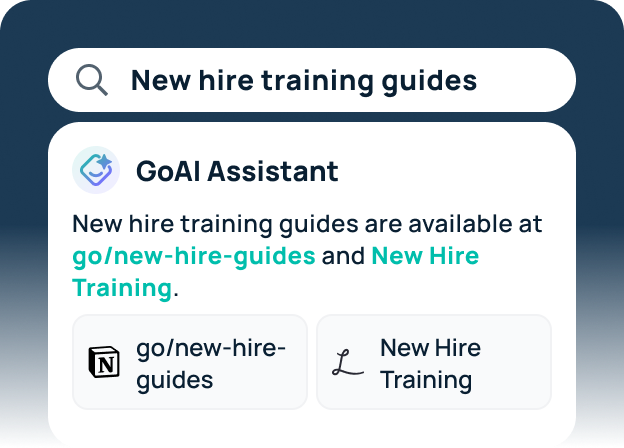
Frequently asked questions
GoSearch is the strongest Microsoft Copilot alternative for enterprises with mixed tech stacks. Unlike Copilot, which is limited to Microsoft 365 data, GoSearch connects 100+ tools including the Microsoft ecosystem, Slack, Jira, Salesforce, Google Workspace, Confluence, and ServiceNow through a hybrid federated and indexed architecture. It returns permission-aware answers in natural language and supports agentic workflows — moving from search to action in a single surface.
Enterprises aren’t moving away from Copilot because it lacks capability — they’re looking beyond it because deployment doesn’t always translate into adoption. Many organizations report that employees view embedded AI as helpful but optional, leading to inconsistent usage and unclear ROI.
At the same time, most enterprises operate across dozens of business systems beyond Microsoft 365. Teams increasingly want AI that connects knowledge, retrieves context, and supports action across their entire environment rather than adding another assistant inside one ecosystem.
GoSearch is purpose-built for cross-stack enterprise search, while Copilot is primarily an M365 productivity assistant. GoSearch connects 100+ integrations natively, supports federated search that queries source systems in real time, and includes no-code agentic workflows. Pricing is transparent and deployment typically takes days rather than weeks. For organizations that rely heavily on Microsoft 365, Copilot may still be useful; GoSearch is the stronger choice for mixed-stack environments.
Yes. GoSearch integrates with Microsoft Teams and can be deployed as a search and knowledge layer that surfaces answers from across your tech stack — including SharePoint and OneDrive — directly inside Teams. Organizations that want Copilot’s M365-native productivity features alongside cross-stack AI search often run both in complement: Copilot for in-app assistance within Word, Excel, and Outlook; GoSearch for enterprise-wide knowledge retrieval and agentic workflows.