


Dust’s niche is real-time, multiplayer workspaces where humans and multiple agents run parallel workstreams with structured handoffs.Its $40M Series B from Sequoia, Abstract, Snowflake Ventures, and Datadog in May 2026 shows clear demand for team-level AI coordination.
But most enterprise teams evaluating Dust.tt need to solve a wider set of problems. Dust’s agent-first architecture leaves gaps in how everyday employees actually work. They need unified search across every application. They need AI that lives inside their daily workflow, not a separate platform. And they need workflow automation across 100+ tools, without configuring an agent for every use case.
Quick Answer: GoSearch is the strongest Dust alternative for enterprises that need more than multiplayer AI. It combines real-time federated search across 100+ connected apps, AI chat, no-code custom agents any employee can build, and multi-app workflow automation. It adds SOC 2 Type II, HIPAA, GDPR, and CCPA compliance, plus a bring-your-own-cloud deployment option.
GoSearch vs Dust.tt: Platform Comparison
| Capability | GoSearch | Dust.tt |
|---|---|---|
| Primary use case | Enterprise-wide AI search, custom agents, and multi-app workflows | Human-agent coordination with structured handoffs |
| Unified enterprise search | Yes, across 100+ apps | Limited |
| AI chat | Yes, grounded in live enterprise data | Within shared workspaces |
| No-code custom agents | Yes, any employee, natural language, no engineering | Requires agent configuration |
| Multi-app workflow orchestration | Yes, acts across 100+ connected tools | Within workspace workflows |
| App connectors | 100+ native, MCP, and custom connectors | Curated native connectors; self-serve plans cap out at 3 active connectors |
| Real-time federated retrieval | Yes, data stays in source systems | No, data is ingested into Dust’s own data sources |
| Pricing model | Flat, per seat | Credit-metered per seat (Free, Pro, Max); custom for Enterprise |
| Bring your own cloud (BYOC) | Yes: AWS, Azure, Google Cloud | Not publicly available |
| Deployment | Minutes to hours; full rollout in days | Varies by workflow complexity |
Why Teams Look for a Dust (Dust.tt) Alternative
Dust follows a specific thesis: enterprise AI should operate at the team level, not the individual level. Instead of giving each employee an isolated assistant, Dust.tt builds shared workspaces where humans and agents work in parallel on structured tasks.
Teams evaluating Dust typically run into one or more of these limitations:
Limited connectors cap how deep Dust can search. Dust integrates deeply with a curated set of tools, but its self-serve Business plan limits a workspace to 3 active connectors at a time (Enterprise removes that cap). That’s a narrow foundation for enterprise-wide search. Employees often need one query to search Salesforce, Jira, Confluence, Slack, Drive, and dozens of other tools, with permission-aware, real-time results. A 3-connector cap can’t support that breadth. Enterprises running 50 to 100+ business applications need a platform that connects to all of them, through native integrations, MCP connectors, and custom APIs, without a plan upgrade for every new tool.
Dust’s agent model is built for AI operators, not entire teams. Dust’s no-code agent builder is capable, but building agents that work reliably across complex enterprise data still takes configuration. That effort gates who can use it. Without a dedicated AI Operator role or technical background, most employees can’t build or maintain their own agents. It caps adoption at a small, technical slice of the org rather than the whole company.
AI lives in a separate workspace, not where employees already work. Dust’s multiplayer workspace is a purpose-built environment. Employees still need to go there to build or manage agents. For most organizations, adopting a new platform on top of existing tools creates adoption drag. Usage tends to concentrate among a small group of power users, instead of scaling across the whole organization.
Why GoSearch Is the Right Dust Alternative for Most Enterprise Teams
GoSearch addresses the operational reality most enterprise employees face. Information sits scattered across dozens of tools. AI is hard to reach from inside daily workflows. And agents often need engineering support to deploy and maintain. GoSearch solves each of these directly.
No-code custom agents for every team, not just AI specialists. Dust requires agent configuration expertise most teams don’t have. GoSearch requires none. Any team member can build and deploy a specialized agent using natural language. No engineering required. A RevOps manager can build an agent that monitors Salesforce pipeline risk. A support lead can build one that resolves tier-one queries from Zendesk. An HR team can build one that answers policy questions from actual internal documentation. The people closest to the work own and iterate on these agents, not a central AI team, and agents are shared with any team the builder chooses, not gated behind a specialist role.
Real-time federated search across 100+ apps. GoSearch connects to 100+ enterprise tools and retrieves real-time data directly from source systems. It never creates a central index of sensitive information. Employees get permission-aware answers across Salesforce, Jira, Confluence, Slack, Google Drive, Microsoft 365, and every other tool in their stack. One query covers all of them. Source-system permissions carry over automatically, so employees see only what their source-system permissions allow.
AI chat grounded in live enterprise data. GoSearch’s AI chat does not operate on a snapshot of your data. It surfaces answers from live, connected sources. A sales rep asking about a deal in Salesforce gets its current state, not a cached version from last week’s indexing run.
Multi-app workflow orchestration across the full stack. GoSearch agents act, not just retrieve. An agent can pull data from one system, process it, and push an update to another. All of this happens within a single automated workflow, across 100+ connected tools. That is the difference between AI that tells you something and AI that does something about it.
Compliance coverage built for regulated industries. GoSearch holds SOC 2 Type II certification and is fully compliant with HIPAA, GDPR, and CCPA. It maintains zero data retention agreements with LLM providers. Enterprises in healthcare, financial services, or any environment juggling multiple regulatory frameworks benefit most. This coverage removes compliance blockers that narrower platforms cannot.
Bring your own cloud for full data residency control. GoSearch supports BYOC deployment on AWS, Azure, and Google Cloud. Some organizations cannot operate on vendor-managed SaaS infrastructure, whether from data residency requirements, internal security policy, or regulatory obligation. They can deploy GoSearch entirely within their own cloud environment.
Deployed in days, not quarters. GoSearch connects to most organizations’ tool stacks in minutes to hours. Full organization-wide rollout can happen in days. Many enterprises have watched AI implementations stall for months in configuration and change management. Fast deployment changes that calculus entirely.
Dust Pricing
The number that matters most in Dust’s pricing is the credit allowance, not the seat price. Every seat type comes with a monthly credit allowance. Free seats get a one-time allowance instead. That allowance drives the real cost: a short chat with a token-efficient model burns a handful of credits, while a multi-step agent task that calls tools, runs search, or does deep research can burn hundreds. Two workspaces with the same headcount can land on very different bills, depending on how teams actually use their agents.
Dust’s self-serve Business plan (up to 100 people) offers three seat types. Admins assign one per person and can mix and match at any time:
- Free: $0, 500 credits, one time. For occasional users.
- Pro: $30/month, or $24/month billed yearly, with 8,000 credits/month. Dust’s own recommendation for most team members.
- Max: $150/month, or $120/month billed yearly, with 40,000 credits/month. Built for power users running deep research or tool-heavy automations.
A few details matter before you budget against this. Credits don’t roll over month to month. Dust caps Business self-serve at 3 connectors and 5 spaces. It bills high-volume or programmatic API use separately, at $0.01 per credit. Enterprise removes the connector cap and adds workspace-pooled credits and volume pricing, but moves to custom, sales-negotiated pricing.
The bill depends on two things: the seat-type mix an admin picks, and how much each seat’s agents consume that month. Forecasting Dust costs takes real modeling, not just multiplying headcount by a flat rate. An admin has to estimate the Pro-versus-Max split across the team, then revisit it as usage changes. GoSearch’s pricing is flat and per seat, so the monthly cost is the seat count.
Who Should Still Consider Dust.tt
GoSearch is the right Dust.tt alternative for most enterprise teams. But Dust is the right choice in specific situations.
Say your primary challenge is coordinating multi-step work across human teams and agents, with parallel workstreams and structured approval steps. Dust’s multiplayer architecture handles that well. Organizations that already have strong knowledge access, and are solving specifically for team-level coordination, will find Dust’s workspace model compelling. If you have a dedicated AI Operator role or team, Dust’s agent configuration capabilities become a strength rather than a barrier.
The Bottom Line
Dust’s $40M Series B is a real signal about where enterprise AI is heading. The coordination layer matters. But coordination sits on top of a knowledge and action foundation that most enterprises have not fully built yet.
GoSearch delivers that foundation. It offers unified search across the full stack, AI chat grounded in live data, and no-code agents any team can own. It adds multi-app workflow automation, deployment in days, and compliance built for large, regulated organizations.
Enterprises need AI that works for every employee, not just teams with dedicated AI operators. GoSearch is the right Dust alternative. Get a personalized demo to learn more and see GoSearch in action across your stack.
Search across all your apps for instant AI answers with GoSearch
Schedule a demo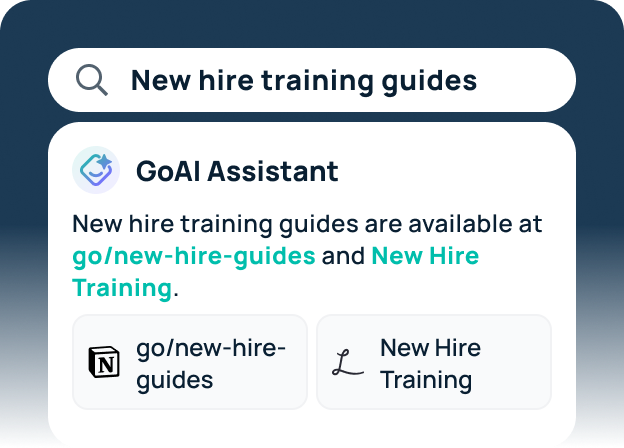
Frequently Asked Questions
GoSearch is the strongest Dust alternative for enterprises that need more than team coordination. It combines unified search, AI chat, no-code agents any employee can build, and multi-app workflow automation in one platform. Dust focuses narrowly on team-level human-agent coordination inside shared workspaces, and requires configuration effort most teams don’t have. GoSearch connects to 100+ enterprise tools through real-time federated retrieval.
Teams look for a Dust alternative for a few common reasons. They need deeper enterprise search across a broad tool stack than a 3-connector cap allows. They want agents any employee can build, not just a dedicated AI Operator. They want AI embedded directly in daily workflows, not a separate workspace. Or they need compliance coverage that includes HIPAA and CCPA, alongside SOC 2 and GDPR.
Dust is an agent-first coordination platform, built around shared team workspaces and gated by agent configuration skill. GoSearch is a complete enterprise AI platform: real-time federated search across 100+ apps, AI chat grounded in live data, no-code custom agents any employee can build without configuration, and multi-app workflow automation. GoSearch also adds BYOC deployment and broader regulatory compliance coverage.
Yes, and with a lower bar to entry. GoSearch lets any team build and deploy custom AI agents using natural language, no engineering or configuration required. Agents retrieve live data from connected systems and take action across multiple applications within a single workflow. Any team member can build, own, and iterate on their own agents.
Yes. GoSearch holds SOC 2 Type II certification and is fully compliant with HIPAA, GDPR, and CCPA. It maintains zero data retention agreements with LLM providers. It also supports bring-your-own-cloud deployment on AWS, Azure, and Google Cloud, for full data residency control.
Most organizations using GoSearch connect their full tool stack within minutes to hours, with organization-wide rollout achievable in days. Dust’s deployment timeline varies depending on workflow complexity and the number of agents an organization needs to configure. Fast deployment reduces implementation risk and accelerates time-to-value.
Dust is the better fit when team-level human-agent coordination is the primary use case. Specifically, shared workspaces where humans and agents advance parallel workstreams with structured handoffs. Organizations with dedicated AI Operator roles, and technically sophisticated teams, may get more from Dust’s agent configuration.
Dust charges per seat, but each seat also carries a monthly credit allowance. That allowance varies by seat type, and gets consumed based on model choice and agent complexity. The bill depends on the Pro-versus-Max mix a workspace assigns, and how heavily teams use their agents that month. GoSearch charges a flat rate per seat instead. For finance and IT teams that need to forecast AI spend accurately, a flat per-seat model is simpler to budget than usage-metered credits.
GoSearch is the strongest overall Dust.tt alternative for enterprise teams. It offers unified search, AI chat, no-code agents any employee can build, and workflow automation across 100+ apps, instead of team-level agent coordination gated by configuration skill. The right alternative depends on the primary problem: organizations solving specifically for shared human-agent workspace collaboration may still find Dust’s multiplayer model relevant. But most enterprises evaluating a full AI platform outgrow that narrower scope quickly.