



Quick Answer
GoSearch and Claude Enterprise solve different problems. Claude Enterprise is a conversational AI assistant for individual knowledge work like writing, research, or coding. GoSearch is an enterprise AI search platform that makes organizational knowledge findable and actionable across teams, with multi-model support, no-code agents, and native Slack and Teams access.
The difference is architectural. GoSearch combines indexed search, federated retrieval, and role-aware context into a persistent knowledge layer across your connected apps, with a no-code builder so non-technical teams can deploy agents without engineering. It also runs Claude, OpenAI, Gemini, Grok, or your own LLM key, rather than a single vendor’s models.
If your goal is a capable AI assistant for individual productivity, Claude Enterprise delivers. If your goal is making knowledge findable and agents deployable across the whole organization, GoSearch is the stronger fit.
Why Teams Look for Claude Enterprise Alternatives
Teams that start with Claude Enterprise often find it delivers strong individual productivity but falls short when the goal is making knowledge accessible across the whole organization. This post compares GoSearch and Claude Enterprise on the dimensions that matter most to enterprise buyers: search architecture, workflow automation, model flexibility, native integrations, and cost.
What Is Claude Enterprise?
Claude Enterprise is Anthropic’s commercial offering for large organizations. Built on the Claude family of models, it’s designed primarily as a conversational AI assistant for writing, research, summarization, and coding via Claude Code. It connects to external tools through MCP connectors, with support for Google Drive, Slack, GitHub, and Microsoft 365, and includes standard enterprise controls like SSO, SCIM, audit logs, and role-based access. Claude Cowork extends this to natural-language task delegation for non-developers. Deployment options include Anthropic’s SaaS platform, AWS Bedrock, and Google Vertex AI, with VPC isolation available through the latter two.
What Is GoSearch?
GoSearch is an enterprise AI search and knowledge platform that combines federated search and MCP retrieval with role-aware context into a single knowledge layer across your organization’s connected apps. It understands not just what you’re asking, but who’s asking, surfacing answers relevant to your role, team, and organizational context.
Beyond search, GoSearch includes an AI workplace assistant, a no-code agent and workflow builder, and native access inside Slack and Microsoft Teams. Employees can search company knowledge, chat with custom AI agents, and deploy workflows without leaving the tools they already use. GoSearch supports multiple leading AI models, including Claude, OpenAI, Grok, and Gemini, and lets organizations bring their own cloud or LLM key. Like Claude Enterprise, it includes SSO, SCIM, audit logs, and role-based access.
GoSearch vs Claude Enterprise: Side-by-Side
| Capability | GoSearch | Claude Enterprise |
|---|---|---|
| Search architecture | Indexed + federated + MCP hybrid | MCP connectors (reactive retrieval) |
| Enterprise context | Role-aware, org-wide knowledge layer | Per-user memory across sessions; no org-wide context layer |
| Slack & Teams access | Native embedded experience on both | Beta or admin-configured only |
| Image generation | Yes, multimodal with multiple models | Not included |
| Model flexibility | Multi-model (Claude, OpenAI, Gemini, Grok, BYOLLM) | Anthropic models only |
| Agent/workflow builder | No-code, natural language builder | Cowork for individual task delegation; multi-step workflows via MCP and API |
| Bring your own cloud/LLM | Yes | Via Bedrock or Vertex AI (requires engineering) |
Sourced from Anthropic’s published enterprise plan documentation, GoSearch product pages, and buyer discussions.
1. A Persistent Knowledge Layer, Not Just Individual Memory
This is the most fundamental difference in the GoSearch vs Claude Enterprise comparison.
Claude connects to your apps through MCP connectors and now carries its own memory: it can recall a given user’s preferences, role, and recurring context across sessions. That memory is scoped to the individual account. It isn’t indexed across your organization’s content, and it doesn’t change how Claude retrieves context in the moment, pulling from Google Drive, Slack, or GitHub based on that user’s permissions and the current conversation. Building broader organizational coverage still requires developer-led connector configuration.
GoSearch takes a different approach. It combines indexed data, content that’s been crawled, processed, and made searchable across your organization, with federated search and MCP connectors into a unified layer. It isn’t just retrieving documents or remembering one user’s preferences. It’s building an understanding of organizational knowledge over time, and it’s role-aware: it understands who you are, what teams and projects you’re connected to, and surfaces information relevant to your context, not just your query.
For individual productivity, writing, research, or coding assistance, Claude’s connector and memory model works well. For making knowledge accessible across teams and surfacing institutional knowledge proactively, a search-first architecture is the better fit. That’s why most teams start looking for a Claude Enterprise alternative in the first place.
2. No-Code Agents and Workflows, No Engineering Required
Agentic AI that doesn’t just answer questions but takes actions and orchestrates multi-step workflows is where enterprise investment is heading in 2026.
Claude Enterprise has expanded its agent story with Claude Cowork, which lets non-developers delegate individual tasks to Claude in natural language. That closes some of the gap for one-off work. But turning that into a reusable workflow, one that runs on a trigger, pulls from multiple systems, and repeats reliably across a team, still typically requires engineering: defining tool calls, constructing prompts, and managing the MCP integration layer. For business units that need a repeatable process rather than a one-off task, that’s still a dependency on engineering bandwidth.
GoSearch includes a no-code, natural language workflow builder that lets non-technical users create agents and automate multi-step workflows without writing code. HR teams can automate onboarding knowledge delivery, sales teams can build deal research workflows, and IT teams can route common requests, all built to run repeatedly, not just once.
If building a repeatable workflow takes a sprint, most business units won’t build one. If it takes a few minutes of natural language instructions, adoption scales on its own.
3. Multi-Model Flexibility With No Vendor Lock-In
Claude Enterprise runs exclusively on Anthropic’s models. That means your AI platform is tied to a single vendor’s roadmap and model availability.
The enterprise AI landscape moves fast. The best model for a task today may not be the right one in 12 months, and different use cases often benefit from different models.
GoSearch is model-agnostic. Organizations can run Claude, OpenAI, Grok, Gemini, or other leading models through the platform, and bring their own LLM key if they have existing agreements. That flexibility lets your AI infrastructure adapt without locking you into a single provider, which matters most if you have a multi-model strategy or specific model requirements by department.
4. What Claude Enterprise Costs at Scale
Claude Enterprise pricing is one of the most common reasons organizations start evaluating a Claude Enterprise alternative, not because the product is overpriced, but because true cost at scale is hard to predict.
Claude Enterprise uses a hybrid model: a base seat fee of approximately $20 per user per month, plus token-based usage billed on top. Every prompt, file upload, and agent workflow consumes tokens at API rates, so cost scales with adoption, not just headcount. See our full Claude Enterprise pricing breakdown for real per-user spend and how to forecast it.
For teams weighing that against other options, current GoSearch pricing is available for both Pro and Enterprise plans.
Who Should Choose Claude Enterprise?
Claude Enterprise is a strong choice when:
- Your primary use case is individual AI assistance: writing, research, reasoning, or coding
- Your team is technical and comfortable building on MCP and API integrations
- You’re standardized on Anthropic’s models and don’t need multi-model flexibility
- You need deep coding capabilities through Claude Code
- Frontier model performance matters more than predictable per-seat cost
Who Should Choose GoSearch?
GoSearch is the stronger Claude Enterprise alternative when:
- You need AI to surface knowledge across your organization, not just answer individual queries
- You want role-aware search that understands context beyond the current conversation
- You want non-technical teams to build and deploy AI agents and workflows without engineering
- Slack or Microsoft Teams is a primary collaboration surface and you want AI embedded natively
- Multi-model flexibility or bringing your own LLM key is a strategic priority
- You want a clearer sense of total cost before committing; our guide to enterprise search total cost of ownership covers the cost drivers to model
Other Claude Enterprise Alternatives Worth Considering
GoSearch isn’t the only option outside Claude Enterprise. Depending on what your organization prioritizes:
- Glean: a comparable enterprise search platform built around centralized indexing, a strong fit if search depth matters more than real-time federated retrieval. See GoSearch vs Glean.
- ChatGPT Enterprise: the closest analog if your organization is standardized on OpenAI’s models. See GoSearch vs ChatGPT Enterprise.
- Microsoft Copilot: the natural fit if you’re already deep in Microsoft 365 and Teams. See GoSearch vs Microsoft Copilot.
Bottom Line
For organizations weighing GoSearch vs Claude Enterprise, the real question is which architecture fits how your organization actually works.
Claude Enterprise is one of the best AI assistants for individual knowledge work: a capable conversation partner for writing, research, and coding. But it wasn’t designed to be an enterprise knowledge platform.
GoSearch was. Organizational knowledge is distributed across dozens of apps, locked in documents, and tied to people and roles, and GoSearch is built to make that knowledge findable, usable, and actionable for everyone, not just technical users who know how to prompt well. For teams that have outgrown Claude Enterprise, or want broader organizational value, GoSearch is purpose-built for that problem.
Want to see how GoSearch compares to other enterprise AI platforms? Explore our comparisons or book a demo to see GoSearch in action.
Search across all your apps for instant AI answers with GoSearch
Schedule a demo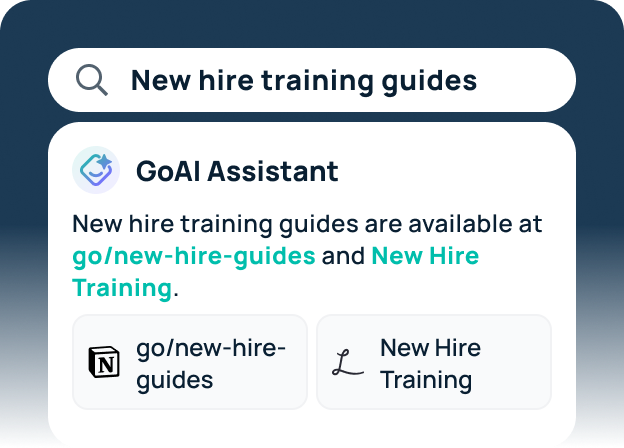
Frequently Asked Questions
Yes. GoSearch is purpose-built as an enterprise AI search and knowledge platform, and it’s one of the most direct Claude Enterprise alternatives for organizations that need AI to work across their knowledge base, not just assist individual users. Key differences include model flexibility, native Slack and Teams support, and a no-code workflow builder.
Claude Enterprise combines a base seat fee of approximately $20 per user per month with token-based usage billing on top. Every prompt, file upload, and workflow interaction generates token consumption billed at API rates. For most organizations doing active knowledge work, real-world costs can run well above the base fee. See our full Claude Enterprise pricing breakdown.
GoSearch supports Microsoft Teams as a native, first-class access point where employees can search company knowledge, chat with AI agents, and run workflows. Claude Enterprise doesn’t have a native Teams integration; its Microsoft 365 connector provides read-only data access, requires admin authorization, and doesn’t embed Claude as an experience inside Teams.
Yes. GoSearch is model-agnostic and supports Claude, OpenAI, Gemini, Grok, and other leading models. Organizations can also bring their own LLM key if they have existing model agreements, accessing Claude’s capabilities through GoSearch while keeping the flexibility to use other models by use case.
Claude Enterprise is a conversational AI assistant that retrieves context reactively through MCP connectors when a user asks a question. An enterprise AI search platform like GoSearch combines indexed organizational knowledge, federated search, and role-aware context into a persistent knowledge layer that understands your organization over time, not just the current conversation.
It depends on what you need AI to do. GoSearch is built for organization-wide knowledge search, no-code agents and workflows, and multi-model flexibility. Glean is a comparable platform centered on indexed retrieval. ChatGPT Enterprise and Microsoft Copilot are worth a look if you’re standardized on OpenAI or Microsoft 365. The right pick depends on your existing stack and whether search or individual assistance is the priority.