


The leading ChatGPT Enterprise alternative for enterprise search, specialized AI agents, and company knowledge across 100+ tools.
Most organizations looking for a ChatGPT Enterprise alternative aren’t unhappy with AI — they’re unhappy with what ChatGPT Enterprise was designed to do. It’s a reliable general-purpose AI assistant. But enterprise teams that need AI to search, retrieve, and act on knowledge across Confluence, Salesforce, Jira, ServiceNow, Slack, and dozens of other tools keep running into the same walls: connector gaps, model lock-in, SaaS-only deployment, and pricing that requires a six-figure annual commitment before you’ve proven value. This comparison breaks down exactly where those walls are, and how GoSearch is built differently.
Quick Answer: GoSearch is the purpose-built ChatGPT Enterprise alternative for organizations that need real enterprise search — and the leading choice for teams that specifically need specialized AI agents grounded in company knowledge. Where ChatGPT Enterprise is a general-purpose AI assistant with growing but limited connector coverage, GoSearch was designed from the ground up to retrieve and act on knowledge across your entire tech stack — with real-time, permission-aware retrieval across 100+ connected tools, multi-LLM flexibility, no-code specialized agents, and a security architecture built for regulated environments.
TL;DR: Key differences at a glance
- Connector reach: ChatGPT Enterprise “apps” cover storage and productivity tools (SharePoint, Drive, Dropbox, Gmail, Slack, GitHub); GoSearch covers 100+ tools including Confluence, Salesforce, Jira, ServiceNow, Asana, and Notion via three connector types
- Specialized agents: GoSearch agents are built with natural language, require no code, and are grounded in real-time retrieval from your actual company knowledge systems; ChatGPT Enterprise agent actions are constrained by its limited connector set
- LLM flexibility: ChatGPT Enterprise is locked to OpenAI models; GoSearch supports OpenAI (including GPT-5.5), Anthropic, and Google Gemini with user-selectable models
- Deployment: ChatGPT Enterprise is SaaS-only; GoSearch supports BYOC on AWS, Azure, or Google Cloud
- Compliance: Both are SOC 2 Type II; GoSearch adds HIPAA-ready, GDPR, CCPA, and Zero Data Retention at the LLM query level
- Pricing: ChatGPT Enterprise is custom-negotiated, estimated $60–$100+/user/month with a ~150-seat minimum; GoSearch has a free plan and a Pro plan that starts at $20/user/month, publicly listed, no seat minimum on self-serve plans. Our Enterprise plans start with 35 seats and are typically at least half the cost.
- Teams and Slack: Both have integrations, but GoSearch surfaces live cross-system knowledge inside those platforms; ChatGPT surfaces its general assistant
Why Teams Are Looking for a ChatGPT Enterprise Alternative
ChatGPT Enterprise has become many organizations’ first enterprise AI investment. It’s backed by OpenAI’s frontier models, offers meaningful data privacy guarantees over consumer ChatGPT tiers, and provides a familiar interface. It performs well for individual knowledge work like drafting, summarizing, and researching.
But as enterprise teams push into organization-wide knowledge access, a consistent pattern emerges. ChatGPT Enterprise wasn’t designed as an enterprise search platform. Its connector ecosystem, while growing, has meaningful limitations. Its deployment model is SaaS-only. Its pricing is opaque and steep at scale. And its model infrastructure is locked to OpenAI.
For teams that need AI to find, surface, and act on knowledge across every system their organization depends on — and specifically for teams that need specialized AI agents built around company knowledge — these constraints matter. This post breaks down exactly how GoSearch compares as a ChatGPT Enterprise alternative across connector architecture, LLM flexibility, data governance, deployment, pricing, and agentic capability.
GoSearch vs ChatGPT Enterprise: Full Comparison Table
| Feature | GoSearch | ChatGPT Enterprise |
|---|---|---|
| Primary purpose | Purpose-built enterprise search, specialized AI agents, workflows | General-purpose AI assistant with enterprise controls |
| Connectors | Plug-and-play native indexing, federated (real-time), MCP connectors that work immediately | Admin-enabled synced apps, off by default |
| Connector depth | 100+ enterprise SaaS apps, custom integrations, bring your own MCP, and GoSearch MCP and API | Storage and productivity apps; limited reach into CRM, ticketing, and ITSM systems |
| LLM flexibility | OpenAI, Anthropic, Google Gemini (user-selectable) | OpenAI models only |
| Zero Data Retention | Yes — applies at the LLM query level with all providers | Training-data exclusion by default; no ZDR guarantee at query level |
| Deployment model | SaaS + Bring Your Own Cloud (BYOC) on AWS, Azure, or Google Cloud | SaaS only; no private cloud or VPC deployment |
| Certifications | SOC 2 Type II, HIPAA, GDPR, CCPA | SOC 2 Type II, GDPR, HIPAA |
| Microsoft Teams | Native enterprise search, agents, workflow integration | ChatGPT available via Teams app; general AI, not cross-system retrieval |
| Slack | Native enterprise search, agents, workflow integration | ChatGPT available via Slack app; general AI, not cross-system retrieval |
| Browser extension | Yes — page-aware, surfaces internal knowledge contextually | No |
| Specialized agents | Agents built around your internal systems — Confluence, Salesforce, Jira, Slack, and 100+ more | Agent actions depend on connected app coverage; primarily productivity and storage apps |
| Agentic workflows | Cross-system workflows: retrieve → generate → act across multiple tools | Agent actions depend on connected app coverage; primarily productivity and storage apps |
| Pricing | Free plan available; Pro plan starts at $20 a month, and Enterprise is custom, minimum 35 seats | Custom pricing; estimated $60–$100+/user/month; minimum ~150 seats |
| Pricing transparency | Publicly listed | Not published; requires sales negotiation |
| Minimum commitment | No minimum on self-serve plans, 35-seat minimum on Enterprise plans | ~150 seats, annual contract required |
| Setup time | Same-session value; no developer resources required | Multi-week negotiation and onboarding process typical |
| Advanced feature billing | Included in plan tiers | Credit-based consumption model for Deep Research, Sora, Codex on top of base seat cost |
6 Reasons to Choose GoSearch as Your ChatGPT Enterprise Alternative
1. Specialized AI Agents Built on Company Knowledge
For teams that specifically need specialized AI agents grounded in company knowledge — not just a general-purpose AI assistant — GoSearch is purpose-built for this use case, and it’s the most important differentiator from ChatGPT Enterprise.
GoSearch agents are built with natural language, require no code, and operate in real time across every connected system in your tech stack. An agent built for your engineering team can retrieve the latest Jira sprint status, pull related Confluence documentation, and surface relevant Slack threads from a single query, with permissions inherited automatically from each source. An agent built for your sales team can pull Salesforce opportunity data, cross-reference product documentation, and generate account-specific briefs on demand.
This is meaningfully different from ChatGPT Enterprise’s agent capabilities, which are constrained by its connector set. ChatGPT Enterprise agents can browse the web, query uploaded files, and take actions in connected productivity and storage apps. They can’t reach Confluence, Salesforce, Jira, ServiceNow, or the other knowledge systems where most enterprise knowledge actually lives.
GoSearch agents aren’t an add-on to a chat interface. They’re built on a retrieval architecture that spans your entire tool stack, retrieves data in real time rather than from periodically refreshed snapshots, and inherits source-level permissions automatically. For organizations where company knowledge lives across many tools and teams need AI that knows that context, GoSearch is the right choice.
2. Connector Depth and Integration Reach
When evaluating any ChatGPT Enterprise alternative, connector quality is the most practically significant difference.
OpenAI renamed its connector library from “connectors” to “apps” in December 2025, describing it as a unified experience covering both interactive UI and knowledge sync. The current synced app lineup includes SharePoint, Dropbox, Box, Outlook, Teams, Google Drive, Gmail, GitHub, and Linear. That’s a meaningful set for organizations whose knowledge lives primarily in Microsoft and Google ecosystems.
But there are important caveats. First, synced apps are off by default for Enterprise plans and require manual admin enablement. Second — and this is the constraint most evaluation guides miss — if your organization uses Enterprise Key Management (EKM) for compliance, all synced app connectors become entirely unavailable. OpenAI states this directly: “if you are an Enterprise or Edu customer with Enterprise Key Management (EKM) enabled, apps with the Sync capability will become unavailable.” Workspace agents are similarly restricted for EKM workspaces. Organizations with EKM enabled are forced back to manual file uploads.
Third, even without EKM, the ecosystem has limited reach into systems where enterprise knowledge commonly lives: Confluence, Salesforce, Jira, ServiceNow, Asana, Notion, Zendesk. For teams that depend on these tools daily, the connector set leaves meaningful gaps.
GoSearch supports three connector types: native indexing for shared company content, federated connectors for real-time source queries, and MCP connectors for agentic retrieval and action. Permissions are inherited automatically via OAuth from each source system. Connectors for Atlassian, Salesforce, Asana, Notion, Linear, GitHub, and more are plug-and-play — not features requiring per-workspace enablement. Custom MCP connectors extend the same model to any MCP-compatible internal system or proprietary API, with no dependency on EKM status.
3. LLM Flexibility and Freedom from Model Lock-In
ChatGPT Enterprise runs exclusively on OpenAI’s model stack. As of early 2026, GPT-5.5 Instant and GPT-5.5 Thinking are the current Enterprise models — though access to GPT-5.5 is disabled by default for Enterprise workspaces and must be individually enabled by admins via role-based access controls. Organizations have no ability to route queries to Anthropic, Google, or any other LLM provider.
This creates meaningful vendor lock-in. OpenAI’s model retirement cadence underscores the risk: GPT-4o, GPT-4.1, and several other models were retired from ChatGPT in February 2026, with Enterprise and Edu customers given until April 3, 2026 to transition. Workloads built around a specific model can be disrupted on OpenAI’s timeline, not yours.
GoSearch supports LLMs from OpenAI, Anthropic, and Google Gemini — including GPT-5.5 — giving organizations the flexibility to choose based on accuracy, speed, cost, or compliance requirements. Zero Data Retention agreements apply with all LLM providers, ensuring query data is never stored, trained on, or reused after each interaction. As a ChatGPT Enterprise alternative for regulated industries, GoSearch’s model-agnostic approach is a significant architectural advantage.
4. Deployment Model and Data Governance
ChatGPT Enterprise is SaaS-only. There is no private cloud, VPC deployment, or on-premises option. For organizations in healthcare, financial services, legal, or government where full infrastructure isolation is required, this remains a hard constraint.
ChatGPT Enterprise excludes business data from model training by default and retains conversation data for 30 days by default, with custom retention policies available. These are stronger guarantees than consumer ChatGPT tiers, but differ from GoSearch’s Zero Data Retention model, which applies at the LLM query layer itself.
GoSearch supports Bring Your Own Cloud (BYOC) deployment on AWS, Azure, or Google Cloud. It is SOC 2 Type II certified, GDPR and CCPA compliant, and HIPAA-ready. Personal connectors retrieve user-level data in real time without indexing it on GoSearch’s platform. Zero Data Retention agreements with all LLM providers extend data protection to every query interaction — not just data at rest.
5. Pricing and Commitment Structure
ChatGPT Enterprise pricing is custom, negotiated directly with OpenAI’s sales team, and not publicly listed. Industry reporting puts the range at approximately $60–$100+ per user per month, with a 150-seat minimum and mandatory annual commitment — putting the floor for an Enterprise contract at roughly $108,000 per year. One frequently overlooked detail: ChatGPT Enterprise moved to a flexible pricing model on April 2, 2026, introducing a separate credit-based consumption tier for Codex usage on top of the base seat cost. This adds variable cost unpredictability on top of an already opaque base price.
GoSearch pricing is publicly listed. Free and Pro plans (starting at $20 per user/per month) allow teams to get started and deliver value quickly. Enterprise plans start at 35 seats and include custom pricing. There are no separate consumption tiers for core search, AI assistant, or agentic features. Setup requires no developer resources, and organizations can achieve value in the same session they start — without a six-figure commitment as the entry point.
6. Access Across Teams, Slack, and the Browser
GoSearch meets users where they work. Enterprise search, AI chat, and agentic workflows are accessible natively inside Microsoft Teams, natively inside Slack, and via a browser extension that reads the context of the page a user is viewing — surfacing relevant internal knowledge without requiring a context switch to a separate application.
ChatGPT offers Teams and Slack integrations that bring the ChatGPT assistant into those platforms. This gives users access to a general-purpose AI from within those environments. It does not transform Teams or Slack into enterprise search interfaces grounded in real-time retrieval across a full tool stack. GoSearch’s integrations surface knowledge from all connected systems, custom agents, and workflows within Teams and Slack. ChatGPT’s surface only the ChatGPT assistant within them.
For organizations whose knowledge is fragmented across many tools, and whose users live in Teams or Slack, the distinction matters day-to-day.
GoSearch for Specialized AI Agents and Company Knowledge
For teams evaluating ChatGPT Enterprise alternatives specifically because they need specialized AI agents built around company knowledge, GoSearch is the purpose-built choice in this category — and the clearest distinction from every other option in the market.
The category matters because most enterprises don’t have a knowledge problem. They have a knowledge access problem. Their knowledge exists — in Confluence, in Jira, in Salesforce, in Slack threads, in service tickets — but it’s fragmented across systems, inaccessible without context-switching, and invisible to any general-purpose AI assistant that can’t reach it.
GoSearch agents solve this directly. They’re built with natural language, require no code or developer resources, and are grounded in real-time retrieval from the connected systems your teams actually use. A GoSearch agent doesn’t work from a periodically refreshed index or a manually uploaded file. It queries live data, inherits permissions at the source, and can act — creating Jira tickets, surfacing Salesforce records, generating answers from Confluence documentation — from a single prompt.
Compared to the other tools commonly cited in this category:
- Dust (https://dust.tt/) is an orchestration layer that connects to multiple LLMs and lets you build custom agents — but it doesn’t provide the underlying enterprise search, federated retrieval, or the 100+ native connector ecosystem that grounds GoSearch agents in real company knowledge. See how GoSearch compares to Dust.
- Onyx AI provides continuously indexed connectors to over 40 tools, primarily for search and Q&A. GoSearch covers a broader connector set, adds agentic action capability (not just retrieval), and pairs agents with a full enterprise search and AI assistant platform.
- Azure OpenAI Service provides secure, cloud-controlled OpenAI model access, but building specialized agents on top of it requires significant developer investment. GoSearch delivers no-code agents out of the box, connected to your live data.
For organizations that have already tried a general-purpose AI assistant and found it can’t answer questions about their internal systems, GoSearch is the natural next step: enterprise search, AI chat, and specialized agents on real company knowledge, in a single governed platform.
What ChatGPT Enterprise Does Well
ChatGPT Enterprise remains a strong product for specific use cases. If your team’s primary requirement is an AI assistant for individual knowledge work like drafting, research, summarization, coding, ChatGPT Enterprise delivers on those needs with OpenAI’s frontier models and a mature admin console. The expanded Microsoft 365 integration launched in early 2026 deepens its value for Microsoft-first organizations. For teams already standardized on OpenAI’s ecosystem, the continuity from individual ChatGPT usage to the Enterprise tier is a real advantage.
Who Should Use Each Platform
ChatGPT Enterprise is the better fit if:
- Your primary use case is augmenting individual knowledge work and your team already uses ChatGPT as its core LLM
- Your connector needs are limited to Microsoft (SharePoint, Outlook, Teams) and Google (Drive, Gmail) ecosystems, plus Slack and GitHub
- You have 150+ users and can absorb a negotiated annual contract at $60–$100+/user/month
- You don’t use Enterprise Key Management or are comfortable with its connector limitations
- You’re deeply invested in OpenAI’s model ecosystem and don’t require LLM provider flexibility
GoSearch is the better ChatGPT Enterprise alternative if:
- You need specialized AI agents grounded in company knowledge — not a general-purpose AI that can’t reach your internal systems
- Your organization needs enterprise search across a multi-tool stack including Confluence, Salesforce, Jira, ServiceNow, Slack, GitHub, Notion, Asana, and beyond
- You need connectors that work immediately without admin enablement steps or EKM constraints
- You want LLM flexibility across OpenAI, Anthropic, and Gemini with Zero Data Retention at the query level
- You operate in a regulated industry requiring BYOC deployment, HIPAA readiness, or strict data governance
- You need enterprise search accessible in Teams, Slack, and the browser with real cross-system retrieval
- You want transparent, predictable pricing without variable consumption tiers for advanced features
- You want to start returning value without a six-figure minimum commitment
Bottom Line
For organizations looking for a ChatGPT Enterprise alternative, the core question is what problem you’re solving. ChatGPT Enterprise is a general-purpose AI assistant with enterprise controls, ideal for augmenting individual productivity across a limited but growing connector set. GoSearch is a purpose-built enterprise search and knowledge platform — and the leading choice for organizations that need specialized AI agents grounded in real company knowledge across every tool their teams depend on.
For the reality most enterprises face — knowledge fragmented across Confluence, Salesforce, Jira, ServiceNow, Slack, and dozens of other tools — GoSearch’s hybrid federated search and MCP architecture reaches further, deploys faster, and governs more consistently than ChatGPT Enterprise’s growing connector ecosystem.
Book a demo to see GoSearch in action.
Search across all your apps for instant AI answers with GoSearch
Schedule a demo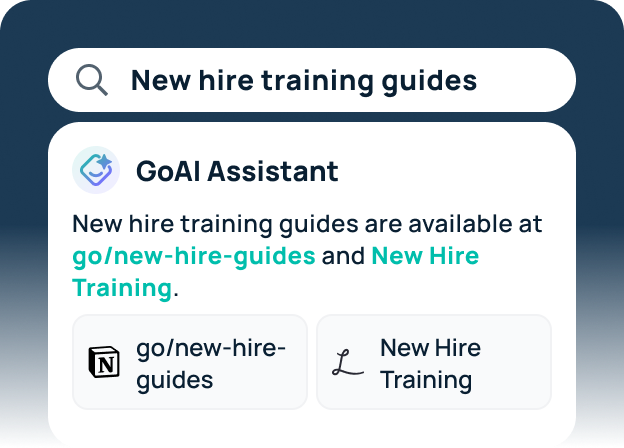
Frequently Asked Questions
Yes. GoSearch is purpose-built for enterprise search where ChatGPT Enterprise is a general-purpose assistant. GoSearch covers broader connector depth (including Confluence, Salesforce, Jira, ServiceNow, and 100+ more tools), supports multiple LLMs from OpenAI, Anthropic, and Gemini, offers BYOC deployment for regulated industries, and starts at $20/user/month on our Pro plan (Enterprise plan is custom) with transparent pricing — versus ChatGPT Enterprise’s estimated $60–$100+/user/month custom contracts with a ~150-seat minimum.
Yes. GoSearch was designed specifically for this use case — building no-code AI agents that retrieve and act on company knowledge across Confluence, Jira, Salesforce, Slack, and 100+ other tools in real time. Where general-purpose alternatives like ChatGPT Enterprise provide AI chat with limited connector depth, GoSearch agents are grounded in live, permission-aware retrieval from the systems your teams actually use. For organizations that need AI to know and act on internal knowledge — not just general knowledge — GoSearch is the purpose-built platform.
The most common reasons are connector limitations, the need for real-time retrieval from Salesforce, Jira, or Confluence rather than file storage, LLM flexibility across providers, BYOC or HIPAA requirements, and pricing transparency. Many organizations also switch when they realize they need specialized AI agents grounded in company knowledge — not a general-purpose assistant that can’t reach their internal systems. GoSearch also delivers enterprise search and agents natively within Teams and Slack in a way that ChatGPT’s app integrations don’t replicate.
Yes, in most enterprise search and knowledge access use cases. GoSearch combines enterprise search, an AI assistant, and agentic workflows in a single platform — covering knowledge retrieval, drafting, research, and cross-system action. Organizations that already use ChatGPT Enterprise can run GoSearch alongside it or replace it depending on their needs.
GoSearch has native integrations for both Microsoft Teams and Slack that surface knowledge from all connected systems in real time. ChatGPT offers apps for Teams and Slack that bring its general AI assistant into those environments but don’t provide cross-system knowledge retrieval from tools like Confluence, Salesforce, or Jira.
ChatGPT Enterprise’s synced apps cover SharePoint, Dropbox, Box, Outlook, Teams, Google Drive, Gmail, GitHub, and Linear — but are off by default and unavailable with EKM enabled. GoSearch supports 100+ tools via native indexing, federated search, and MCP connectors — including Confluence, Salesforce, Jira, ServiceNow, Asana, Notion, and more — with permissions inherited automatically via OAuth and no EKM constraints.
GoSearch supports LLMs from OpenAI (including GPT-5.5), Anthropic, and Google Gemini, with user-selectable models and Zero Data Retention at the query level. ChatGPT Enterprise is locked to OpenAI’s model infrastructure with no option to use alternative providers.
GoSearch is stronger for regulated industries. SOC 2 Type II certification, GDPR and HIPAA readiness, BYOC deployment on AWS/Azure/Google Cloud, federated connectors that never index sensitive data on GoSearch’s platform, and Zero Data Retention agreements at the LLM layer provide governance depth that ChatGPT Enterprise’s SaaS-only model cannot match.
ChatGPT Enterprise requires direct negotiation with OpenAI’s sales team. Current industry estimates place the cost at $60–$100+/user/month with a minimum of approximately 150 seats, putting the annual floor around $108,000–$180,000 before separate consumption charges for advanced features (Deep Research, Sora, Codex, thinking models). GoSearch is transparent: our Pro plan starts at $20/user/month, and our Enterprise plan offers custom pricing with a minimum of 35 seats, with no separate consumption tiers for core features.