



Knowledge fuels today’s organizations—but most companies still can’t access it efficiently. Files are buried in Google Drive, messages hidden in Slack, project updates scattered across Jira, Salesforce, and Notion, and critical customer insights trapped in endless email threads.
The average employee spends 20–30% of their workday searching for information, resulting in thousands of wasted hours each month and millions of dollars in lost productivity every year.
In 2026, enterprise search tools will no longer be a “nice to have.” They will be business-critical infrastructure. The organizations that thrive will treat search as a strategic investment, not just another IT utility.
Why Enterprise Search Tools Are Essential
In every organization, knowledge is scattered across countless apps and systems. Without a unified way to access it, employees waste hours searching, and critical insights stay hidden. Enterprise search tools solve this problem by making knowledge accessible, actionable, and secure.
- Unlock Productivity: Consolidate fragmented knowledge into a single, unified search experience.
- Accelerate Time-to-Insight: Deliver AI-powered answers that surface relevant information instantly.
- Enable Smarter Decisions: Foster a knowledge-driven culture where insights flow freely, and decisions move at market speed.
Modern enterprise search isn’t just about finding files. It’s about creating an AI-powered backbone for knowledge work—one that connects data, people, and insights seamlessly.
Organizations that embrace enterprise search will outperform, out-innovate, and outpace competitors still struggling with silos and manual searches.
The message is clear: in 2026, enterprise search tools are not optional—they are the foundation for productivity, agility, and growth.
What Is an Enterprise Search Tool?
An enterprise search tool is specialized software that allows employees to find information across all internal systems through a single search bar.
Unlike public search engines, these tools are designed for complex private ecosystems inside organizations, where information is:
- Fragmented across dozens (or hundreds) of SaaS applications
- Locked behind permission systems and access controls
- Subject to strict compliance standards like SOC 2, GDPR, and HIPAA
A robust enterprise search solution doesn’t just retrieve files. It understands intent and context through technologies like:
- Natural Language Processing (NLP): Interpret human queries in everyday language.
- Semantic Search: Find meaning beyond exact keyword matches.
- Generative AI: Summarize results into direct answers rather than forcing employees to scan dozens of links.
Example: Instead of returning 40 documents when someone asks, “What’s our PTO policy?”, a modern tool gives the policy answer directly—saving time and removing friction.
Why Organizations Invest in Enterprise Search Tools
Organizations adopt enterprise search platforms because they solve today’s biggest workplace challenges – while delivering measurable ROI.
1. SaaS Proliferation
The average mid-sized company uses 100+ SaaS applications. Without unified search, employees waste hours switching between tools and duplicating work.
Impact: A 1,000-employee company can lose millions annually in productivity from fragmented knowledge.
2. Hybrid & Remote Workforces
With distributed teams, context is often lost across time zones and channels. Unified search ensures everyone—from HR to engineering—has equal access to institutional knowledge.
Impact: Faster collaboration and fewer costly delays.
3. Onboarding & Employee Experience
New hires need answers quickly. Enterprise search removes bottlenecks like waiting on managers or HR, cutting ramp-up time.
Impact: Shorter onboarding saves thousands per employee and reduces turnover risk.
4. Security & Compliance
Leading platforms enforce permission-aware search, aligning access with role-based controls and compliance standards like SOC 2, GDPR, and HIPAA.
Impact: Lowers risk of violations, breaches, and reputational damage.
5. Competitive Speed
Fast knowledge access improves decision-making, speed-to-market, and customer outcomes.
Impact: Organizations that reduce knowledge friction report 2–3x faster response times and higher satisfaction scores.
Use Case: A support team with enterprise search can resolve client questions in seconds rather than minutes—cutting response times and boosting CSAT.
Bottom Line
Enterprise search reclaims hundreds of hours per employee per year, unlocking multi-million-dollar productivity gains and fueling faster growth.
The Business Value of Enterprise Search Tools
When implemented effectively, enterprise search platforms deliver measurable ROI across multiple dimensions:
- Improved Workforce Productivity: Even a 10% reduction in time spent searching equates to thousands of regained work hours.
- Accelerated Decision-Making: Leaders instantly surface reports, dashboards, and historical data to guide strategy.
- Reduced Duplication of Effort: Teams quickly locate existing assets—presentations, collateral, or code—instead of recreating them.
- Faster Onboarding: New hires self-serve answers to common questions (“How do I submit expenses?”) without disrupting colleagues.
- Stronger Collaboration: Departments align more quickly when everyone works from the same knowledge base.
- Knowledge Retention: Institutional know-how stays accessible even after employees leave.
- Secure, Compliant Access: Permission-aware governance protects sensitive data without creating workflow bottlenecks.
The ROI isn’t just theoretical—many organizations report time savings equivalent to $2M–$5M annually after deploying enterprise search tools at scale.
What to Look for in Enterprise Search Tools
Not all platforms are created equal. When evaluating enterprise search solutions, organizations should prioritize:
- Deep Integrations: Seamless connections to major SaaS tools like Slack, Jira, Salesforce, Google Workspace, and Notion.
- AI Capabilities: Features such as semantic search, generative summarization, and contextual answers that go beyond basic keyword matching.
- Security & Compliance: SOC 2, GDPR, and HIPAA readiness with role-based permission controls to protect sensitive data.
- Ease of Use: A consumer-grade interface that encourages adoption across all roles and departments.
- Scalability: The ability to grow alongside your organization’s expanding data and application footprint.
- Analytics: Reporting on adoption, query trends, and productivity impact to prove ROI.
- Deployment Speed: Solutions that can be implemented in days—not months—for faster time-to-value.
For a deeper dive, check out GoLinks’ guide: How to Pick the Best Enterprise Search Tool for a complete checklist of 12 must-have criteria.
Top Enterprise Search Software in 2025
The enterprise search market has matured quickly, with a mix of established players and AI-first challengers. Here are the platforms leading the category for 2026:
- GoSearch – AI-powered platform with a hybrid approach (indexed + federated), rapid deployment, and enterprise-grade security. Known for agent-driven automation and fast ROI.
- Glean – Focused on knowledge discovery and AI recommendations. Watch for security risks tied to full-data indexing and potential cost surprises at renewal.
- Coveo – AI-driven personalization, recommendations, and analytics. Flexible pricing, but costs can spike with data growth.
- Elastic Enterprise Search – Highly customizable and developer-friendly. Popular with engineering-led teams, though setup can be complex.
- Microsoft Search – Seamless for Microsoft 365 environments. Limited flexibility outside that ecosystem.
Other Notables: Azure AI Search, Guru, Algolia, and Lucidworks — offering strengths such as API extensibility, knowledge management, and advanced relevance tuning and analytics.
Trends Shaping the Future of Enterprise Search Tools
Enterprise search is rapidly evolving from static search engines into intelligent knowledge partners. Key trends include:
- Generative AI Answers – Results shift from document lists to narrative-style summaries with direct answers.
- Proactive Knowledge Delivery – Recommendations surface before employees even search, tailored to role and workflow.
- Voice & Multimodal Interfaces – Queries can be made through voice, screenshots, or even video clips.
- Predictive, Personalized Insights – Proactive recommendations guide employees to the right knowledge faster, accelerating decision-making.
- Granular Security Controls – Advanced permission frameworks ensure secure access without slowing productivity.
The future of enterprise search is clear: these tools won’t just answer questions—they’ll anticipate them. Organizations that embrace these innovations will see measurable ROI in the form of faster decisions, stronger collaboration, and millions saved in reclaimed productivity hours.
Why GoSearch Stands Out
Among enterprise search tools, GoSearch is designed to minimize friction while maximizing ROI:
- AI-Powered Contextual Answers – Not just links, but summarized, actionable insights.
- Hybrid Search Architecture – Real-time federated search combined with fast indexing.
- Rapid Deployment – Up and running in days, not months.
- Enterprise-Grade Security – SOC 2, GDPR, and HIPAA ready, with permission-aware access.
- User-Friendly UX – Built for adoption across all roles with minimal training.
By transforming search into action, GoSearch enables faster decisions, smoother collaboration, and long-term knowledge retention—turning knowledge into a true competitive advantage.
Conclusion: Enterprise Search as a Performance Multiplier
Enterprise search tools are no longer just IT upgrades—they are strategic enablers of productivity, innovation, and agility. The right platform will:
- Save time and reduce costs
- Accelerate decision-making
- Improve onboarding and collaboration
- Preserve institutional knowledge
- Ensure compliance without sacrificing usability
For executives in 2025, the question is no longer “Do we need enterprise search tools?”—it’s “Which platform will deliver the greatest value and competitive advantage for our organization?”
Ready to see how enterprise search can transform your workplace? Book a demo today and unlock faster decision-making, smarter collaboration, and measurable ROI.
Search across all your apps for instant AI answers with GoSearch
Schedule a demo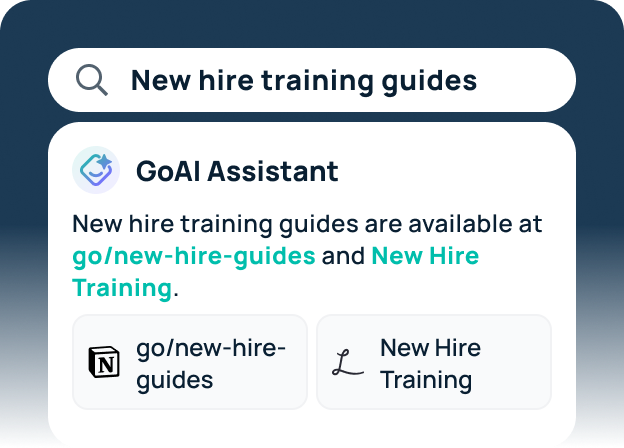
FAQs About Enterprise Search Tools
They enable employees to search across all internal systems—files, databases, cloud apps, and messages—from one interface.
They reduce wasted time, prevent duplicate work, accelerate decision-making, improve onboarding, and preserve institutional knowledge.
Key considerations include integrations, AI capabilities, security, scalability, adoption rates, analytics, and overall ROI potential.
AI enables natural language queries, semantic understanding, and generative summarization—helping employees get to the right answer faster.
Yes. Leading platforms offer permission-aware search and meet compliance standards such as SOC 2, GDPR, and HIPAA.
GoSearch delivers faster ROI with AI-first intelligence, enterprise-grade security, robust integrations, and minimal maintenance compared to custom builds.