

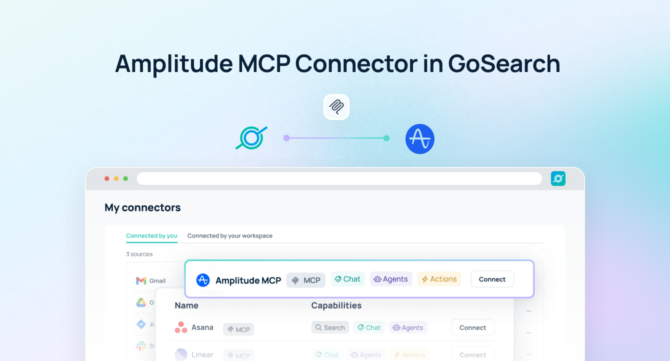

An Amplitude MCP server is a Model Context Protocol endpoint that connects AI agents to live Amplitude data — including events, funnels, retention charts, user cohorts, and behavioral insights — enabling intelligent querying and coordinated action without duplicating product analytics outside Amplitude.
Quick Answer: An Amplitude MCP server is a Model Context Protocol endpoint that gives AI agents real-time, permission-aware access to product analytics, user behavior data, charts, and cohorts — no data exports or custom integrations required.
With GoSearch, teams can deploy an Amplitude MCP server to interrogate product and user behavior data using natural language, automate analytics-informed workflows, and connect Amplitude to the broader enterprise stack. Instead of logging into dashboards to answer product questions or manually sharing chart screenshots in Slack, AI agents work directly inside Amplitude’s analytics model with full permission enforcement — and act on what they find across every connected system.
As product-led organizations mature their AI strategies, the ability to reason over live behavioral data and trigger coordinated action from those findings separates teams that react to product signals from teams that get ahead of them.
TL;DR
- An Amplitude MCP server is a Model Context Protocol endpoint that gives AI agents structured, permission-aware access to live Amplitude events, charts, funnels, cohorts, and behavioral insights.
- GoSearch’s Amplitude MCP server goes beyond read access — AI agents can act on product analytics and orchestrate workflows across 100+ connected enterprise tools in a single execution.
- Setup takes under 5 minutes. GoSearch inherits Amplitude’s existing permissions automatically, so teams are querying live product data without any additional indexing or syncing infrastructure.
- Key use cases include on-demand behavioral analysis, retention monitoring, feature adoption tracking, cross-system product alerts, and analytics-informed workflow automation.
- GoSearch’s Amplitude MCP server differs from Amplitude’s native MCP server, which provides chart and insight access for individual AI clients. GoSearch adds enterprise orchestration, write actions across connected systems, and a unified governance layer spanning your entire tool stack.
What Is an Amplitude MCP Server?
An Amplitude MCP server is a Model Context Protocol (MCP) endpoint that provides AI models and agents with structured, permission-aware access to Amplitude’s product analytics platform — including event data, user cohorts, funnel analyses, retention curves, A/B test results, and saved charts — in real time, without requiring dashboard exports, manual chart reviews, or custom analytics pipeline development.
MCP is an open standard for connecting AI systems to external tools and data sources. Rather than building and maintaining separate connectors for each application, MCP gives AI agents a consistent, standardized way to retrieve data, call tools, and execute actions across systems. Anthropic, which developed the standard, has seen broad adoption across Claude, Cursor, VS Code, and enterprise platforms globally.
Unlike integrations that depend on data warehouse syncs or scheduled report exports, an Amplitude MCP server lets AI operate on live behavioral data. Teams can use it to:
- Retrieve funnel drop-off rates, retention trends, and feature adoption metrics by natural language description
- Surface user cohort analysis and behavioral segments alongside product, engineering, or customer success context
- Trigger cross-system actions in Slack, Jira, Salesforce, or connected product and revenue tools based on analytical findings
- Automate weekly product health digests, experiment readouts, and engagement anomaly alerts
- Connect behavioral signals to the workflows where product decisions actually get made
Because the Amplitude MCP server enforces existing project and permission boundaries, AI agents access only the analytics data each user is authorized to view — maintaining data governance while dramatically reducing the time between a product question and a grounded, data-backed answer.
GoSearch Amplitude MCP Server vs. Amplitude’s Native MCP Server
Amplitude’s native MCP server provides chart and insight access for individual AI clients — a useful starting point for product teams that want to query their analytics from within an AI assistant or development tool.
The GoSearch Amplitude MCP server is designed for a broader scope: enterprise orchestration that connects Amplitude’s product intelligence to action across the full tool stack.
| Amplitude Native MCP | GoSearch Amplitude MCP | |
|---|---|---|
| Access charts, funnels & cohorts | ✅ | ✅ |
| Real-time, permission-aware access | ✅ | ✅ |
| Behavioral insight retrieval | ✅ | ✅ |
| Take actions across connected systems | ❌ | ✅ |
| Cross-system orchestration | ❌ | ✅ (100+ connectors) |
| Unified governance layer | ❌ | ✅ |
| Connect to Slack, Jira, Salesforce, CRM | ❌ | ✅ |
| Multi-agent routing | ❌ | ✅ |
If your team needs Amplitude to do more than answer questions about product behavior — triggering engineering tickets, alerting customer success teams, connecting analytics findings to operational systems, or enabling agents to reason and act across your full enterprise stack — GoSearch is the right platform.
How the GoSearch Amplitude MCP Server Works
The GoSearch Amplitude MCP server connects AI agents directly to live product analytics and coordinates downstream action across the enterprise.
When a user submits a query or a workflow is triggered, GoSearch interprets the request and dynamically invokes the Amplitude MCP server as a callable tool. The agent retrieves the relevant charts, cohorts, funnels, or behavioral metrics, synthesizes that data into a clear answer or action plan, and — when needed — combines Amplitude’s product intelligence with context from other connected systems like Jira, Salesforce, Intercom, or internal documentation.
This architecture moves product teams beyond passive dashboard consumption into active, signal-driven execution — where AI surfaces what the data reveals and follows through on what it means for the product, the team, and the customer.
What You Can Do With an Amplitude MCP Server
Connecting Amplitude via MCP unlocks a range of high-impact use cases that extend well beyond querying a saved chart.
Product and growth teams can answer behavioral questions on demand — drop-off rates in a specific funnel, retention differences between cohorts, feature adoption across user segments — without opening Amplitude, building a new chart, or waiting on a data analyst. The right answer comes back grounded in live event data, not a dashboard screenshot from last week.
Engineering teams can connect product signals to development workflows. When a metric drops below a threshold, an AI agent can retrieve the relevant Amplitude analysis, identify which funnel step is degrading, and create a Jira ticket for investigation — compressing what would otherwise be a multi-step, multi-person process into a single automated response.
Customer success and go-to-market teams gain behavioral context about the accounts and users they serve. Rather than asking the product team to pull usage data, an AI agent retrieves the relevant cohort or engagement trend from Amplitude and surfaces it directly inside CRM or support workflows — giving customer-facing teams the product intelligence they need to have more informed conversations.
Example Queries
A GoSearch Amplitude MCP server makes it possible to combine product analytics depth with cross-system action in ways no standalone analytics tool can deliver.
- “Show me the 30-day retention curve for users who completed onboarding this quarter versus last quarter.”
- “Identify the funnel step with the highest drop-off in our activation flow and create a Jira ticket for the product team to investigate.”
- “Find any features where weekly active usage has declined by more than 15% over the past month and notify the product lead via Slack.”
- “Pull engagement metrics for our enterprise cohort and add a usage summary to each account record in Salesforce.”
- “Summarize the results of the most recently concluded A/B experiment and post the readout to the #product-updates channel.”
- “Show me which user segments have the highest 90-day retention and flag them for the growth team to analyze.”
- “Alert the customer success team whenever a named account’s product engagement drops below their historical average for two consecutive weeks.”
These examples show how a GoSearch Amplitude MCP server turns behavioral analytics into coordinated enterprise action — not just a number on a chart.
Amplitude MCP Server vs. Traditional Approaches
Conventional approaches to connecting Amplitude data with broader enterprise workflows rely on manual chart sharing, scheduled email digests, or data warehouse pipelines that introduce latency and engineering overhead. Here’s how they compare:
| Amplitude MCP Server | Traditional Analytics Integration | Manual Export / Dashboard | |
|---|---|---|---|
| Data freshness | Real-time | Near real-time | Stale |
| Setup complexity | Low | High (custom dev) | N/A |
| Permission enforcement | Inherited from Amplitude | Must be rebuilt | Often bypassed |
| Cross-system orchestration | Yes (via GoSearch) | No | No |
| Infrastructure overhead | Minimal | High | High |
| Time to first query | Minutes | Weeks | N/A |
An Amplitude MCP server gives AI agents live, structured, permission-aware access to product analytics without reproducing data outside the platform. Every AI output reflects what Amplitude actually knows right now — current event counts, live cohort membership, the latest funnel metrics — rather than a chart rendered from yesterday’s export.
Learn why MCP is replacing custom integrations across enterprise AI →
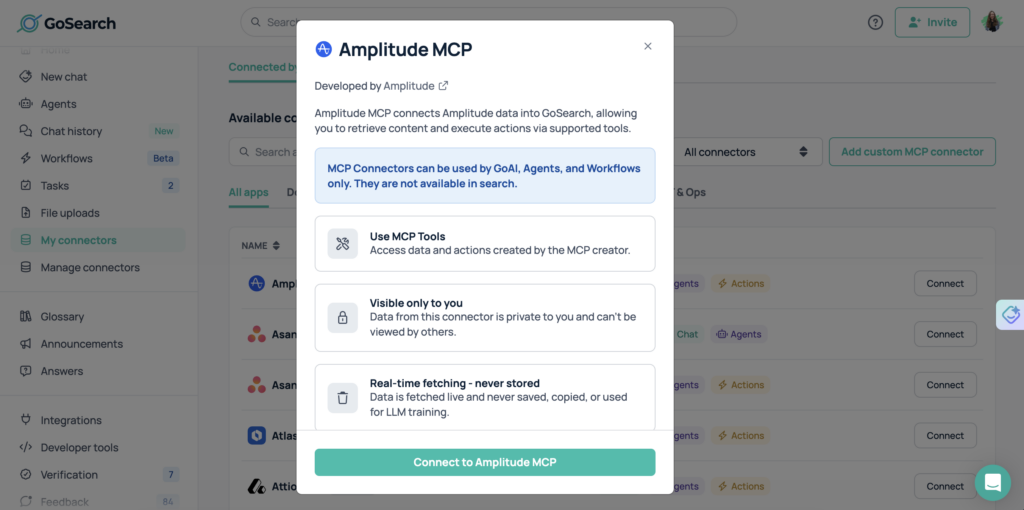
How to Connect Amplitude to an MCP Server in GoSearch
Connecting Amplitude to GoSearch via MCP is fast and requires no dedicated analytics or engineering resources. Most teams are querying live product data within the same session they begin setup.
- Enable the Amplitude MCP server in GoSearch.
Navigate to GoSearch’s connector library and activate the Amplitude MCP server from the integrations panel.
- Authenticate using Amplitude’s existing access controls.
Connect via Amplitude API credentials. GoSearch inherits Amplitude’s existing project permissions and user access configurations automatically — no need to recreate data access rules or rebuild role definitions. Required scopes include read access to charts, funnels, cohorts, and event data within authorized projects.
- Amplitude becomes a live tool for any AI agent or workflow in GoSearch.
No indexing, syncing, or data duplication is required. All access happens in real time through secure APIs. Amplitude is immediately callable by any AI agent or automated workflow you deploy through GoSearch.
- Start querying immediately.
Use natural language to retrieve behavioral analytics, surface product insights, or trigger cross-system workflows. Test with a simple query like: “What is the current week-over-week active user trend for our core product?”
Who Should Use an Amplitude MCP Server?
An Amplitude MCP server delivers value across every team that uses product behavior data to make decisions or drive action.
Product managers can retrieve funnel analysis, retention breakdowns, and feature adoption metrics on demand — through natural language rather than chart building — and immediately connect those findings to roadmap decisions, engineering priorities, and stakeholder communications.
Growth and experimentation teams can surface experiment results, cohort comparisons, and engagement trends directly within planning and communication workflows, reducing the cycle time between an analytical finding and a coordinated team response.
Engineering teams gain access to behavioral signals alongside code and infrastructure context. A drop in a key metric can automatically surface the relevant Amplitude analysis and trigger an investigation ticket — without requiring a product manager to manually bridge the two systems.
Customer success and account management teams can pull product usage data for specific accounts directly within CRM and support workflows, giving them the behavioral context needed to run more informed QBRs, anticipate churn risk, and identify expansion opportunities.
IT and security teams maintain full control over analytics data access, permission enforcement, and project-level governance across all AI-powered product analytics workflows. GoSearch inherits and enforces Amplitude’s access controls at every step — no AI agent ever accesses event data or cohorts beyond its authorized scope.
Why Use GoSearch for MCP Servers?
GoSearch provides a unified platform for deploying and managing MCP servers across the enterprise. By connecting Amplitude with more than 100 enterprise systems, GoSearch enables AI agents to reason over product analytics and coordinate action across tools — product, engineering, customer success, marketing, and revenue — under a single governance layer.
Teams can route behavioral signals directly into the operational workflows where decisions get made, ensuring that a retention drop, a feature adoption spike, or an engagement anomaly triggers the right response across the right systems automatically. Because GoSearch treats Amplitude as a live analytical engine rather than a reporting destination, product intelligence becomes a continuous input to enterprise decision-making rather than a periodic deliverable from the data team.
Get Started With the Amplitude MCP Server
The GoSearch Amplitude MCP server enables organizations to operationalize product analytics across tools and workflows. AI agents can retrieve, analyze, and act on live Amplitude data — triggering engineering investigations, updating CRM records, generating experiment readouts, and coordinating cross-system product workflows automatically — with no manual dashboard navigation and full security and compliance across the enterprise.
Get a demo to see how GoSearch connects Amplitude and other MCP servers to power AI workflows that turn product signals into coordinated action.
Search across all your apps for instant AI answers with GoSearch
Schedule a demo
Amplitude MCP Server: Frequently Asked Questions
An Amplitude MCP server is a Model Context Protocol endpoint that allows AI agents to access live Amplitude data — including events, funnels, retention charts, user cohorts, and behavioral insights — in real time. It gives AI models a standardized, permission-aware way to query and act on product analytics without requiring dashboard exports, manual chart reviews, or custom API development.
The Amplitude API requires custom development and ongoing maintenance for each integration. An MCP server exposes Amplitude as a standardized, callable tool that any MCP-compatible AI agent can use immediately — no custom code required. It also allows AI agents to combine Amplitude product analytics with data from other enterprise systems in a single coordinated workflow.
No. Amplitude’s native MCP server provides chart and insight access for individual AI clients — a solid starting point for product teams querying their analytics from within an AI assistant. GoSearch’s Amplitude MCP server is built for enterprise orchestration, enabling AI agents to act on behavioral findings across 100+ connected systems, coordinate cross-functional product workflows, and operate under a unified governance layer.
The GoSearch Amplitude MCP server requires read access to charts, funnels, cohorts, and event data within authorized Amplitude projects. Amplitude’s existing project permissions and user access configurations are inherited automatically. AI agents cannot access analytics data beyond what the authenticated user is authorized to view.
GoSearch’s Amplitude MCP server supports both retrieval and action. AI agents can query Amplitude’s product analytics and also trigger downstream actions — creating engineering tickets, sending metric alerts, updating CRM records, and coordinating multi-system workflows based on what the behavioral data reveals.
MCP is an open standard with broad adoption. Compatible tools include Claude (Anthropic), Cursor, VS Code with Copilot, and enterprise platforms like GoSearch that manage MCP servers at scale. Any MCP-compatible client can connect to an MCP server using the standardized protocol.
Most teams complete setup in under 5 minutes. Authentication uses Amplitude’s existing API credential flow, permissions are inherited automatically, and no data indexing is required. Teams are typically querying live Amplitude analytics within the same session they begin setup.

![Selecting the Best Enterprise Search Software [Features + Vendors]](https://images.gosearch.ai/blog/content/uploads/2023/10/17234328/Blog-Header-3-370x184.png)