


GoSearch has added GPT-5.5 to its model lineup, giving enterprise teams access to OpenAI’s most capable model yet alongside the latest models from Anthropic and Google Gemini, all within a single, governed AI platform built for work.
For enterprise teams, model choice matters. Different tasks demand different models. A complex multi-step agent workflow and a quick knowledge base query don’t need the same intelligence. GoSearch lets teams select the right model for the right job. With GPT-5.5 now available, the ceiling for what those agents and workflows can accomplish has moved significantly higher.
Quick Answer: GoSearch now supports GPT-5.5 — OpenAI’s most capable model to date, released April 23, 2026 — alongside the latest models from Anthropic and Google Gemini. Enterprise teams can select GPT-5.5 across GoSearch’s search, AI chat, agents, and workflows to power more capable agentic tasks, higher-quality knowledge synthesis, and more reliable multi-step automation. GPT-5.5 delivers stronger reasoning without a speed tradeoff, making it the most capable and efficient frontier model option now available in GoSearch.
What Is GPT-5.5?
GPT-5.5 is OpenAI’s latest frontier model, released April 23, 2026. According to OpenAI, it represents a meaningful step up in intelligence over GPT-5.4, with gains concentrated in exactly the areas that matter most for enterprise AI: agentic work, knowledge tasks, and sustained multi-step reasoning.
A few things make GPT-5.5 stand apart from its predecessors:
Stronger agentic performance. OpenAI reports that the gains are “especially strong in agentic coding, computer use, knowledge work, and early scientific research — areas where progress depends on reasoning across context and taking action over time.” For enterprise workflows that span multiple tools, require planning across long contexts, and execute tasks end-to-end, this is a direct capability upgrade.
No speed tradeoff. Larger, more capable models are typically slower. GPT-5.5 is an exception: OpenAI states it matches GPT-5.4’s per-token latency in real-world serving while performing at a higher level of intelligence. It also uses significantly fewer tokens to complete the same tasks, making it more efficient and more capable simultaneously.
Handles messy, real-world instructions. According to Digital Trends, GPT-5.5 is designed to handle “messy” instructions — requests that are incomplete or loosely defined — and still produce structured outputs. This reduces friction for enterprise users who can’t always frame prompts with precision.
Better sustained reasoning. GPT-5.5 is better at persisting across multi-stage research and analysis loops: exploring an idea, gathering evidence, testing assumptions, interpreting results, and deciding what to try next, without losing context or coherence across a long task.
Enterprise-grade safety. OpenAI released GPT-5.5 with its strongest set of safeguards to date, having evaluated the model across its full suite of safety and preparedness frameworks. For organizations with compliance requirements, this matters.
The practical result, confirmed by NVIDIA teams who had early access: debugging cycles that once took days are closing in hours, and experimentation that previously required weeks is turning into overnight progress.
Why Model Choice Matters for Enterprise AI
The enterprise AI landscape is consolidating around one central truth: model selection is a strategic decision, not a technical preference.
According to Deloitte’s 2026 State of AI in the Enterprise report, worker access to AI rose 50% in 2025, and twice as many leaders as the prior year are reporting transformative impact — but only 34% are truly reimagining their business with AI. The gap between teams that deploy AI and teams that derive enterprise-scale value from it is largely a question of how well AI is integrated into real workflows, not just whether it’s available.
Different use cases demand different models. A frontier model optimized for agentic reasoning handles complex, multi-step agent workflows better than a fast, lightweight model — and vice versa for high-volume, lower-complexity queries. OpenAI’s own enterprise data shows that workers who save more than 10 hours per week are using multiple models, engaging with more tools, and using AI across a wider range of tasks. The highest-performing enterprise AI users aren’t locked into a single model — they’re selecting the right intelligence for the task at hand.
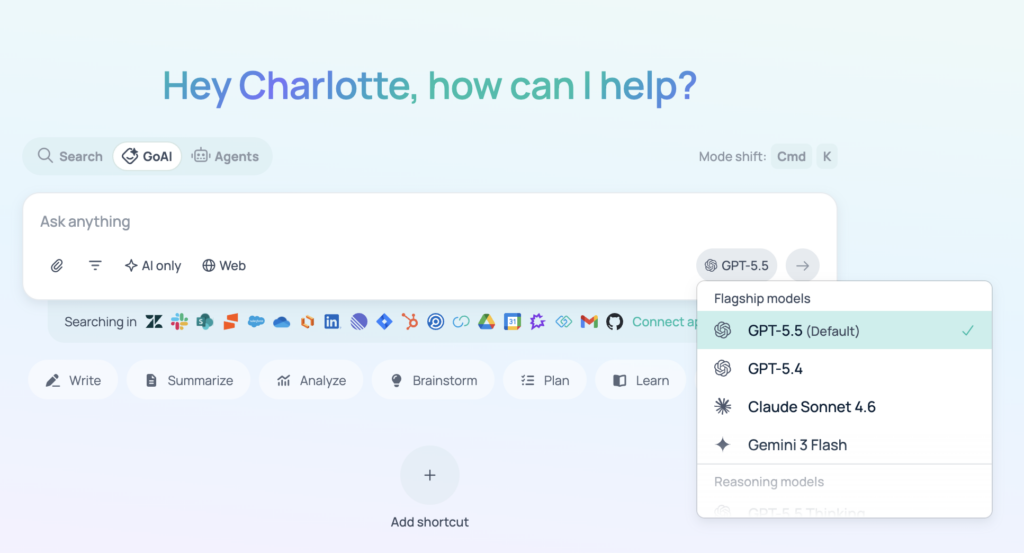
GoSearch is built around this principle. With GPT-5.5 now available alongside Claude Sonnet 4.6, Gemini 3.1 Pro, and other leading models, enterprise teams can match model capability to task complexity across every surface: search, AI chat, agents, and automated workflows.
GPT-5.5 in GoSearch: Four Enterprise Use Cases
1. Enterprise Search
Enterprise search is one of the highest-leverage applications of frontier AI and one of the hardest to do well. Employees spend enormous amounts of time searching for information across disconnected systems: CRM records, documentation, project tools, communication threads, and file repositories. When search is powered by a model that can reason, synthesize, and surface the right answer rather than just returning matching documents, that changes the calculus entirely.
GPT-5.5’s improvements in knowledge work and sustained reasoning make it particularly well-suited to enterprise search queries that require more than keyword matching. A question like “What did we commit to Acme Corp in the last two QBRs, and how does it compare to our current delivery status?” requires reading context from multiple sources, reconciling information across time, and synthesizing a coherent answer, not retrieving a single document.
GoSearch connects to more than 100 enterprise systems via MCP servers and native integrations, feeding live, permission-aware data into every search query. With GPT-5.5 as the reasoning layer, the quality of synthesis across those connected sources improves materially. Employees get answers grounded in the actual state of the organization, not a ranked list of documents they still have to read.
According to Menlo Ventures’ 2025 State of Generative AI in the Enterprise report, enterprise AI spending surged to $37 billion in 2025, with organizations increasingly preferring to buy integrated AI solutions rather than build — because ready-made solutions reach production more quickly and demonstrate immediate value. Enterprise search is one of the clearest examples of where integrated, model-powered AI delivers faster time-to-value than anything built internally.
2. AI Chat
AI chat in an enterprise context is a fundamentally different product than consumer chatbots. It needs to reason over proprietary data, maintain governance across sensitive information, handle domain-specific terminology, and produce outputs reliable enough for business decisions.
GPT-5.5’s improvements in handling loosely defined instructions are directly relevant here. Enterprise employees rarely craft perfectly structured prompts. A salesperson asking “what’s the latest with the Acme deal?” or a finance analyst asking “how are we tracking against Q2 targets?” needs the AI to interpret intent, retrieve the right context, and deliver a useful answer — without requiring prompt engineering expertise.
GoSearch’s AI chat is connected to the organization’s live data through its 100+ integrations. With GPT-5.5 available as a model choice, enterprise teams can select a higher-capability reasoning model for complex analysis queries while using faster, lighter models for high-volume everyday tasks. The result is an AI chat experience that’s both more capable and more cost-efficient — because not every query needs frontier intelligence.
Greg Brockman, OpenAI’s president, described GPT-5.5 as “a faster, sharper thinker for fewer tokens,” noting that it means “more frontier AI available for businesses and consumers.” That efficiency advantage matters at enterprise scale, where query volume is high and cost-per-token adds up across an organization.
3. AI Agents
Agentic AI is where GPT-5.5’s capabilities are most pronounced and where the stakes for enterprise teams are highest. Agents are increasingly responsible for real work: researching competitors, triaging tickets, processing documents, coordinating workflows, and executing multi-step tasks across connected systems. The quality of that work depends directly on the model’s ability to plan, reason, and persist across a long sequence of actions without losing coherence.
According to a Q1 2026 enterprise AI adoption review, more than 80% of Fortune 500 companies now run AI agents in production. But agent ROI remains uneven: only 23% of organizations see significant ROI from AI agents, despite widespread deployment. The gap is largely explained by model capability — agents running on less capable models make more errors, require more human intervention, and fail to complete longer task sequences reliably.
GPT-5.5 directly addresses these failure modes. OpenAI reports it persists better across multi-stage workflows, handles context over longer sequences, and produces more reliable outputs with fewer wasted cycles. For GoSearch’s agent layer — which can invoke MCP servers, retrieve live data, and take actions across connected enterprise systems — this translates into agents that complete more tasks end-to-end without human correction.
Enterprise teams can configure GoSearch agents to use GPT-5.5 for high-stakes, multi-step tasks while routing simpler queries to faster models. That model routing capability — combined with GPT-5.5’s efficiency advantage — means more capable agents don’t necessarily mean higher costs. OpenAI confirmed the model uses significantly fewer tokens to complete the same tasks compared to earlier models, making frontier-level agent performance more accessible at scale.
NVIDIA’s blog on the GPT-5.5 launch noted that teams using GPT-5.5 in Codex are “shipping end-to-end features from natural language prompts, with stronger reliability and fewer wasted cycles than earlier models.” The same principle applies to enterprise agents in GoSearch: reliability and completion rate are the metrics that determine whether agentic AI delivers real business value.
4. Automated Workflows
GoSearch’s workflow layer allows enterprise teams to build automated, multi-step processes that combine AI reasoning with live data from connected systems. A workflow might retrieve open support tickets from Intercom, summarize them, identify escalation candidates, create Jira tickets for engineering, and notify the relevant team in Slack — all without human intervention at each step.
The quality of those workflows depends on the model’s ability to reason reliably across multiple steps, handle ambiguous or incomplete inputs, and maintain coherent context through a long execution chain. GPT-5.5’s agentic reasoning improvements make it a stronger foundation for these multi-step automated workflows than any previous OpenAI model.
OpenAI’s enterprise research shows the average ChatGPT Enterprise user saves 40–60 minutes per day, with heavy users saving more than 10 hours per week. Those gains are concentrated in exactly the kind of repetitive, multi-step knowledge work that GoSearch workflows are designed to automate. GPT-5.5 raises the ceiling on what those workflows can accomplish reliably — particularly for complex, cross-system processes that previously required human oversight at key decision points.
Deloitte’s 2026 AI report found that 66% of organizations are already reporting real efficiency gains from AI, and the number of companies with 40% or more of their AI projects in production is set to double in the next six months. Workflow automation is the category most likely to drive that production adoption. Model capability is the variable that most directly determines whether those workflows run reliably enough to trust with real business processes.
GoSearch: The Enterprise AI Platform Built for Model Flexibility
GoSearch is the enterprise AI platform that connects your tools, your data, and your people — powered by the best available AI models, with the governance and security that enterprise teams require.
With GPT-5.5 now available alongside Claude Sonnet 4.6, Gemini 3.1 Pro, and other leading models, GoSearch gives enterprise teams genuine model choice at every layer of the platform. The right model for a complex agent workflow isn’t the same as the right model for a quick search query or a routine workflow step, and GoSearch lets teams configure accordingly.
Every query, chat, agent, and workflow runs against live, permission-aware data from more than 100 connected enterprise systems via GoSearch’s MCP server and native integration layer. That means GPT-5.5 isn’t reasoning over static training data, it’s reasoning over your organization’s actual, up-to-date information, with the governance controls your IT and security teams require.
The highest-ROI enterprise AI deployments share three traits: domain specificity, deep workflow integration, and buying versus building. GoSearch is purpose-built around all three. Domain-specific enterprise search, deeply integrated workflow automation, and a platform available today without requiring months of internal development.
In Summary
GoSearch now supports GPT-5.5, giving enterprise teams access to OpenAI’s most capable model alongside the latest models from Anthropic and Google Gemini — all within a single, governed AI platform. GPT-5.5 brings meaningful gains in agentic performance, knowledge work, and multi-step reasoning, with no tradeoff in speed and improved token efficiency. For enterprise teams using GoSearch, this means stronger search synthesis across 100+ connected systems, more capable AI chat that handles real-world, loosely framed queries, AI agents that complete multi-step tasks more reliably end-to-end, and automated workflows that require less human intervention at key decision points. GoSearch lets teams select the right model for the right task — and GPT-5.5 raises the ceiling for what the most demanding enterprise AI tasks can accomplish.
Get Started With GPT-5.5 in GoSearch
GPT-5.5 is available now for GoSearch enterprise customers. Teams can select GPT-5.5 as their model of choice across GoSearch’s search, AI chat, agent, and workflow surfaces.
Try GoSearch for free to see how GoSearch combines GPT-5.5 with live enterprise data from your connected systems to power search, AI chat, agents, and workflows that deliver measurable results across your organization.
Personal access to agentic enterprise search, free with GoSearch.
Sign up
GPT-5.5 Frequently Asked Questions
GPT-5.5 is OpenAI’s latest frontier model, released April 23, 2026. It delivers meaningful gains in agentic performance, knowledge work, and multi-step reasoning compared to GPT-5.4, while matching its predecessor’s per-token latency and using fewer tokens to complete the same tasks — making it more capable and more efficient simultaneously.
GPT-5.5 is a step up in intelligence over GPT-5.4, with the most pronounced gains in agentic coding, computer use, knowledge work, and multi-stage reasoning tasks. Notably, it achieves this higher level of capability without a speed penalty — it matches GPT-5.4’s real-world serving latency while performing at a higher level, and completes the same tasks using significantly fewer tokens.
Yes. OpenAI released GPT-5.5 with its strongest set of safeguards to date and designed it specifically for the kinds of sustained, multi-step knowledge work that enterprises depend on. Its improvements in handling loosely defined instructions, persisting across long task sequences, and producing reliable outputs make it particularly well-suited to enterprise workflows. Platforms like GoSearch make GPT-5.5 available within an enterprise governance layer that enforces permissions and keeps data secure.
GPT-5.5 performs best in use cases that require sustained reasoning across context: multi-step agentic workflows, complex knowledge synthesis across multiple data sources, enterprise search that requires synthesizing answers rather than returning documents, and automated workflows that need to complete long task sequences reliably without human intervention. It also shows meaningful gains in technical research, coding, and document analysis tasks.
GPT-5.5 persists more reliably across multi-stage agentic tasks, handles ambiguous or incomplete instructions more effectively, and produces outputs with fewer errors and wasted cycles compared to previous models. OpenAI reports the gains are especially strong in agentic coding and computer use — areas where progress depends on reasoning across context and taking action over time. For enterprise teams running agents that execute tasks across connected systems, this translates to higher completion rates and less need for human correction at each step.
GPT-5.5’s stronger knowledge work and reasoning capabilities allow it to synthesize answers across multiple data sources more accurately than previous models. Rather than matching keywords to documents, a search platform powered by GPT-5.5 can reason across live data from CRM, project management, documentation, support, and other connected tools to return a single, coherent answer grounded in an organization’s actual information. GoSearch connects GPT-5.5 to more than 100 enterprise systems for exactly this purpose.
GPT-5.5 is available through OpenAI’s API and in ChatGPT for Plus, Pro, Business, and Enterprise users. Enterprise AI platforms that integrate the OpenAI API — including GoSearch — also make GPT-5.5 available within their own governed environments, allowing teams to use the model alongside other frontier models from Anthropic and Google within a single platform.
GPT-5.5 leads on agentic task performance and sustained multi-step reasoning, making it particularly strong for complex automated workflows and end-to-end task execution. Claude models from Anthropic excel at nuanced writing, instruction following, and long-context document analysis. Gemini models offer strong multimodal capabilities and deep integration with Google Workspace. For enterprise teams, the answer is rarely one model — platforms like GoSearch that support all three give teams the flexibility to use the right model for each task.