



Enterprise search buyers often hear the same message from vendors: indexing everything is the best and only way to deliver fast, intelligent search. Centralize all data, store it in one place, and let AI work from there.
In practice, this assumption does not always hold up, especially for large organizations with sensitive data, complex permissions, and constantly changing systems.
Modern enterprise search platforms like GoSearch take a hybrid approach, combining indexing where it adds value with real-time federated search for personal and sensitive data. Below are some of the most common myths about indexing, and why a hybrid model delivers better outcomes for enterprise teams.
Myth 1: Indexing is always faster than federated search
Indexing is often positioned as the fastest possible search model because data is preloaded and stored centrally. While this can reduce query latency in some cases, speed alone does not define search quality.
In enterprise environments, indexed systems require continuous syncing, reindexing, and permission updates. As data changes, indexes fall out of date, especially for systems like CRMs, ticketing tools, and shared drives that update frequently.
A hybrid approach uses indexing for stable, shared content while retrieving personal or dynamic data in real time from source systems. In practice, this delivers fast results while ensuring the information returned is current and accurate.
For most users, fresh and correct results matter more than marginal differences in query response time.
Myth 2: Indexing provides more context because data is centralized
A common concern is that federated search loses context or metadata because files are not stored locally. In reality, the opposite is often true.
When systems are fully indexed, data from multiple objects is flattened into a single schema or table. This can remove object-level distinctions, relationships, and filters that exist in the source system.
With real-time federated search, GoSearch queries applications directly through APIs across multiple objects. This allows the search engine to preserve native structure, object relationships, and granular filters that are difficult to reconstruct after indexing.
Instead of reverse engineering context after ingestion, federated search uses the source system’s own data model. This often results in richer context, more accurate filtering, and more relevant answers for users.
Myth 3: Indexing is required for AI and semantic relevance
Indexing is frequently framed as a prerequisite for AI-powered search, semantic understanding, and large language model integration. While indexes can support these capabilities, they are not required.
GoSearch applies AI at query time, combining semantic understanding with real-time data retrieval. This allows models to reason over live data without relying on a static snapshot stored elsewhere.
In many cases, applying AI to real-time data produces better results because it reflects current state, permissions, and relationships rather than outdated indexed copies.
This approach is particularly important for systems where accuracy and freshness are critical, such as sales pipelines, support tickets, and operational dashboards.
Myth 4: Indexing is safer because everything is controlled centrally
Centralizing enterprise data through indexing can simplify some workflows, but it also increases risk. Large indexed data stores expand the attack surface and introduce additional governance challenges.
A hybrid model reduces stored data by indexing only shared or universal content and retrieving sensitive or personal information on demand. Permissions are enforced by the source system at query time rather than duplicated in a secondary database.
For security and IT teams, this means fewer copies of sensitive data, clearer audit boundaries, and less risk of accidental exposure.
Myth 5: Federated search does not scale for large enterprises
Federated search is sometimes viewed as a compromise solution that works only for small teams or limited use cases. This assumption is outdated.
Modern APIs, caching strategies, and query optimization allow federated search to operate efficiently at enterprise scale. By avoiding unnecessary indexing, organizations also reduce storage costs, reindexing overhead, and ongoing maintenance.
GoSearch is designed to scale across thousands of users and hundreds of tools without requiring a dedicated team to manage ingestion pipelines or index tuning.
Why a hybrid enterprise search model works better
The debate between indexing and federated search is not about choosing one over the other. It is about applying each approach where it makes sense.
A hybrid enterprise search model allows organizations to:
- Index shared, stable content for fast discovery
- Retrieve sensitive or personal data in real time with source-level permissions
- Preserve native system context and metadata
- Reduce data duplication and governance complexity
- Lower long-term infrastructure and operational costs
This approach reflects how modern enterprises actually work. Data lives across many systems, changes constantly, and is governed by strict access rules.
TL;DR: Enterprise Search Indexing vs Hybrid Search
- Enterprise search indexing centralizes data but can flatten context, duplicate sensitive information, and increase operational overhead.
- Federated search retrieves data directly from source systems, preserving native structure and permissions.
- A hybrid enterprise search model combines indexing for shared content with real-time access for sensitive or dynamic data.
- This approach improves accuracy, security, and scalability while reducing long-term infrastructure and governance costs.
Rethinking enterprise search architecture
Indexing everything is not inherently better. In many cases, it trades accuracy, context, and security for architectural simplicity.
By combining federated and indexed search, GoSearch delivers enterprise AI search that is faster to deploy, safer to operate, and more aligned with how teams use their tools every day.
For organizations evaluating enterprise search platforms, understanding these architectural tradeoffs is key to making a long-term decision that scales.
Frequently Asked Questions About Enterprise Search Indexing
Is enterprise search indexing required for AI-powered search?
No. While indexing can support some AI workflows, modern enterprise search platforms can apply semantic understanding and large language models at query time. Real-time federated search allows AI to reason over live data while preserving permissions and current context.
What is the difference between enterprise search indexing and federated search?
Enterprise search indexing stores copies of data in a centralized index, while federated search retrieves information directly from source systems in real time. A hybrid model combines both approaches, indexing shared content while federating access to personal or sensitive data.
Does federated enterprise search scale for large organizations?
Yes. Advances in APIs, caching, and query optimization allow federated search to operate at enterprise scale. Hybrid architectures often reduce storage costs and operational overhead compared to indexing everything.
Why do some enterprise search vendors still index everything?
Indexing simplifies architecture and reduces reliance on real-time APIs, but it can flatten context, duplicate sensitive data, and increase governance and infrastructure costs as organizations scale.
Search across all your apps for instant AI answers with GoSearch
Schedule a demo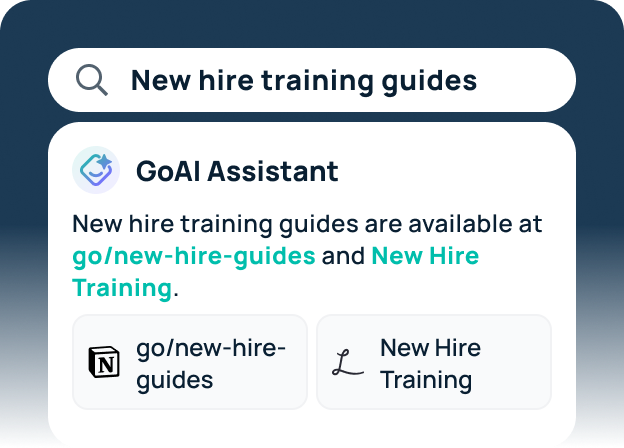


![Selecting the Best Enterprise Search Software [Features + Vendors]](https://images.gosearch.ai/blog/content/uploads/2023/10/17234328/Blog-Header-3-370x184.png)