Need a little productivity boost? Join our monthly newsletter and we'll go/link you to the latest tips and trends in tech!
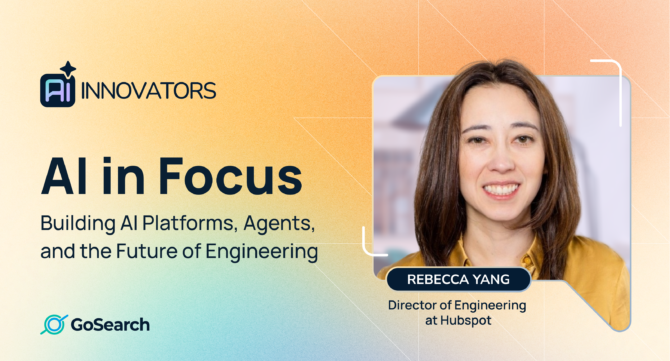
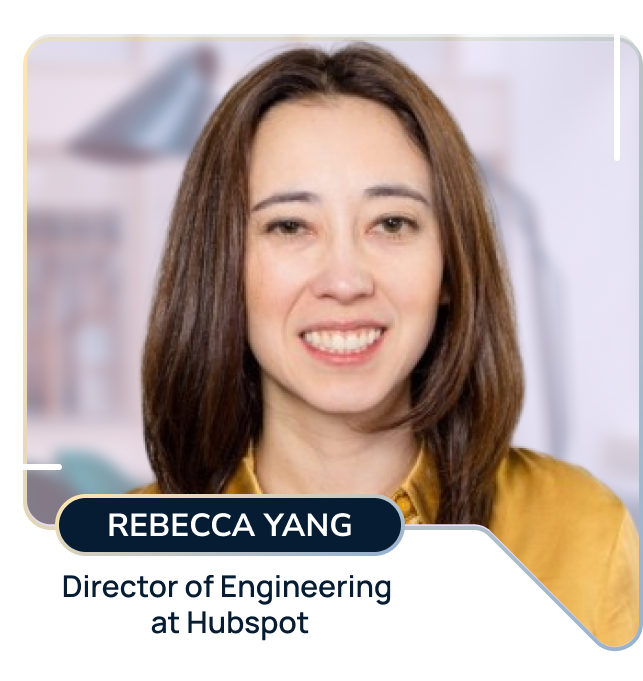
In this edition of AI Innovators, we sat down with Rebecca Yang, Director of Engineering at HubSpot, to discuss AI infrastructure, platform thinking, MCP, enterprise adoption, and what separates real AI innovation from hype.
Rebecca previously helped scale Clearbit before its HubSpot acquisition and now leads engineering initiatives across AI-powered data systems, smart properties, intent signals, and platform infrastructure.
Key Takeaways
Context is King: Enterprise AI value depends on how well systems access and connect internal and external data.
Platform vs. Feature: Real AI platforms hold up when underlying models change; features break when models are swapped.
Agents ≠ Workflows: Most current “agents” are enhanced workflows — true autonomy means independent decision-making and a larger blast radius when things go wrong.
Governance is Essential: Provenance, reversibility, and guardrails aren’t optional — silent, large-scale data corruption is the real enterprise AI risk.
Execution Matters Most: Successful enterprise AI adoption depends on ownership, measurement, and strong enablement — not just model selection.
Rebecca Yang, Director of Engineering at HubSpot, on what separates AI platforms from features, why context drives enterprise AI value, and how MCP, agents, and infrastructure design are shaping the future of enterprise AI.
From SEO to AI Infrastructure
You’ve spent your career across the Bay Area technology ecosystem. Can you tell us about your background and how you ended up focusing on AI?
Rebecca Yang: I grew up in Palo Alto, so I’ve been immersed in tech culture from day one. I started my career at iProspect, working on search engine optimization and search engine marketing, then moved to Adobe Marketing Cloud, focusing on media optimization. From there, I joined a few startups in SMS marketing and call tracking before landing at Clearbit, which was later acquired by HubSpot.
What’s interesting is that my career has largely centered around B2B — and I love it. B2B problems are honest: you’re solving a real business problem, delivering measurable return on investment, and customers tell you quickly whether the product actually adds value.
“In B2B, you can’t hide behind flashy features forever. If the product doesn’t create value, people know.”
— Rebecca Yang, Director of Engineering at Hubspot
Where SEO and AI Converge
You started in SEO, which feels incredibly relevant again now with AI search, AEO, and GEO becoming mainstream.
Rebecca Yang: It’s funny because we’ve seen this cycle before. During the early SEO era, companies tried to game search engines with keyword stuffing and manipulative tactics — and eventually, search engines adapted.
The same pattern will likely emerge with large language models and AI discovery. Companies will try to manipulate visibility inside AI systems, and frontier model providers will continuously adapt to prevent abuse. It’ll be another version of the same cat-and-mouse game.
From Clearbit to HubSpot: Inside the AI Shift
What did the transition from Clearbit to HubSpot look like from an AI product perspective?
Rebecca Yang: At Clearbit, our core business was extracting structured insights from unstructured internet data. Historically, that required a huge amount of engineering effort — regular expressions, scraping logic, traversal systems.
Then suddenly, a lot of those problems became inexpensive LLM calls.
What changed wasn’t the value of the work. What changed was the cost of doing it well.
That’s really the broader AI story happening across the industry right now.
One thing that helped us integrate into HubSpot was that Clearbit was already very modular and AI-first in how we thought about products. That made it easier to plug into the broader HubSpot ecosystem.
The biggest challenge was technical. Clearbit primarily used Ruby, Go, and JavaScript, while HubSpot runs heavily on Java and TypeScript. But engineers adapted incredibly quickly once expectations were clearly set.
“What changed wasn’t the value of the work. What changed was the cost of doing it well.”
— Rebecca Yang, Director of Engineering at Hubspot
Hype Cycles, Skepticism, and Staying Curious
You’ve lived through multiple technology waves — dot-com, social, crypto, metaverse, and now AI. How has that shaped your perspective?
Rebecca Yang: I’ve learned that some things that look incredibly valuable turn out to be hype, while others that initially sound ridiculous become transformational.
I remember hearing about Bitcoin in 2009 and thinking it sounded like a scam. In retrospect, I wish I had been more curious.
That experience taught me to stay open-minded while also maintaining healthy skepticism. There’s a lot of hype in technology, but there are also genuine platform shifts happening beneath the noise.
I don’t think anyone can perfectly predict the future, but I do think you can build the ability to adapt quickly.
Working at HubSpot has also been interesting because the company brings a long-term, disciplined perspective, while the Bay Area culture brings intensity and speed. Good decisions often happen at the intersection of those two mindsets.
AI Platforms vs. AI Features
What’s the difference between building an AI platform versus simply adding AI features?
Rebecca Yang: The easiest test is this: if your underlying model disappears tomorrow and your product completely breaks, you probably built a feature on top of a model.
If you can swap models relatively seamlessly and customers barely notice, you built a platform.
A lot of so-called AI platforms today would fail that test.
The hardest challenge right now is data shape and infrastructure design — because the “right” architecture keeps changing. A year ago, everyone thought vector databases were the answer. Today, many teams are moving toward more dynamic agentic retrieval systems and Model Context Protocol-based approaches.
The stack is evolving incredibly fast.
Why Context Still Wins
Everyone talks about context layers and proprietary data as the moat for enterprise AI. How important is context in practice?
Rebecca Yang: Context matters enormously — and you realize just how much the second a connector breaks and your AI system loses access to the information it needs.
HubSpot has a massive amount of go-to-market context: CRM data, marketing content, emails, transcripts, websites, customer interactions. Combined, that data generates far more useful intelligence than any single source alone.
For our team specifically, combining external data with internal customer context creates incredibly powerful global datasets.
“You realize how important context is the second one of your connectors breaks.”
— Rebecca Yang, Director of Engineering at Hubspot
What Actually Defines an AI Agent?
Everyone is calling their products “agents” right now. What separates a real AI agent from sophisticated automation?
Rebecca Yang: Most “agents” today are really workflows with LLM calls embedded inside them.
That’s not necessarily bad, but it’s different from true autonomy.
Traditional automation fails gracefully and deterministically. A true autonomous agent makes decisions independently, which means it can also fail confidently and create a much larger blast radius when something goes wrong.
That’s the defining difference: autonomy and consequence.
Why Enterprise AI Needs Guardrails Before It Earns Trust
As a public company handling sensitive customer data, how do you think about AI governance and security?
Rebecca Yang: Compliance is the minimum standard. Responsible product design goes much further.
The scariest failure mode in enterprise AI isn’t a bad chatbot response — it’s silent corruption at scale: thousands of incorrect CRM updates, bad merges, or degraded customer data accumulating over time.
That’s why provenance matters so much. You need to know where data came from, how it can be used, and whether actions can be reversed.
Reversibility, confidence thresholds, and organizational guardrails are all critical.
Why MCP Matters More Than People Realize
MCP has become one of the biggest topics in enterprise AI. Do you see it as transformational or simply infrastructure plumbing?
Rebecca Yang: It’s both. But plumbing matters. HTTP was plumbing. Roman aqueducts were plumbing.
What matters is standardization. Model Context Protocol gives agents structured access to tools, actions, and context. Internally, it has dramatically accelerated how our teams build products — agents can now reason across systems, logs, services, APIs, and developer environments far more effectively.
The speed improvement is very real.
Why Some Enterprise AI Rollouts Fail
Many companies are struggling to show ROI from AI investments. Why do some deployments succeed while others fail?
Rebecca Yang: The successful rollouts I’ve seen all share three things:
Clear accountability
Strong measurement
Deep enablement
At HubSpot, we track adoption closely. We measure developer productivity improvements. We run dedicated training, office hours, and rollout programs.
But the biggest factor is executive conviction. The teams leading successful deployments genuinely believe the technology can create value, so they optimize the rollout experience instead of abandoning the initiative at the first sign of friction.
Rapid Fire Questions
Most overused term in enterprise AI right now?
Rebecca Yang: “Agentic.”
One AI tool you personally use every day?
Rebecca Yang: Claude at work. Perplexity Computer on the personal side.
What skill should engineers focus on most right now?
Rebecca Yang: Problem decomposition and the ability to rapidly forget outdated assumptions.
Every new frontier model changes what’s possible.
Is AI making engineers better or lazier?
Rebecca Yang: Both. The floor is rising for average engineers, while the ceiling is rising for great engineers. The definition of a “great engineer” is changing rapidly.
What advice would you give your younger self entering tech today?
Rebecca Yang: If something feels overwhelming or intimidating, that’s usually a sign you’re learning and growing in the right environment.
One final question: If you weren’t working in AI or engineering, what would you be doing?
Rebecca Yang: This might sound a little unusual, but I think senior care is overdue for a reimagining. Just as approaches like Montessori and Waldorf changed how we think about childhood development, I believe we need a more thoughtful, dignified model for caring for older adults. If I weren’t an engineer, I’d probably be building something like a Montessori for senior care — environments that prioritize independence, purpose, and quality of life in later stages of aging.
The Engineering Mindset That Will Define the AI Era
Rebecca Yang’s perspective highlights one of the biggest realities shaping enterprise AI today: the winners won’t be companies bolting on AI features—they’ll be the organizations building adaptable platforms grounded in context, infrastructure, governance, and measurable value.
As the industry shifts toward agents, Model Context Protocol, and AI-native workflows, one thing stays constant: the companies that combine strong engineering fundamentals with curiosity and adaptability will move fastest.
About GoSearch
GoSearch is an AI-powered enterprise search and agent platform that helps organizations unify knowledge across applications, build AI workflows, and deploy secure AI agents at scale.
Unlike traditional enterprise search tools, GoSearch combines federated search, indexed search, and MCP-based connectivity to give teams real-time access to information across workplace tools, SaaS applications, documents, chats, CRMs, and internal systems.
Organizations use GoSearch to:
Power enterprise AI search across disconnected systems
Build no-code AI agents and workflows
Connect applications using MCP servers and connectors
Improve employee productivity with trusted AI answers and automation
Brandon Most is Head of Marketing at GoLinks, GoSearch, and GoProfiles, where he helps enterprise teams navigate the AI landscape and deploy tools that actually improve how work gets done. With nearly 20 years of SaaS marketing experience, he connects buyers with solutions that deliver measurable impact — and advises the boards and executive teams of several venture-backed startups.
OpenAI Dots pricing and alternatives for enterprise buyers. Balance between always-on agents whereas GoSearch brings proactive, permission-aware AI to every employee.