Need a little productivity boost? Join our monthly newsletter and we'll go/link you to the latest tips and trends in tech!
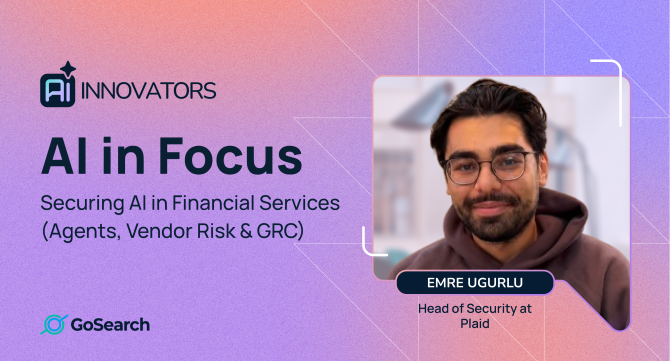
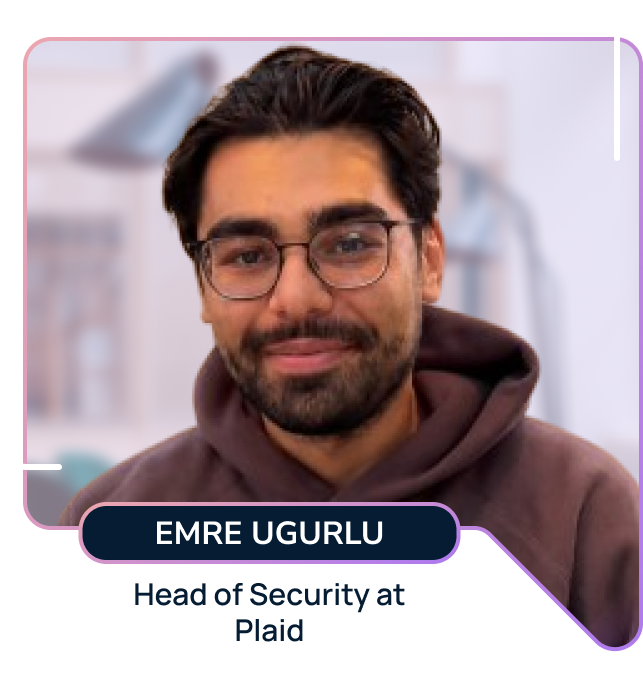
In this edition of AI Innovators, we sat down with Emre Ugurlu, Head of Security GRC at Plaid. Emre leads governance, risk, and compliance across Plaid’s security controls, from SOC 2 and ISO certifications, access and policy reviews to ecosystem risk management, and customer trust.
Emre didn’t plan on a career in security. In his last year of college, a part-time consulting gig had him running SOC 2 programs and penetration tests for startups, and he never looked back. That hands-on, build-it-from-scratch background shows up in everything he had to say about AI agents, vendor risk, and how security teams can keep pace.
*Listen to a few minutes of our conversation with Emre Ugurlu
Key Takeaways
AI agents in finance are inevitable: Consumers will want agents to act on their behalf, so the opportunity lies in building a safe way for them to access financial data.
Scope the authority, not the hype: Instead of asking whether AI is safe, ask what it needs to know, what it’s allowed to do, and what happens when it’s wrong.
Vendor approval isn’t use-case approval: Approving a vendor shouldn’t automatically approve every way your team uses it.
Move beyond questionnaires: With permission and an agreed scope, practical testing of critical vendors builds more trust than a checklist.
Agents can watch your vendors, too: Plaid assigns an agent to each vendor to monitor breaches and risk signals every day.
Tell us about your background and your role at Plaid.
Emre Ugurlu: I’m the Head of Security GRC at Plaid. My role covers governance, risk, and compliance for many of our security controls. We own core compliance efforts like SOC 2 and ISO, as well as governance obligations like access reviews, training completion, change management reviews, and policy reviews.
We also own ecosystem risk management, where we vet the security practices of both customers and vendors onboarding to the platform. On top of that, there’s technical risk management, which uses a framework-based approach to assess security risks that could impact the cloud. Finally, there’s customer trust, which we build by sharing information about our security practices with customers.
What first drew you to cybersecurity and technology?
Emre Ugurlu: I honestly just fell into it. I never imagined going into cybersecurity. I studied computer science, and during my last year of college, I had the chance to work part-time at a consulting company with a friend.
They had nine or ten clients, and at 19 or 20, I was running SOC 2 programs for a bunch of startups. We got to do some pen testing on those companies and build their policies from scratch. It was really fun. I stuck with it and ended up finding my way into GRC.
AI agents are increasingly trying to access financial systems, and many third parties are blocking them. What do you make of the rise of AI agents in finance, and what’s the impact on technology?
Emre Ugurlu: AI is moving quickly into financial services, and I think there’s no way around it. People are going to want agents to take action on their behalf and provide them with financial services. No matter how hard folks try to block it, individuals will find a way to do it.
The opportunity is providing a safe way for agents to access financial data and take action on behalf of consumers. Everyone is trying to figure that out right now and jump on that opportunity.
“No matter how hard folks try to block it, individuals will find a way. The opportunity is giving agents a safe path to financial data.“
– Emre Ugurlu, Head of Security GRC, Plaid
Who should be held responsible when an agent takes a malicious action: the company that built it, or the person who deployed it?
Emre Ugurlu: Right now, it feels like it’s both. Eventually, I think responsibility might land on the company that owns the agent to keep it within the boundary of its instructions.
They may not have a formal obligation to do so, but that requirement will come from their customers. If companies want people to keep using their agents, and customers are saying, “This is causing legitimate issues for us and for the broader ecosystem,” the company will have to fix it.
As AI moves into financial services, how are you thinking about the opportunities and risks from a security and GRC perspective?
Emre Ugurlu: On the risk side, I start by separating what the AI knows from what we’re allowing it to do. A tool that helps someone research a question is completely different from a system that influences a customer’s decision, which is different again from an agent taking action on an account.
The use case and its potential consequences should determine how much scrutiny we apply. So I’m not asking, “Is AI safe?” I’m asking: What are we trying to accomplish? What information does it need? What authority are we giving it? And what happens when it gets something wrong?
“I’m not asking, ‘Is AI safe?’ I’m asking what authority we’re giving it and what happens when it gets something wrong.“
– Emre Ugurlu, Head of Security GRC, Plaid
When adopting third-party AI tools, how do you evaluate and manage the associated security and governance risks?
Emre Ugurlu: I start with understanding what we’re actually trusting the vendor to do. Approving a vendor shouldn’t automatically mean every use of that vendor is approved. I want to understand the data flow. What information are we sending? Which underlying providers receive it? Is it retained or used for training? Is it accessible to support personnel?
That’s a natural evolution of third-party risk management. It’s not novel; it’s just a different way of looking at it. I resolve those questions through documentation, contractual commitments, configuration, and evidence.
Then I look at the integration itself. Does it need access to the whole environment, or just a specific set of documents? Does it need to write anything, or only read? Who controls the permissions?
Something I’ve been toying with, especially for critical vendors, AI or not, is moving the industry beyond questionnaires. With the vendor’s permission and an agreed scope, I’d want practical testing against the risks that matter to us. Could we use a local model, similar to what bad actors are doing, to lightly pen test a vendor before onboarding? Can we access information we shouldn’t see? Can malicious content change the system’s behavior?
The point isn’t to block a vendor if we find something. It’s a different way of building trust. If we identify findings, the focus shifts to the relationship and how the vendor responds.
“I’d love for the industry to move beyond just questionnaires. Practical testing is a different way of building trust.“
– Emre Ugurlu, Head of Security GRC, Plaid
How does Plaid decide whether employees can use LLMs and third-party AI tools? Are they locked down?
Emre Ugurlu: We haven’t locked down how people interact with AI. We have an AI governance team that runs multiple layers of checks, balances, and approvals, and we’re very strict about identifying the data flow and what we plan to send.
There’s a whole framework around it. Everyone submits a ticket with their use case. If it’s not risky, we approve it. If it is, it goes through additional layers. We also have tools that ingest telemetry around agent usage, so we can capture malicious behavior.
Each vendor review is different. How does Plaid tier vendors, and what do you look for to make sure your data is safe?
Emre Ugurlu: Each vendor assessment is treated differently depending on the type of data being processed. We tier vendors: T1 is the most sensitive, T2 is less sensitive, and T3 isn’t very sensitive at all. Based on that tier, we ask very targeted questions, and T1 vendors get a curated questionnaire.
We always want to understand data flow. What are we sending them? Which underlying providers receive it? Will they encrypt our data at rest? Do they have a zero-trust architecture? Are their access controls locked down? Are there security controls in the tool itself that we should enable and review ahead of time? I wouldn’t approve a vendor if we’re sending extremely sensitive data and they’re handling it poorly.
One more that’s really important: what changes when we enable a new feature? Sometimes vendors introduce a feature without telling us, anyone in the organization can turn it on, and it ends up being a legitimate concern.
Risk in tech, and especially AI, changes constantly. How do you stay on top of it?
Emre Ugurlu: I live it, so I have no choice. But a useful answer is our vendor risk management program. This past month has been rough for the supply chain ecosystem, with many vendors impacted by cyberattacks.
So we spun up an incident and breach monitoring tool for every one of our vendors. Each vendor gets its own agent that tracks its risks every single day, whether it shows up in the news or there’s something we need to act on. If it flags anything concerning to me, I read into it and take action.
“Each vendor gets its own personal agent that tracks its risks every single day.“
– Emre Ugurlu, Head of Security GRC, Plaid
When a widespread vulnerability hits the news, how does Plaid respond?
Emre Ugurlu: With the recent PHP issue, thankfully none of our production systems were impacted. Some third-party vendors may have been using PHP for things like marketing sites, so it wasn’t product-impacting. We still took it very seriously and did extensive scanning across our entire product surface. We didn’t find any vulnerabilities.
Rapid Fire Questions:
What AI trend are you most excited about?
Emre Ugurlu: Wearables are going to get a lot cooler. Do we really want to keep using phones 10 years down the line? Maybe the next wearable is glasses with AI built in, or a chip like Neuralink. I think those will get really popular.
Will AI replace white-collar jobs in the next five years, or will we see an AI bubble first?
Emre Ugurlu: The AI bubble will happen regardless. But I’m not convinced AI is going to take our jobs. Many jobs will evolve, and you’ll see a lot of new businesses spinning up. With every revolution, a subset of jobs disappeared and another evolved. I don’t think we’re ever going to replace humans, and if we did, I wouldn’t want to live in that world.
If you weren’t in tech, what would you be doing?
Emre Ugurlu: Probably running a soft-serve ice cream truck, or owning a cafe. Something with human interaction, a service that makes people happy.
What advice would you give students preparing for a world shaped by AI?
Emre Ugurlu: Find something you’re really interested in, invest in it, and build a project around it. I get so many LinkedIn DMs from students asking for internships. My feedback is always the same: instead of asking for an internship, try to understand the person’s problem. Build that relationship, then come back the next week and say, “I made this project that might solve your problem.”
You get something for your portfolio, a relationship, and a way in when an opportunity comes up. A general credit course won’t teach you how to apply it in the real world. It’s more important to study the problem and learn from there.
“Instead of asking for an internship, understand the person’s problem, then come back with a project that solves it.“
– Emre Ugurlu, Head of Security GRC, Plaid
Know What Your AI Can See, and What It Can Do
Emre’s framework applies well beyond financial services. Before any AI tool touches company data, security teams want to know what it can access, whether it can read or write, who controls permissions, and what happens when it’s wrong. Enterprise search is one of the clearest examples: it connects to HR policies, sensitive docs, and every app your team uses.
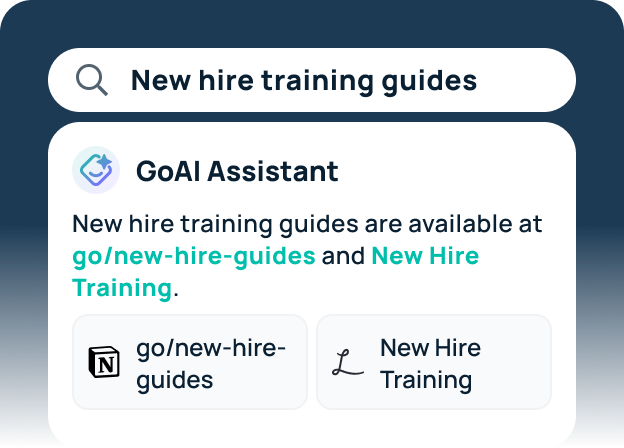
GoSearch was built with that scrutiny in mind. It respects your existing app permissions, so people only see what they’re allowed to access, and it’s backed by SOC 2 Type 2 and GDPR compliance. Security teams get the visibility they need, and employees get instant AI answers across their apps.
GoSearch: AI enterprise search and agents that find answers across all your apps, with permissions built in.
GoProfiles: An AI-powered people platform with employee profiles, a company directory, org charts, and peer recognition.
GoLinks: Short, memorable go links that make any resource easy to find and share.
Want more conversations with security and AI leaders? Dig into the full AI Innovators series, or book a demo to see how GoSearch keeps AI answers within your existing permissions.
Search across all your apps for instant AI answers with GoSearch
Brandon Most is Head of Marketing at GoLinks, GoSearch, and GoProfiles, where he helps enterprise teams navigate the AI landscape and deploy tools that actually improve how work gets done. With nearly 20 years of SaaS marketing experience, he connects buyers with solutions that deliver measurable impact — and advises the boards and executive teams of several venture-backed startups.