


Google added a new model to its Flash lineup this week, and GoSearch customers now have it available alongside every other model in the platform. Gemini 3.6 Flash is Google’s latest “workhorse” model, built to run coding agents, knowledge work, and multimodal tasks at a lower token cost than its predecessor.
For teams building agents in GoSearch, the question isn’t whether Gemini 3.6 Flash is good. It’s where it fits next to the OpenAI and Anthropic models already in the lineup, and which agents should actually be pointed at it.
Quick answer: Gemini 3.6 Flash is Google’s updated mid-tier model, built for coding, knowledge work, and multimodal reasoning at meaningfully lower token cost than Gemini 3.5 Flash. It uses up to 17% fewer output tokens on standard workloads and up to 65% fewer on coding-heavy tasks, while also taking fewer reasoning steps and tool calls to complete multi-step work. In GoSearch, that makes it a strong default for high-volume agents: support and IT ticket triage, document Q&A, multi-step research agents, and coding or diagnostic agents that don’t need frontier-level reasoning. Gemini 3.6 Flash is available now for no-code agents, automated workflows, and AI chat in GoSearch, alongside GoSearch’s existing OpenAI and Anthropic model options.
What Is Gemini 3.6 Flash?
Gemini 3.6 Flash is Google DeepMind’s newest release in the Flash tier, announced July 21, 2026 alongside two companion models: Gemini 3.5 Flash-Lite and a gated cybersecurity-focused model. Google positions 3.6 Flash as the default choice for developers building production agents, where token efficiency, latency, and reliability matter more than maximum reasoning depth.
Google describes the model as delivering coding and reasoning quality that approaches its Pro tier, while keeping the speed and cost profile that makes Flash practical for real-time, high-volume agent work. That framing matters right now because Google has not yet shipped an update to Gemini Pro, which last saw a refresh in February. Flash has effectively been carrying Google’s competitive weight against OpenAI’s GPT-5.6 family and Anthropic’s Claude lineup for months, and 3.6 Flash continues that pattern.
How Does Gemini 3.6 Flash Compare to Gemini 3.5 Flash?
The headline change is efficiency, not raw capability. Gemini 3.6 Flash builds directly on 3.5 Flash’s architecture and improves how much work it gets done per token and per tool call.
| Gemini 3.5 Flash | Gemini 3.6 Flash | |
|---|---|---|
| Output tokens on standard workloads (Artificial Analysis Index) | Baseline | Up to 17% fewer |
| Output tokens on coding tasks (DeepSWE benchmark) | Baseline | Up to 65% fewer |
| Output pricing (per 1M tokens) | $9.00 | $7.50 |
| Input pricing (per 1M tokens) | — | $1.50 |
| Reasoning steps and tool calls per multi-step workflow | Baseline | Fewer |
| Unsolicited code edits on read-only diagnostic tasks | Higher | Reduced |
The reduction in unsolicited edits is a practical detail worth calling out for agent builders specifically. Google reports that 3.6 Flash resolves read-only diagnostic tasks without making changes it wasn’t asked to make, which lowers the review burden on agents that are supposed to investigate rather than act. Google also reports improvements in multimodal reasoning, including chart interpretation, visual blueprint conversion, and multi-element web layout generation, which extends the model’s usefulness past pure text and code tasks.
What Are the Best Use Cases for Gemini 3.6 Flash in AI Agents?
Flash-tier models are built for volume and speed rather than the hardest, most open-ended reasoning problems. In GoSearch, that makes Gemini 3.6 Flash a strong fit for agents that run often, need to stay fast, and don’t require frontier-level judgment on every step.
Benefits by team:
- IT and helpdesk: Ticket triage and routing agents that need to process high volumes of requests quickly.
- Engineering: Scoped coding agents and read-only code review or diagnostic agents, where fewer unsolicited edits mean less time spent reviewing changes nobody asked for.
- Support: Document and knowledge-base Q&A agents that answer routine questions across a large connector footprint.
- Sales and RevOps: Research agents that pull structured answers from CRM, docs, and productivity tools without needing deep multi-step reasoning.
- Data and analytics: Agents that interpret charts, dashboards, or visual reports, where the model’s improved multimodal reasoning applies directly.
Tasks that involve longer-horizon planning, ambiguous multi-step reasoning, or high-stakes decisions are still better suited to a frontier-tier model. The practical test is the same one that applies across GoSearch’s multi-model lineup: start with the faster model, and move an agent up only when it’s consistently missing steps or losing context on the task in front of it.
When Should You Use Gemini 3.6 Flash vs Other GoSearch Models?
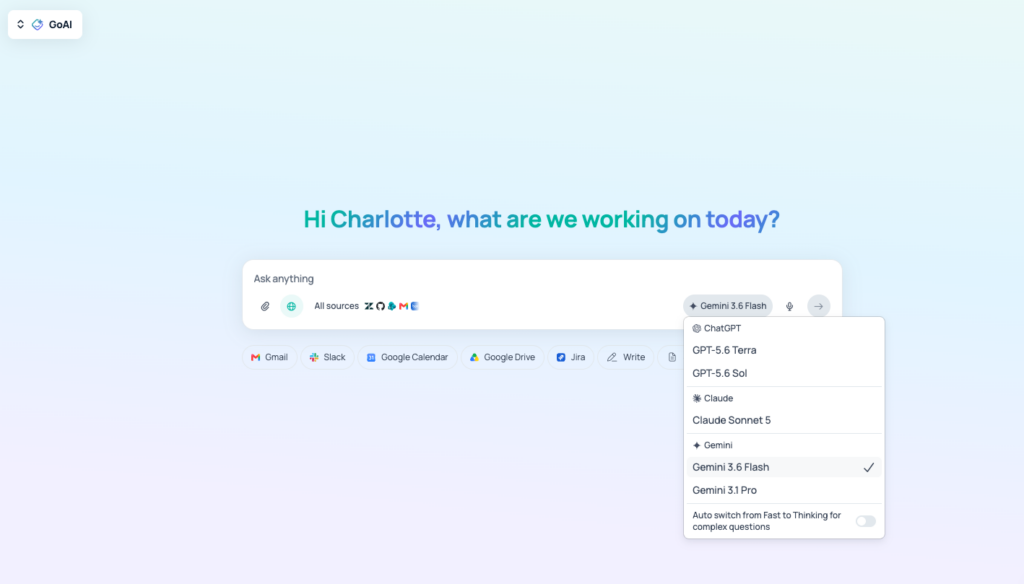
GoSearch has always been multi-LLM, giving teams access to models from OpenAI, Anthropic, and Google Gemini with Zero Data Retention rather than locking customers into a single provider’s roadmap. Gemini 3.6 Flash joins that lineup as a Google-native option built specifically for high-volume, fast agent work.
Model choice in GoSearch works best as a per-agent decision, not an org-wide default. A support triage agent that runs thousands of times a day has very different requirements than a research agent handling a handful of complex, high-stakes queries. Gemini 3.6 Flash is built for the first category. For agents that need to hold context across many steps or reason through genuinely ambiguous, open-ended problems, a frontier-tier model from GoSearch’s lineup is still the better fit.
How Do I Start Using Gemini 3.6 Flash in GoSearch?
Gemini 3.6 Flash is available now inside GoSearch for no-code agent building, automated workflows, and AI chat. Existing GoSearch customers can select it as the model for any new or existing agent without additional setup, and it works across GoSearch’s full connector library the same way every other supported model does.
Teams evaluating where to use it should start with high-volume, well-scoped agents, like ticket triage, document Q&A, or read-only diagnostics, and measure output quality against the model currently in use. If it holds up, keep it there. If not, GoSearch makes it a one-step change to move that agent to a different model.
See GoSearch’s full model lineup and agent builder in a personalized demo.
Search across all your apps for instant AI answers with GoSearch
Schedule a demo
Frequently Asked Questions
Gemini 3.6 Flash is built for coding, knowledge work, and multimodal reasoning at high volume. Google designed it for developers building production agents that need speed, lower token cost, and reliability over maximum reasoning depth. In GoSearch, that translates to strong performance on ticket triage, document Q&A, scoped coding tasks, and agents that interpret charts or visual content.
Gemini 3.6 Flash uses up to 17% fewer output tokens on standard workloads and up to 65% fewer on coding-heavy tasks, according to Google. It also takes fewer reasoning steps and tool calls to complete multi-step workflows and reduces unsolicited edits on read-only diagnostic tasks. Output pricing dropped from $9.00 to $7.50 per million tokens.
Yes. Gemini 3.6 Flash is available now in GoSearch for no-code agents, automated workflows, and AI chat, alongside GoSearch’s existing OpenAI and Anthropic model options. No additional setup is required to select it for a new or existing agent.
It depends on the task. Gemini 3.6 Flash is built for high-volume, well-scoped work where speed matters most, like ticket triage or document Q&A. Agents that need to hold context across many steps or reason through open-ended, high-stakes problems are still better matched to a frontier-tier model in GoSearch’s lineup.
Yes. GoSearch is multi-LLM by design, supporting models from OpenAI, Anthropic, and Google Gemini with Zero Data Retention. Customers choose models per agent rather than committing to a single provider, and newly released models like Gemini 3.6 Flash are added to the available lineup as they launch.