

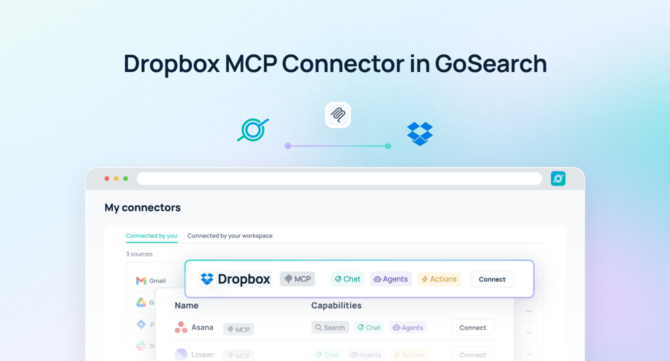

A Dropbox MCP server connects AI agents to live Dropbox content — including files, folders, shared links, Paper documents, and team spaces — enabling intelligent querying and coordinated action without duplicating documents outside Dropbox.
Quick Answer: A Dropbox MCP server is a Model Context Protocol endpoint that gives AI agents real-time, permission-aware access to Dropbox files and team content — no manual file navigation or custom integrations required.
With GoSearch, teams can deploy a Dropbox MCP server to search and summarize documents using natural language, automate content workflows, and connect Dropbox to the broader enterprise stack. Instead of hunting through nested folders or toggling between tabs to track down a shared file, AI agents work directly inside Dropbox’s data model with full permission enforcement — and act on what they find across every connected system.
As Dropbox becomes a central repository for team knowledge, sales assets, legal documents, and collaborative content across organizations, the ability to reason over live file data and coordinate action from those signals across the full enterprise stack becomes as important as the documents themselves.
TL;DR
- A Dropbox MCP server is a Model Context Protocol endpoint that gives AI agents structured, permission-aware access to live Dropbox files, folders, shared links, Paper documents, and team spaces.
- GoSearch’s Dropbox MCP server goes beyond read access — AI agents can take actions in Dropbox and orchestrate workflows across 100+ connected enterprise tools in a single execution.
- Setup takes under 5 minutes. GoSearch inherits Dropbox’s existing permissions automatically, so teams are querying live file content without any additional indexing or syncing infrastructure.
- Key use cases include document retrieval, content summarization, contract and asset management, cross-system file routing, and automated document reporting.
- GoSearch’s Dropbox MCP server differs from a standalone Dropbox API integration, which requires custom development and focuses on file access for individual applications. GoSearch adds enterprise orchestration, write actions across connected systems, and a unified governance layer spanning your entire tool stack.
What Is a Dropbox MCP Server?
A Dropbox MCP server is a Model Context Protocol (MCP) endpoint that provides AI models and agents with structured, permission-aware access to Dropbox’s cloud storage platform — including files, folders, team spaces, shared links, Paper documents, and file metadata — in real time, without requiring manual folder navigation, exports, or custom integration development.
MCP is an open standard for connecting AI systems to external tools. Rather than building and maintaining separate connectors for each application, MCP gives AI agents a consistent, standardized way to retrieve data, call tools, and execute actions across systems. Anthropic, which developed the standard, has seen broad adoption across Claude, Cursor, VS Code, and enterprise platforms globally.
Unlike integrations built on periodic sync jobs or manual file sharing, a Dropbox MCP server lets AI operate on live document data. Teams can use it to:
- Retrieve, search, and summarize files and folders across Dropbox by natural language description
- Surface shared links, Paper documents, and team space content alongside broader business context
- Locate contracts, briefs, templates, and assets without navigating nested folder structures
- Trigger cross-system actions in Slack, Notion, Salesforce, or connected project and communication tools
- Automate document routing, content summaries, asset delivery, and file organization workflows
Because the Dropbox MCP server enforces existing user and team-level permissions, AI agents access only the files and content each user is authorized to view — maintaining document security and compliance while removing the friction of manually tracking content across folders and shared spaces.
GoSearch Dropbox MCP Server vs. a Standard Dropbox API Integration
A standard Dropbox API integration provides file access for individual applications — a solid starting point for developers who need to read or write files from a specific workflow. But it requires custom development, ongoing maintenance, and a separate permission model for every application that connects to Dropbox.
The GoSearch Dropbox MCP server is designed for a broader scope: enterprise orchestration that extends Dropbox’s document intelligence beyond storage and into coordinated action across the full enterprise stack.
| Standard Dropbox API | GoSearch Dropbox MCP | |
|---|---|---|
| Access files, folders & shared links | ✅ | ✅ |
| Real-time, permission-aware access | ✅ | ✅ |
| Paper documents & team spaces | ✅ | ✅ |
| Take actions across connected systems | ❌ | ✅ |
| Cross-system orchestration | ❌ | ✅ (100+ connectors) |
| Unified governance layer | ❌ | ✅ |
| Connect to Slack, Salesforce, Notion, Jira | ❌ | ✅ |
| Multi-agent routing | ❌ | ✅ |
If your team needs Dropbox to do more than surface files on request — routing documents to the right people, connecting file content to business workflows, or enabling agents to reason and act across your full enterprise stack — GoSearch is the right platform.
How the GoSearch Dropbox MCP Server Works
The GoSearch Dropbox MCP server connects AI agents directly to live document data and coordinates downstream action across the enterprise.
When a user submits a query or a workflow is triggered, GoSearch interprets the request and dynamically invokes the Dropbox MCP server as a callable tool. The agent retrieves the relevant files, folder contents, shared links, or Paper documents, synthesizes that content into a clear answer or action plan, and — when needed — combines Dropbox context with data from other connected systems like Salesforce, Slack, Notion, or internal knowledge bases and project management tools.
This architecture gives operations, content, legal, and business teams the ability to move from passive file storage to active, content-driven coordination — where AI surfaces what the document data reveals and follows through on what it means for delivery, compliance, and collaboration.
What You Can Do With a Dropbox MCP Server
Connecting Dropbox via MCP unlocks a range of high-impact use cases that span the full document and content lifecycle.
Teams can retrieve specific files, folder summaries, and document versions directly within their existing workflows — without switching into Dropbox to hunt for the right file. When someone needs the latest version of a proposal, a legal template, or a brand asset before a meeting, an AI agent can locate it, summarize the contents, and surface the relevant shared link in a single response, grounded in the actual state of the Dropbox account.
Operations and content teams gain real-time access to shared spaces and team folders across departments and projects. Stale documents can trigger automated review reminders, version updates, or routing workflows without manual follow-up — compressing the time between a content gap and a coordinated team response.
Legal and compliance teams can monitor contracts, NDAs, and sensitive documents across shared folders and route time-sensitive files to the right reviewers automatically. Rather than tracking document status repository by repository, AI agents surface actionable findings and initiate the right response across connected tools in real time.
Example Queries
A GoSearch Dropbox MCP server makes it possible to combine document depth with cross-system action in ways no standalone storage platform can deliver alone.
- “Find the most recent version of the enterprise sales deck and send it to the account executive via Slack.”
- “Summarize all files in the Q2 Campaign folder and create a Notion page with the key deliverables and owners.”
- “Locate all contracts in the Legal shared folder that haven’t been updated in the past 30 days and flag them for review.”
- “Pull all files tagged ‘final’ from the Product Launch folder and generate a handoff summary for the go-to-market team.”
- “Identify onboarding documents that were last modified more than 90 days ago and create Jira tickets for a content review.”
- “List all shared links created in the past week and confirm each one has the correct access permissions.”
- “Generate a weekly content inventory report covering new files, updated documents, and shared assets across all active team folders.”
These examples show how a GoSearch Dropbox MCP server turns file storage into coordinated enterprise action — not just a document repository view.
Dropbox MCP Server vs. Traditional Approaches
Conventional approaches to connecting Dropbox data with broader enterprise workflows depend on manual file sharing, periodic sync, or point integrations that break down as team size and content volume grows. Here’s how they compare:
| Dropbox MCP Server | Traditional API Integration | Manual File Sharing / Sync | |
|---|---|---|---|
| Data freshness | Real-time | Near real-time | Stale or event-only |
| Setup complexity | Low | High (custom dev) | Medium |
| Permission enforcement | Inherited from Dropbox | Must be rebuilt | Often bypassed |
| Cross-system orchestration | Yes (via GoSearch) | No | No |
| Infrastructure overhead | Minimal | High | Medium |
| Time to first query | Minutes | Weeks | Weeks |
A Dropbox MCP server gives AI agents live, structured, permission-aware access to document data without duplicating it outside the platform. Every AI output reflects the current state of files, folders, and shared content — not a sync event from hours ago or a file someone remembered to share before the deadline.
Learn why MCP is replacing custom integrations across enterprise AI →
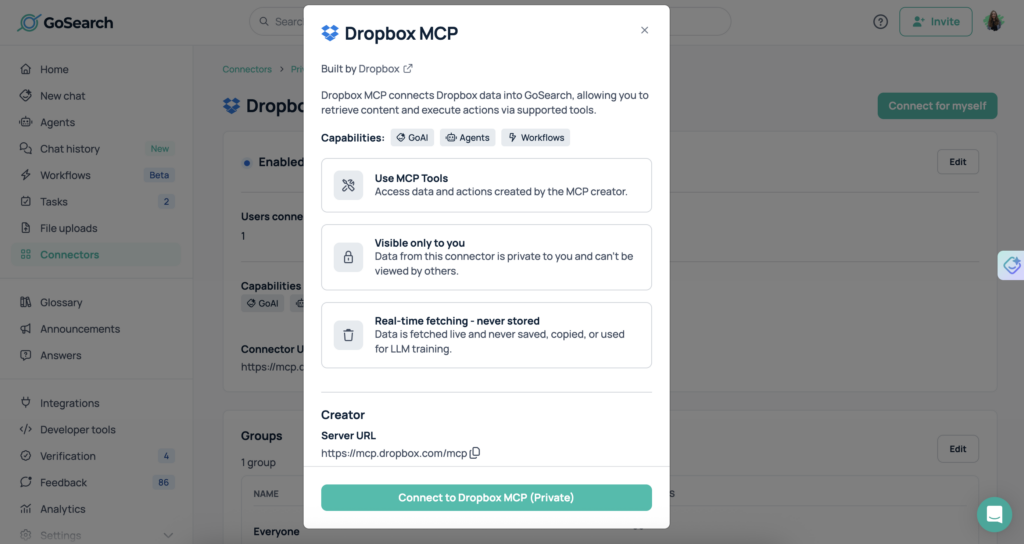
How to Connect Dropbox to an MCP Server in GoSearch
Connecting Dropbox to GoSearch via MCP is fast and requires no dedicated engineering effort. Most teams are querying live file and folder content within the same session they begin setup.
- Enable the Dropbox MCP server in GoSearch.
Navigate to GoSearch’s connector library and activate the Dropbox MCP server from the integrations panel.
- Authenticate using Dropbox’s existing access controls.
Connect via OAuth. GoSearch inherits Dropbox’s existing user and team-level permissions automatically — no need to recreate access rules or rebuild folder structures. Required scopes include read access to files, folders, shared links, documents, and team spaces.
- Dropbox becomes a live tool for any AI agent or workflow in GoSearch.
No indexing, syncing, or data duplication is required. All access happens in real time through secure APIs. Dropbox is immediately callable by any AI agent or automated workflow you deploy through GoSearch.
- Start querying immediately.
Use natural language to retrieve documents, surface folder insights, or trigger cross-system workflows. Test with a simple query like: “Show me all files shared with my team in the past seven days.”
Who Should Use a Dropbox MCP Server?
A Dropbox MCP server delivers value across every team that creates, stores, reviews, or distributes content through Dropbox.
Operations and content teams can retrieve files, folder summaries, and asset histories directly within their existing workflows — reducing the manual file hunting that fragments focus and slows delivery, and giving teams the content they need without leaving the tools where they already work.
Sales and client-facing teams gain on-demand access to the latest decks, proposals, and customer materials across shared folders. Automated delivery and routing replace ad hoc file-sharing messages when a client needs a document before a call or deadline.
Managers and team leads can generate on-demand views of folder activity, document ownership, and content update frequency without building custom dashboards or waiting on manual reporting cycles.
Legal and compliance teams maintain real-time awareness of sensitive documents, contract status, and access permissions across the full Dropbox estate — with AI agents routing time-sensitive files to the right reviewers and logging actions across connected systems automatically.
IT and operations teams maintain full control over data access, permission enforcement, and auditability across all AI-powered document workflows. GoSearch inherits and enforces Dropbox’s access controls at every step — no AI agent ever accesses a file or folder it isn’t authorized to view.
Why Use GoSearch for MCP Servers?
GoSearch provides a unified platform for deploying and managing MCP servers across the enterprise. By connecting Dropbox with more than 100 enterprise systems, GoSearch enables AI agents to reason over document data and coordinate action across tools — content management, project tracking, communication, legal review, and business operations — under a single governance layer.
Teams can route document signals directly into the operational workflows where they matter most, ensuring that an outdated contract, a missing asset, or a critical file request doesn’t sit buried in a folder but flows through to the systems and people equipped to act on it. Because GoSearch treats Dropbox as a live system of record rather than a static file archive, document intelligence becomes a continuous input to enterprise coordination rather than a siloed view for individuals managing their own storage.
Get Started With the Dropbox MCP Server
The GoSearch Dropbox MCP server enables organizations to operationalize document data across tools and workflows. AI agents can retrieve, analyze, and act on live Dropbox content — surfacing the right files, summarizing folder activity, routing assets to the right people, and coordinating cross-system document responses automatically — with no manual folder navigation and full security and compliance across the enterprise.
Get a demo to see how GoSearch connects Dropbox and other MCP servers to power AI workflows that turn document signals into action across your entire stack.
Search across all your apps for instant AI answers with GoSearch
Schedule a demo
Dropbox MCP Server: Frequently Asked Questions
A Dropbox MCP server is a Model Context Protocol endpoint that allows AI agents to access live Dropbox data — including files, folders, shared links, Paper documents, and team spaces — in real time. It gives AI models a standardized, permission-aware way to query and act on document content without requiring exports, manual searches, or custom API development.
The Dropbox API requires custom development and ongoing maintenance for each integration. An MCP server exposes Dropbox as a standardized, callable tool that any MCP-compatible AI agent can use immediately — no custom code required. It also allows AI agents to combine Dropbox file data with information from other enterprise systems in a single coordinated workflow.
The GoSearch Dropbox MCP server requires read access to files, folders, shared links, Paper documents, and team spaces. When connecting via OAuth, Dropbox’s existing user and team-level permissions are inherited automatically. AI agents cannot access files or folders beyond what the authenticated user is authorized to view.
GoSearch’s Dropbox MCP server supports both retrieval and action. AI agents can query Dropbox’s document data and also trigger downstream actions — routing files, posting notifications, updating records in connected tools, and coordinating multi-system workflows based on what the document content reveals.
MCP is an open standard with broad adoption. Compatible tools include Claude (Anthropic), Cursor, VS Code with Copilot, and enterprise platforms like GoSearch that manage MCP servers at scale. Any MCP-compatible client can connect to an MCP server using the standardized protocol.
Connecting Dropbox directly to an individual AI client gives that client file access for its own use. GoSearch’s Dropbox MCP server is built for enterprise orchestration — enabling AI agents to take actions across 100+ connected systems, coordinate cross-team document workflows, and operate under a unified governance layer that spans every tool in your stack.
Most teams complete setup in under 5 minutes. Authentication uses Dropbox’s existing OAuth flow, permissions are inherited automatically, and no content indexing is required. Teams are typically querying live Dropbox data within the same session they begin setup.

![Selecting the Best Enterprise Search Software [Features + Vendors]](https://images.gosearch.ai/blog/content/uploads/2023/10/17234328/Blog-Header-3-370x184.png)