

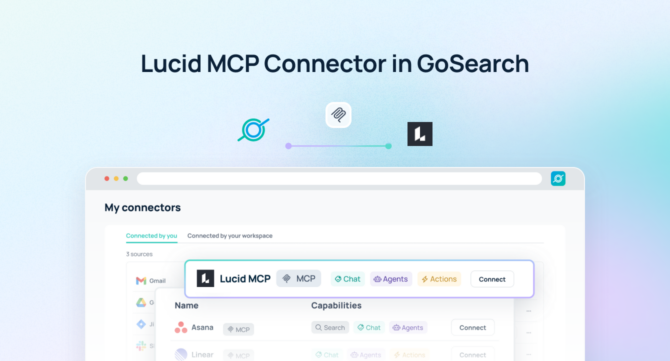

A Lucid MCP server is a Model Context Protocol endpoint that connects AI agents to live Lucid content — including Lucidchart diagrams, Lucidspark boards, and shared visual workspaces — enabling intelligent querying and coordinated action without moving visual assets outside Lucid.
Quick Answer: A Lucid MCP server gives AI agents direct, permission-aware access to diagrams, flowcharts, and visual documentation in real time — no data exports or custom integrations required.
With GoSearch, teams can deploy a Lucid MCP server to search and surface visual documentation using natural language, automate diagram-related workflows, and connect visual context to the rest of the enterprise tool stack. Instead of hunting through shared drives or pasting diagram links into chat threads, AI agents work directly inside Lucid’s content model with full permission enforcement.
As organizations scale AI across product, engineering, and operations, visual documentation becomes a critical and often underutilized signal for decision-making, onboarding, and cross-functional alignment.
TL;DR
- A Lucid MCP server is a Model Context Protocol endpoint that gives AI agents structured, permission-aware access to live Lucid diagrams, boards, and visual workspaces.
- GoSearch’s Lucid MCP server goes beyond read access — AI agents can take actions in Lucid and orchestrate workflows across 100+ connected enterprise tools in a single execution.
- Setup takes under 5 minutes. GoSearch inherits Lucid’s existing permissions automatically, so teams are querying live visual documentation without any indexing or syncing infrastructure.
- Key use cases include surfacing process diagrams, connecting visual documentation to code and project context, automating diagram-linked workflows, and keeping architecture docs in sync with live systems.
- GoSearch’s Lucid MCP server is built for enterprise orchestration — combining Lucid content with data from across your stack in ways a standalone diagram tool cannot.
What Is a Lucid MCP Server?
A Lucid MCP server is a Model Context Protocol (MCP) endpoint that provides AI models and agents with structured, permission-aware access to Lucid’s visual content — including diagrams, flowcharts, org charts, process maps, and collaborative boards — in real time, without requiring file exports, manual searches, or custom development work.
MCP is an open standard for connecting AI systems to external tools and data sources. Rather than building and maintaining a separate connector for each application, MCP gives AI agents a consistent, standardized way to retrieve data, call tools, and execute actions across systems. Anthropic, which developed the standard, has seen broad adoption across Claude, Cursor, VS Code, and enterprise platforms worldwide.
Unlike integrations that rely on periodic exports or static file references, a Lucid MCP server lets AI operate on live diagram content. Teams can use it to:
- Retrieve specific diagrams, process maps, or architecture docs by natural language description
- Surface relevant visual context alongside code, tickets, or project documentation
- Update, organize, or annotate Lucid content as part of a broader workflow
- Trigger cross-system actions in Confluence, Jira, Slack, or other connected tools
- Keep visual documentation in sync with live systems without manual intervention
Because the Lucid MCP server enforces existing permission boundaries, AI agents access only the diagrams and boards each user is authorized to view — maintaining documentation governance while dramatically reducing the friction of finding and using visual knowledge.
GoSearch Lucid MCP Server vs. Point Integrations
Most teams today find Lucid content through manual browsing, shared links, or keyword searches that miss context. Connecting Lucid to AI through point integrations introduces its own limitations — stale references, permission gaps, and no ability to act across systems.
The GoSearch Lucid MCP server is purpose-built for enterprise orchestration, treating Lucid as a live, callable part of a broader AI-powered workflow.
| Point Integration / Manual Search | GoSearch Lucid MCP | |
|---|---|---|
| Access live diagrams & boards | Limited | ✅ |
| Real-time, permission-aware access | ❌ | ✅ |
| Take actions in Lucid | ❌ | ✅ |
| Cross-system orchestration | ❌ | ✅ (100+ connectors) |
| Unified governance layer | ❌ | ✅ |
| Connect to Confluence, Jira, Slack | ❌ | ✅ |
| Multi-agent routing | ❌ | ✅ |
If your team needs to do more than find a diagram — triggering documentation workflows, connecting visual context to engineering or product systems, or enabling AI agents to reason across your entire knowledge base — GoSearch is the right platform.
How the GoSearch Lucid MCP Server Works
The GoSearch Lucid MCP server connects AI agents directly to live visual documentation and coordinates downstream actions across the enterprise.
When a user submits a query or triggers a workflow, GoSearch interprets the request and dynamically invokes the Lucid MCP server as a callable tool. The agent retrieves relevant diagrams, boards, or visual assets, synthesizes that content into a clear answer or action, and — when needed — combines visual context with information from other connected systems like Confluence, GitHub, Jira, or internal wikis.
This architecture transforms visual documentation from a passive artifact into an active input for AI reasoning — one that can be found, acted on, and kept current without manual effort.
What You Can Do With a Lucid MCP Server
Connecting Lucid via MCP unlocks a wide range of use cases that go well beyond searching for a specific file.
Engineering and product teams can surface architecture diagrams, data flow maps, and system design docs directly within the tools they already use. When a developer asks how a service is structured, an AI agent can retrieve the relevant Lucidchart diagram and present it alongside code context — without anyone needing to remember where the diagram lives.
Onboarding and enablement teams can connect new hires to process documentation, org charts, and workflow diagrams through natural language questions rather than lengthy drive navigation. Visual knowledge that previously required a senior colleague to surface becomes immediately accessible.
Operations and IT teams can use AI agents to keep diagrams current — flagging stale documentation, triggering review workflows, and surfacing outdated process maps when underlying systems change. Because access is live and permission-aware, every action reflects the actual current state of Lucid content rather than a cached reference from a previous export.
Example Queries for a Lucid MCP Server
One of the most compelling aspects of a Lucid MCP server is the ability to ask contextual, multi-system questions and trigger coordinated documentation workflows automatically.
- “Find the current architecture diagram for our payments service and summarize the key components.”
- “Show me all process maps in the onboarding workspace that were updated in the last 30 days.”
- “Pull the data flow diagram for the user authentication system and link it to the related Jira epic.”
- “Identify any architecture diagrams that reference the legacy billing service and flag them for review.”
- “Create a task in Asana to update the Q3 process documentation and attach the relevant Lucidchart board.”
- “Surface all org charts where the reported manager has changed in the past quarter.”
- “Find diagrams tagged with ‘compliance’ and generate a summary of the processes they document.”
These examples show how MCP-powered agents handle multi-step documentation workflows — not just one-off file lookups.
Lucid MCP Server vs. Traditional Approaches
Conventional approaches to connecting Lucid content with AI workflows depend on manual search, file exports, or brittle integrations that quickly fall out of date. Here’s how they compare:
| Lucid MCP Server | Traditional Integration | Manual Search / Export | |
|---|---|---|---|
| Content freshness | Real-time | Near real-time | Stale |
| Setup complexity | Low | High (custom dev) | N/A |
| Permission enforcement | Inherited from Lucid | Must be rebuilt | Often bypassed |
| Cross-system orchestration | Yes (via GoSearch) | No | No |
| Infrastructure overhead | Minimal | High | High |
| Time to first query | Minutes | Weeks | N/A |
A Lucid MCP server gives AI agents live, structured access to visual documentation without duplicating or exporting it. Outputs are always grounded in what Lucid actually contains — the latest version of a diagram, the current state of a board — rather than a file someone remembered to download last week.
Learn why MCP is replacing custom integrations across enterprise AI →
How to Connect Lucid to an MCP Server in GoSearch
Connecting Lucid to GoSearch via MCP is fast and requires no engineering resources. Most teams are querying live diagram content within the same session they begin setup.
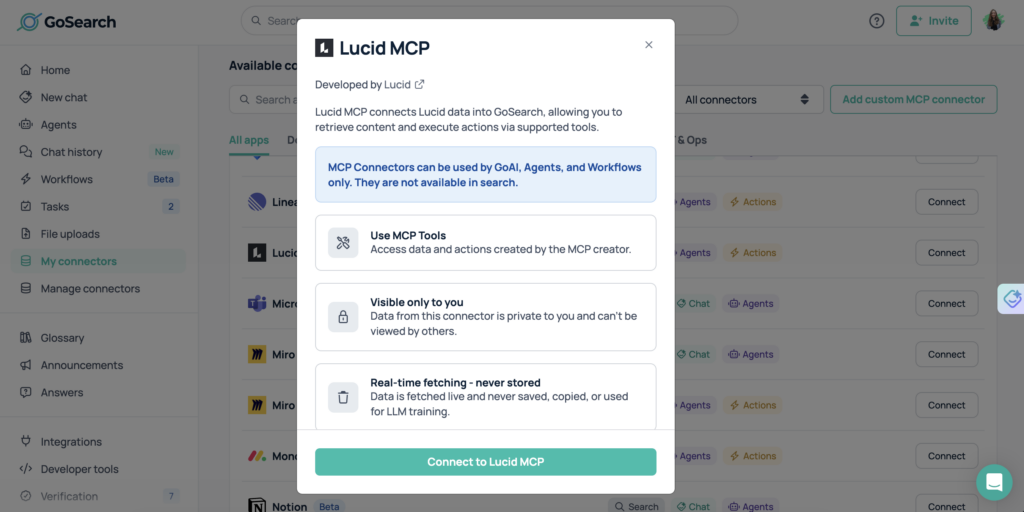
- Enable the Lucid MCP server in GoSearch.
Navigate to GoSearch’s connector library and activate the Lucid MCP server from the integrations panel.
- Authenticate using Lucid’s existing access controls.
Connect via OAuth using your Lucid credentials. GoSearch inherits Lucid’s existing permission scopes automatically — no need to re-define access rules or rebuild sharing settings. Required scopes include read access to documents, diagrams, and shared workspaces.
- Lucid becomes a live tool for any AI agent or workflow in GoSearch.
No indexing, syncing, or content duplication is required. All access happens in real time through secure APIs. Lucid is immediately callable by any AI agent or automated workflow you deploy through GoSearch.
- Start querying immediately.
Use natural language to find diagrams, surface visual context, or trigger cross-system documentation workflows. Test with a simple query like: “Show me the most recently updated architecture diagrams in our engineering workspace.”
Who Should Use a Lucid MCP Server?
A Lucid MCP server delivers value across any team that creates, maintains, or relies on visual documentation.
Engineering and architecture teams can retrieve system diagrams and data flow maps directly within their development workflows — surfacing the right visual context alongside code, pull requests, or incident tickets without context switching.
Product managers gain fast access to process flows, user journey maps, and roadmap visuals in the context of planning conversations. Rather than tracking down the right diagram in a sprawling shared drive, AI agents surface the relevant content on demand.
Operations and IT teams can maintain documentation hygiene at scale — automatically flagging outdated diagrams, routing review tasks, and keeping visual documentation aligned with live system changes.
People and HR teams can use AI agents to surface org charts, team structure diagrams, and onboarding process maps in response to natural language questions from employees or managers.
Compliance and governance teams maintain full visibility into which diagrams exist, who has access, and when they were last updated — all enforced through GoSearch’s unified governance layer that inherits Lucid’s access controls at every step.
Why Use GoSearch for MCP Servers?
GoSearch provides a unified platform for deploying and managing MCP servers across the enterprise. By connecting Lucid with more than 100 enterprise systems, GoSearch enables AI agents to reason, act, and coordinate workflows across tools — documentation, engineering, project management, communication, and more — under a single governance layer.
Teams can route queries and workflows to whichever systems hold the most relevant context, combining Lucid’s visual knowledge with live data from Jira, Confluence, GitHub, Slack, and beyond. Because GoSearch treats Lucid as an active system of record rather than a file repository, visual documentation flows into decisions and workflows instead of sitting untouched in a shared folder.
Get Started With the Lucid MCP Server
The GoSearch Lucid MCP server enables organizations to operationalize visual documentation across tools and workflows. AI agents can retrieve, analyze, and act on real-time diagram content — linking visual knowledge to engineering systems, project management tools, and communication platforms automatically — with no manual file management and full security and compliance across the enterprise.
Get a demo to see how GoSearch connects Lucid and other MCP servers to power enterprise-wide AI workflows that both inform and act.
Search across all your apps for instant AI answers with GoSearch
Schedule a demo
Lucid MCP Server: Frequently Asked Questions
A Lucid MCP server is a Model Context Protocol endpoint that allows AI agents to access live Lucid content — including diagrams, flowcharts, process maps, and collaborative boards — in real time. It gives AI models a standardized, permission-aware way to find and act on visual documentation without requiring file exports, manual searches, or custom API development.
The Lucid API requires custom development and ongoing maintenance for each integration. An MCP server exposes Lucid as a standardized, callable tool that any MCP-compatible AI agent can use immediately — no custom code required. It also allows AI agents to combine Lucid visual content with data from other systems in a single coordinated workflow.
The GoSearch Lucid MCP server requires read access to documents, diagrams, and shared workspaces. When authenticating via OAuth, the relevant Lucid permission scopes must be enabled. GoSearch inherits and enforces these scopes automatically — AI agents cannot access content beyond what the authenticated user is permitted to view.
GoSearch’s Lucid MCP server supports both read and write operations. AI agents can retrieve diagrams and board content, and also take actions such as organizing documents, triggering review workflows, linking visual assets to records in connected systems, and initiating notifications or tasks in other tools.
MCP is an open standard with broad adoption. Compatible tools include Claude (Anthropic), Cursor, VS Code with Copilot, and enterprise platforms like GoSearch that manage MCP servers at scale. Any MCP-compatible client can connect to an MCP server using the standardized protocol.
Most teams complete setup in under 5 minutes. Authentication uses Lucid’s existing OAuth flow, permissions are inherited automatically, and no content indexing is required. Teams are typically querying live Lucid content within the same session they begin setup.

![Selecting the Best Enterprise Search Software [Features + Vendors]](https://images.gosearch.ai/blog/content/uploads/2023/10/17234328/Blog-Header-3-370x184.png)