

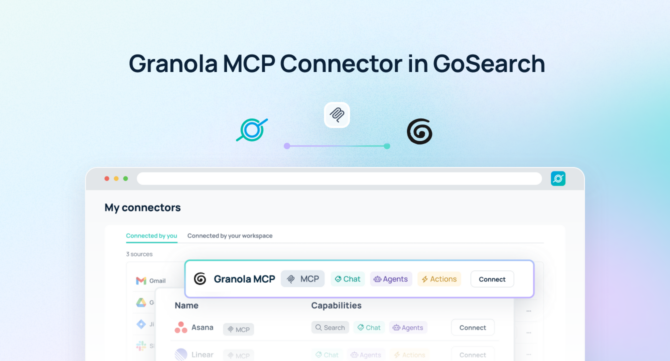

A Granola MCP server connects AI agents to live Granola meeting data — including AI-enhanced notes, transcripts, action items, and meeting history — enabling intelligent querying and coordinated action without duplicating meeting intelligence outside Granola.
Quick Answer: A Granola MCP server is a Model Context Protocol endpoint that gives AI agents real-time, permission-aware access to Granola meeting notes, transcripts, and conversation summaries in real time — no data exports or custom integrations required.
With GoSearch, teams can deploy a Granola MCP server to surface meeting context using natural language, automate follow-up workflows, and connect meeting intelligence to the broader enterprise stack. Instead of scrolling through notes after every call or manually transferring action items into project tools, AI agents work directly inside Granola’s meeting data with full permission enforcement — and act on what they find across every connected system.
As organizations run more of their decision-making through meetings, the gap between what was discussed and what actually gets captured, shared, and acted on becomes one of the most costly sources of organizational friction. A Granola MCP server, combined with GoSearch’s orchestration layer, closes that gap.
TL;DR
- A Granola MCP server is a Model Context Protocol endpoint that gives AI agents structured, permission-aware access to live Granola meeting notes, transcripts, summaries, and action items.
- GoSearch’s Granola MCP server goes beyond read access — AI agents can act on meeting intelligence and orchestrate follow-up workflows across 100+ connected enterprise tools in a single execution.
- Setup takes under 5 minutes. GoSearch inherits Granola’s existing permissions automatically, so teams are querying live meeting data without any additional indexing or syncing infrastructure.
- Key use cases include meeting follow-up automation, action item routing, cross-system context retrieval, decision tracking, and stakeholder briefing generation.
- GoSearch’s Granola MCP server differs from Granola’s native MCP server, which provides meeting note access for individual AI clients. GoSearch adds enterprise orchestration, write actions across connected systems, and a unified governance layer spanning your entire tool stack.
What Is a Granola MCP Server?
A Granola MCP server is a Model Context Protocol (MCP) endpoint that provides AI models and agents with structured, permission-aware access to Granola’s meeting intelligence platform — including AI-enhanced meeting notes, transcripts, summaries, action items, and meeting history — in real time, without requiring manual note sharing, export workflows, or custom integration development.
MCP is an open standard for connecting AI systems to external tools. Rather than building and maintaining separate connectors for each application, MCP gives AI agents a consistent, standardized way to retrieve content, call tools, and execute actions across systems. Anthropic, which developed the standard, has seen broad adoption across Claude, Cursor, VS Code, and enterprise platforms globally.
Unlike integrations that depend on calendar syncs or periodic note exports, a Granola MCP server lets AI operate on live meeting intelligence. Teams can use it to:
- Retrieve notes, summaries, and action items from specific meetings by natural language description
- Surface relevant meeting context alongside CRM records, project tickets, or account history
- Route action items to the right owners in connected task management or project tools
- Trigger cross-system follow-ups in Slack, email, Salesforce, or Jira based on meeting outcomes
- Automate briefing documents, status updates, and stakeholder summaries from meeting content
Because the Granola MCP server enforces existing sharing and access permissions, AI agents surface only the meeting content each user is authorized to view — maintaining confidentiality across sensitive conversations while removing the manual overhead of tracking and distributing meeting intelligence.
GoSearch Granola MCP Server vs. Granola’s Native MCP Server
Granola’s native MCP server provides meeting note and transcript access for individual AI clients — a practical starting point for users who want to query their meeting history from within an AI assistant or writing tool.
The GoSearch Granola MCP server is designed for a broader scope: enterprise orchestration that extends meeting intelligence beyond the individual and into coordinated action across the full tool stack.
| Granola Native MCP | GoSearch Granola MCP | |
|---|---|---|
| Access meeting notes & transcripts | ✅ | ✅ |
| Real-time, permission-aware access | ✅ | ✅ |
| Action item and summary retrieval | ✅ | ✅ |
| Take actions across connected systems | ❌ | ✅ |
| Cross-system orchestration | ❌ | ✅ (100+ connectors) |
| Unified governance layer | ❌ | ✅ |
| Connect to Slack, Salesforce, Jira, CRM | ❌ | ✅ |
| Multi-agent routing | ❌ | ✅ |
If your team needs Granola to do more than answer questions about past meetings — triggering follow-up workflows, connecting meeting outcomes to operational systems, or enabling agents to reason and act across your full enterprise stack — GoSearch is the right platform.
How the GoSearch Granola MCP Server Works
The GoSearch Granola MCP server connects AI agents directly to live meeting intelligence and coordinates downstream action across the enterprise.
When a user submits a query or a workflow is triggered, GoSearch interprets the request and dynamically invokes the Granola MCP server as a callable tool. The agent retrieves the relevant meeting notes, action items, or transcript excerpts, synthesizes that content into a clear answer or action plan, and — when needed — combines Granola’s meeting intelligence with data from other connected systems like Salesforce, Jira, Slack, or internal wikis.
This architecture transforms meeting notes from a passive record into an active input to enterprise workflows — one that AI agents can find, act on, and connect to the systems where work actually gets done.
What You Can Do With a Granola MCP Server
Connecting Granola via MCP unlocks a range of high-impact use cases that go well beyond searching for what was said in a meeting.
Sales and customer success teams can pull meeting notes and account conversation history directly into CRM records, deal reviews, and handoff documents — without manually copying notes between tools. When context from a discovery call or quarterly business review is needed, an AI agent retrieves it from Granola and surfaces it exactly where it’s needed.
Engineering and product teams can capture decision context from planning meetings and connect it to the tickets, specs, and roadmap items those decisions produced. The reasoning behind a technical choice or prioritization call stops living only in someone’s personal notes and becomes retrievable organizational knowledge.
Operations and executive teams can generate stakeholder briefings, weekly summaries, and cross-functional status updates by pulling relevant meeting content across multiple sessions — without anyone spending time manually consolidating notes from a dozen different conversations.
Example Queries
A GoSearch Granola MCP server makes it possible to combine meeting intelligence with cross-system action in ways no standalone note-taking tool can match.
- “Summarize all action items from this week’s customer meetings and create the corresponding tasks in Asana.”
- “Pull the notes from yesterday’s product planning session and draft a summary to post in the #product-updates Slack channel.”
- “Find all meetings with Acme Corp over the past 90 days and generate a relationship summary for the account review.”
- “Retrieve any commitments made to customers in last week’s QBRs and log them as follow-up tasks in Salesforce.”
- “Identify all meetings where the topic of pricing came up this quarter and summarize the key discussion points.”
- “Pull action items assigned to the engineering lead across all meetings from the past two weeks and send them a digest via Slack.”
- “Find the most recent meeting with our legal team and extract any open decisions or outstanding items for follow-up.”
These examples show how a GoSearch Granola MCP server turns meeting intelligence into coordinated enterprise action — not just a searchable archive of what was said.
Granola MCP Server vs. Traditional Approaches
Conventional approaches to making meeting intelligence actionable depend on manual note sharing, copy-paste workflows, or point-in-time exports that are already outdated by the time they reach the people who need them. Here’s how they compare:
| Granola MCP Server | Traditional Integration | Manual Note Sharing | |
|---|---|---|---|
| Content freshness | Real-time | Near real-time | Stale |
| Setup complexity | Low | High (custom dev) | N/A |
| Permission enforcement | Inherited from Granola | Must be rebuilt | Often bypassed |
| Cross-system orchestration | Yes (via GoSearch) | No | No |
| Infrastructure overhead | Minimal | High | High |
| Time to first query | Minutes | Weeks | N/A |
A Granola MCP server gives AI agents live, structured, permission-aware access to meeting intelligence without reproducing it outside the source system. Every AI output reflects the current state of Granola’s notes — including the most recently enhanced summaries and action items — rather than a document someone exported and emailed last Thursday.
Learn why MCP is replacing custom integrations across enterprise AI →
How to Connect Granola to an MCP Server in GoSearch
Connecting Granola to GoSearch via MCP is fast and requires no dedicated technical resources. Most teams are querying live meeting intelligence within the same session they begin setup.
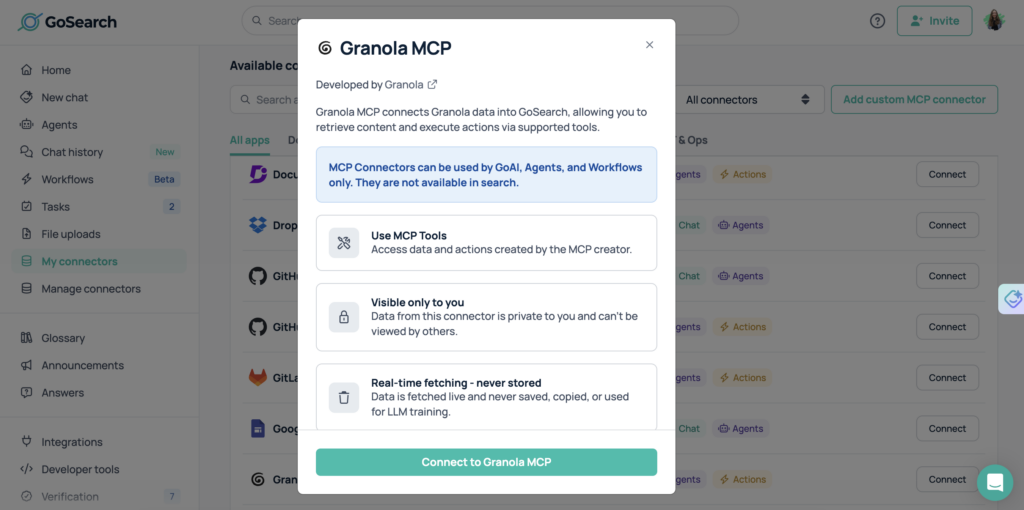
- Enable the Granola MCP server in GoSearch.
Navigate to GoSearch’s connector library and activate the Granola MCP server from the integrations panel.
- Authenticate using Granola’s existing access controls.
Connect via Granola’s authentication flow. GoSearch inherits Granola’s existing sharing permissions and access configurations automatically — no need to recreate note access rules or rebuild permission structures. Required scopes include read access to meeting notes, summaries, transcripts, and action items.
- Granola becomes a live tool for any AI agent or workflow in GoSearch.
No indexing, syncing, or content duplication is required. All access happens in real time through secure APIs. Granola is immediately callable by any AI agent or automated workflow you deploy through GoSearch.
- Start querying immediately.
Use natural language to retrieve meeting notes, surface action items, or trigger cross-system follow-up workflows. Test with a simple query like: “Show me all action items from meetings I attended this week.”
Who Should Use a Granola MCP Server?
A Granola MCP server delivers value across every team whose work depends on decisions and commitments made in meetings.
Sales and account teams can retrieve full conversation history with any customer or prospect, surface commitments made in previous calls, and feed that context directly into CRM records and deal management workflows — without manually transferring notes between tools.
Customer success teams gain a complete picture of every customer interaction across all meetings, enabling more informed QBRs, proactive outreach, and handoff documentation that reflects what was actually discussed rather than what someone remembered to write down.
Product and engineering teams can recover the reasoning behind decisions made in planning meetings, connect discussion outcomes to the tickets and specs they produced, and ensure that institutional knowledge from key conversations doesn’t evaporate when notes are left unshared.
Operations and executive teams can generate cross-functional briefings and status summaries by pulling relevant meeting content from across the organization — compressing hours of note consolidation into a single natural language query.
IT and security teams maintain full control over meeting content access, permission enforcement, and data governance across all AI-powered meeting intelligence workflows. GoSearch inherits and enforces Granola’s access controls at every step — no AI agent ever surfaces a meeting it isn’t authorized to access.
Why Use GoSearch for MCP Servers?
GoSearch provides a unified platform for deploying and managing MCP servers across the enterprise. By connecting Granola with more than 100 enterprise systems, GoSearch enables AI agents to reason over meeting intelligence and coordinate action across tools — CRM, project management, communication, documentation, and more — under a single governance layer.
Teams can route meeting outcomes directly into the operational systems where follow-through happens, ensuring that commitments made in a call don’t get lost between the meeting and the task tracker. Because GoSearch treats Granola as a live system of record rather than a personal note-taking app, meeting intelligence becomes a shared organizational asset that drives action rather than an individual’s private archive.
Get Started With the Granola MCP Server
The GoSearch Granola MCP server enables organizations to operationalize meeting intelligence across tools and workflows. AI agents can retrieve, summarize, and act on live Granola meeting content — routing action items, updating CRM records, generating briefings, and coordinating cross-system follow-ups automatically — with no manual note management and full security and compliance across the enterprise.
Get a demo to see how GoSearch connects Granola and other MCP servers to power AI workflows that turn every meeting into momentum.
Search across all your apps for instant AI answers with GoSearch
Schedule a demo
Granola MCP Server: Frequently Asked Questions
A Granola MCP server is a Model Context Protocol endpoint that allows AI agents to access live Granola meeting data — including AI-enhanced notes, transcripts, summaries, and action items — in real time. It gives AI models a standardized, permission-aware way to retrieve and act on meeting intelligence without requiring manual note sharing, exports, or custom API development.
The Granola API requires custom development and ongoing maintenance for each integration. An MCP server exposes Granola as a standardized, callable tool that any MCP-compatible AI agent can use immediately — no custom code required. It also allows AI agents to combine Granola meeting intelligence with data from other enterprise systems in a single coordinated workflow.
No. Granola’s native MCP server provides meeting note and transcript access for individual AI clients — a solid starting point for users querying their meeting history from within an AI assistant. GoSearch’s Granola MCP server is built for enterprise orchestration, enabling AI agents to act on meeting intelligence across 100+ connected systems, coordinate cross-team follow-up workflows, and operate under a unified governance layer.
The GoSearch Granola MCP server requires read access to meeting notes, summaries, transcripts, and action items. Granola’s existing sharing permissions are inherited automatically. AI agents cannot surface meeting content beyond what the authenticated user is authorized to access.
GoSearch’s Granola MCP server supports both retrieval and action. AI agents can query Granola meeting intelligence and also trigger downstream actions — creating tasks in connected tools, posting summaries to communication platforms, updating CRM records, and coordinating multi-system follow-up workflows based on meeting outcomes.
MCP is an open standard with broad adoption. Compatible tools include Claude (Anthropic), Cursor, VS Code with Copilot, and enterprise platforms like GoSearch that manage MCP servers at scale. Any MCP-compatible client can connect to an MCP server using the standardized protocol.
Most teams complete setup in under 5 minutes. Granola’s authentication flow is straightforward, permissions are inherited automatically, and no content indexing is required. Teams are typically querying live meeting intelligence within the same session they begin setup.