Onyx has grown from an open-source document search project into a full AI platform with chat, agents, deep research, and enterprise controls. In September 2026, Zoom announced that Onyx is joining Zoom AI Services. Buyers now compare GoSearch against a platform with a much larger parent behind it.
Both platforms connect to company apps and answer questions with cited sources. They differ in how they retrieve data, how many systems their agents can act in, and how much infrastructure a team has to run. This comparison covers those differences and the cases where Onyx is the better fit.
Quick answer: GoSearch fits teams that want a managed platform that queries 100+ apps live, with read and write access, no-code agents, and multi-agent workflows. Onyx fits teams that want an open-source, self-hostable platform, including air-gapped deployments with local models. The sharpest differences are real-time federated retrieval versus indexed sync, agents that write to apps out of the box versus actions an admin configures through OpenAPI or MCP, and a managed service versus infrastructure your team operates. Onyx says it stays open source and self-hostable after Zoom’s acquisition, and its published pricing has not changed.
Updated October 2026. Onyx details sourced from Onyx documentation, the Onyx pricing page, and the Onyx GitHub repository.
What is Onyx, and what changed in 2026?
Onyx, formerly Danswer, is an open-source AI platform that connects to company data and answers questions with cited sources. Its Community Edition is free under an MIT license. Paid Business and Enterprise plans add permission inheritance, role-based access control, usage dashboards, SCIM group sync, and white-labeling. Beyond search, Onyx offers custom agents, deep research, web search, code execution, and Craft, which builds documents, presentations, and web apps from company knowledge in an isolated sandbox. Employees can reach it through a web app, a desktop app, a Slack and Discord bot, a Chrome extension, an MCP server, or an embeddable widget.
On September 23, 2026, Onyx’s co-founders announced that the company is joining Zoom. Zoom did not disclose the terms. The 18-person team joins Zoom AI Services, and Onyx says the product stays open source and self-hostable. Zoom said the team will help it serve customers that need on-premises deployment and strict data sovereignty.
How do GoSearch and Onyx compare at a glance?
| Onyx | GoSearch | |
|---|---|---|
| Connectors | 40+ indexing connectors. Writing back to apps takes an OpenAPI or MCP action. | 100+ connectors with read and write access. |
| Retrieval | Indexed sync. Connectors pull content into the Onyx index on a regular schedule. | Hybrid. Real-time federated search, native indexing, and MCP. |
| Agents | Built in the Admin Panel. Each system an agent writes to needs a configured OpenAPI or MCP action. | Built with no code. Agents read and write across 100+ apps from the start. |
| Workflows | Agentic deep research, where one agent plans and writes a report. | Workflows that chain multiple agents across apps in one run. |
| Security and compliance | SOC 2 Type II and GDPR on Onyx Cloud. Self-hosted teams handle their own patching and availability. | SOC 2 Type II, GDPR, HIPAA, and CCPA, with zero data retention agreements across LLM providers. |
| Deployment and support | Onyx Cloud, or self-hosting with Docker or Kubernetes. Business includes community support, and Enterprise adds dedicated support. | Managed platform with a BYOC option. Dedicated support and onboarding included. |
How do GoSearch and Onyx compare on connectors?
Onyx lists 40+ connectors on its connectors page, and its GitHub repository cites 50+ apps. Those connectors index content ahead of time and sync changes on a regular schedule. Permission syncing is a paid feature, and Onyx documentation says it works only for a defined list of connectors. Writing back to an app takes a separate action, covered below.
GoSearch connects to 100+ apps with read and write access on every connector. It respects each source system’s permissions, and admins control which data sources connect and what gets indexed. That coverage matters most for teams whose knowledge sits in niche or industry-specific tools that a 40-connector catalog may not reach.
How does real-time retrieval compare with indexed sync?
Onyx pre-indexes everything. Onyx says this approach delivers fast, permission-aware answers across sources, even when a source system is slow or down. The trade-off is freshness. Results reflect the last sync, and the indexed copy of company data lives in an Onyx-managed store.
GoSearch runs a hybrid architecture. Its federated search fetches results in real time and does not store copies of your data. Admins can still choose native indexing for sources where it makes sense, and MCP extends coverage further. Answers reflect the current state of each system, which matters for fast-moving data like tickets, deals, and incidents.
Can Onyx agents take action across apps?
They can, with setup. Onyx agents combine custom instructions, knowledge, and actions, and an admin can build one in the Admin Panel without writing code. To let an agent act in another system, an admin or curator configures an OpenAPI action or an MCP server for that system first. Onyx release notes show users can now attach MCP actions to their own agents too, which lowers that barrier over time.
GoSearch agents are built with no code and act across the full connected stack of 100+ apps, reading and writing data from the start. Any employee can build one, from creating Jira tickets to updating Salesforce records, without a configuration step for each system.
Does Onyx support multi-step workflows?
Onyx’s closest equivalent is agentic deep research, where a single agent plans, searches, and writes a report. Craft serves a different job, generating documents and apps from company knowledge. Both put one agent on one task.
GoSearch workflows chain several specialized agents into one automated sequence. A request can move through multiple steps and systems without a person handing it off along the way.
How do deployment, security, and support compare?
Onyx Cloud is SOC 2 Type II and GDPR compliant, and Onyx runs it for you. Self-hosting shifts the work to your team. Onyx documentation recommends Cloud unless self-hosting is specifically needed, because it takes more operational overhead. A self-hosted team owns patching, monitoring, backups, and availability. Support follows the plan. The Onyx pricing page lists community support for Business and dedicated support with an SLA for Enterprise.
GoSearch is a managed platform built for the enterprise from the start. It is SOC 2 Type II certified and GDPR, HIPAA, and CCPA compliant, with encryption in transit and at rest, audit logging, SAML single sign-on, and zero data retention backed by agreements with its LLM providers. Teams that need more control over where data lives can deploy GoSearch in their own cloud with BYOC. Dedicated support and onboarding come with the platform.
When does Onyx make more sense than GoSearch?
Onyx could be the stronger fit in three cases.
- Air-gapped deployments. Onyx documentation confirms it can run completely offline when you host your own LLM.
- Local and open-weight models. Onyx connects to Ollama, vLLM, LM Studio, and any OpenAI-compatible endpoint, so teams can keep inference on their own hardware.
- Source-level control. The MIT-licensed Community Edition lets engineering teams inspect, modify, and extend the code.
Zoom’s backing adds a larger vendor to that model, and Zoom has positioned Onyx for customers with on-premises and data sovereignty requirements. GoSearch fits teams that want a managed platform, live retrieval, and agents that act across their stack without infrastructure to run.
How do Onyx and GoSearch compare on cost?
Onyx’s Community Edition is free. Business costs $20 per user per month billed annually or $25 billed monthly, and Enterprise is custom-quoted, according to the Onyx pricing page. Self-hosting adds infrastructure, LLM usage, and operations costs on top of the license. The Onyx pricing FAQ breaks those costs down. GoSearch uses flat per-seat pricing and offers a free plan, so teams can test it before committing.
Which platform is right for your team?
The right choice comes down to how you want to deploy and use enterprise AI. Onyx is a strong option for teams that need open-source flexibility, self-hosting, local models, or air-gapped deployments. GoSearch is built for teams that want a managed platform that can connect to their entire stack, retrieve current information, and take action across apps without managing the underlying infrastructure.
For teams evaluating both, the biggest differences are more than licensing. GoSearch combines 100+ app connections, real-time federated retrieval, no-code agents, and multi-agent workflows in one managed platform. Onyx gives engineering teams more control over the underlying system and deployment.
If your priority is getting enterprise search and AI automation into production without adding another infrastructure project, GoSearch is the better fit. Get a demo to dive deeper into how the platforms compare.
Search across all your apps for instant AI answers with GoSearch
Schedule a demo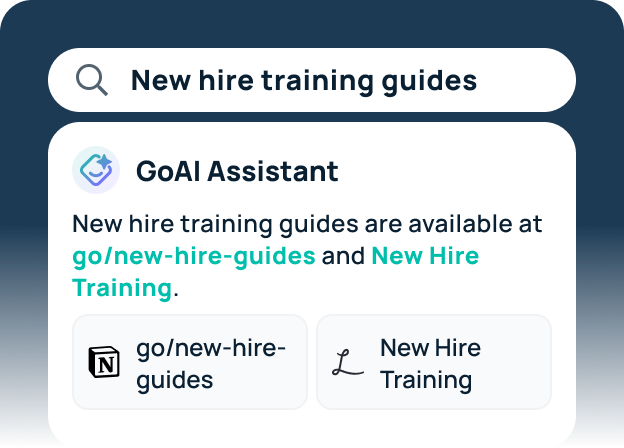
Frequently asked questions
Yes. Onyx’s co-founders announced on September 23, 2026 that the company is joining Zoom, and the team now works within Zoom AI Services. Zoom did not disclose the terms. Onyx says the product stays open source and self-hostable, and its published pricing has not changed. Buyers planning multi-year commitments can ask for written confirmation of how packaging will work through renewal.
Onyx’s Community Edition is free under an MIT license, but you host and operate it yourself, and it leaves out permission syncing and role-based access control. Business costs $20 per user per month billed annually or $25 billed monthly, and Enterprise is custom-quoted. Self-hosting also adds infrastructure, LLM usage, and operations costs. The Onyx pricing FAQ covers those in detail.
Yes, for teams that want a managed platform without running infrastructure. GoSearch connects to 100+ apps with read and write access, retrieves data live through federated search, and builds agents with no code. Onyx remains a strong fit for air-gapped deployments, local models, and teams that want open-source control. The full GoSearch vs. Onyx comparison shows each capability side by side.