



There are four main types of search engines: web search engines, site search engines, enterprise search engines, and application-specific search engines. Each type serves a distinct purpose — from helping billions of people explore the public internet to helping employees instantly locate internal company files.
Understanding the different types of search engines matters whether you’re choosing a tool for your business, optimizing content for discovery, or simply curious about how modern information retrieval works.
What Are the 4 Types of Search Engines?
| Type | Scope | Key Examples | Use When |
| Web Search Engine | Public internet | Google, Bing, Baidu, DuckDuckGo | You need to search the public internet |
| Site Search Engine | Single website | Algolia, Swiftype, Apache Solr | You need to help website visitors find content |
| Enterprise Search Engine | Private internal data | GoSearch, Elastic Workplace Search | You need to find internal company documents and data |
| Application-Specific Search Engine | Single platform ecosystem | Google Cloud Search, Microsoft Copilot, Salesforce Einstein | You need to search within a specific tool or platform |
1. Web Search Engines
A web search engine is a software system that crawls, indexes, and ranks publicly available content across the internet. The most widely used type of search engine, web search engines process billions of queries every day — making them the primary gateway through which people discover information online.

How Web Search Engines Work
Web search engines work in three stages. First, automated bots called web crawlers continuously scan web pages, following links and collecting data on content and structure. Second, that data is organized into a searchable index — a massive database of web content. Third, when a user submits a query, a ranking algorithm evaluates indexed pages based on authority, relevance, and user intent to return the most useful results. Artificial intelligence and machine learning now play a central role in all three stages, making modern web search significantly more accurate than early keyword-based systems.
Examples of Web Search Engines
- Google — The world’s largest search engine, holding over 90% of global market share and the benchmark against which all other search engines are measured
- Microsoft Bing — The leading alternative for Windows and Edge users, now deeply integrated with Copilot AI for generative search experiences
- DuckDuckGo — The most popular privacy-focused search engine, which does not track or profile its users
- Baidu — The dominant search engine in China, built specifically for Chinese-language content and local search behavior
- Yahoo Search — Still widely used in the United States and Japan, powered by Bing’s underlying search index
Why Web Search Engines Matter
Web search engines are the foundation of how the world accesses information. For businesses and content creators, ranking well in web search results directly drives visibility, traffic, and revenue. For users, the stakes are equally high — the quality of results shapes decisions on everything from purchases to medical care to political opinions. As AI continues to evolve, web search engines are shifting from returning static lists of links to delivering direct answers, summaries, and conversational responses — fundamentally changing how content needs to be written and structured to get discovered.
2. Site Search Engines
A site search engine indexes and retrieves content from within a single website or domain. It is the internal search feature visitors use to find blog posts, product pages, help articles, or documentation — without leaving the site. While often overlooked, site search is one of the highest-intent interactions a visitor can have, making it a critical component of any content-heavy website or e-commerce store.

How Site Search Engines Work
Site search engines work similarly to web search engines, but at a much smaller scale. A crawler indexes all content within a specified domain and stores it in a local index. When a visitor enters a query, the engine retrieves and ranks the most relevant results from that index. Modern site search implementations go beyond basic keyword matching — using AI and natural language processing to deliver predictive suggestions as users type, handle typos and synonyms, and rank results based on behavioral signals such as click-through rates and past searches.
Examples of Site Search Engines
- Algolia — A widely adopted AI-powered site search platform known for its speed and relevance, particularly in e-commerce and SaaS documentation
- Swiftype — Offers fast, customizable search for websites and apps, with simple integration and analytics built in
- Apache Solr — An open source search engine built on Apache Lucene, favored by developers who need flexible, scalable indexing with full control over configuration
- Elasticsearch — An open source, distributed search engine widely used by organizations that require high-volume, customizable search infrastructure at scale
The Role of Open Source Search Engines
Open source search engines like Elasticsearch and Apache Solr have significantly expanded how organizations build and control their search experiences. Because their source code is publicly available, development teams can customize ranking logic, integrate with proprietary data pipelines, and maintain full ownership of user data — eliminating the vendor lock-in that comes with proprietary search platforms. For organizations with complex search requirements or strict data governance policies, open source remains the most flexible option available.
3. Enterprise Search Engines
An enterprise search engine indexes and retrieves content from an organization’s private, internal systems — including cloud storage, messaging platforms, project management tools, and databases. Unlike web or site search engines, enterprise search operates entirely behind an organization’s firewall, surfacing information that is never publicly accessible. For a deeper look at how these systems work — architecture, permissions, and retrieval methods — see our guide to what enterprise search is.

How Enterprise Search Engines Work
Enterprise search engines connect to internal data sources such as Google Drive, Slack, Confluence, Jira, and SharePoint, then index their contents into a unified, searchable interface. Rather than searching one tool at a time, employees can query across all connected sources simultaneously using natural language — retrieving files, messages, and documents in seconds regardless of where they are stored.
Modern enterprise search platforms go several steps further. They use natural language processing (NLP) to understand the intent behind a query rather than matching keywords literally. They apply role-based access controls to ensure employees only see content they are authorized to access. And they deliver personalized results based on a user’s role, team, and recent activity — so two employees searching for the same term may see different, more contextually relevant results.
Key Features of Enterprise Search Engines
- Federated search — queries multiple data sources and repositories simultaneously from a single interface
- Personalized results — ranked based on role, team membership, or recent activity rather than popularity alone
- AI summarization — surfaces direct answers and summaries rather than requiring users to open and read individual documents
- Access controls — enforces data governance and security policies so sensitive content is only visible to authorized users
- Analytics dashboards — identify search trends, knowledge gaps, and content that employees struggle to find
Enterprise Search in Action: GoSearch
GoSearch is an AI-powered enterprise search engine that connects over 100 data sources — including Slack, Jira, Notion, and SharePoint — into a single unified search experience. Employees can submit natural language queries such as “show me the latest sales deck” and receive precise, context-rich results immediately, without knowing which tool the file lives in or who created it.
Where web search engines index the public internet, GoSearch indexes a company’s internal knowledge — acting as an intelligent search layer across every tool, file, and conversation in an organization.
Why Enterprise Search Matters
Employees spend nearly 20% of their workweek searching for information — time lost switching between tools, repeating questions that have already been answered, and making decisions based on incomplete data. An effective enterprise search engine eliminates that friction by making an organization’s collective knowledge instantly accessible to everyone who needs it. The downstream impact extends beyond productivity: faster access to accurate information improves decision-making, reduces duplicated work, and strengthens collaboration across distributed teams.
4. Application-Specific Search Engines
An application-specific search engine is built to search within a single software platform or ecosystem. Unlike enterprise search engines, which connect multiple tools into a unified interface, application-specific search engines are embedded directly into a single platform — indexing only the data within that ecosystem and tuning results to the specific content types, user roles, and workflows it contains. This makes them the most focused of the four types of search engines: narrow in scope, but highly relevant within the platform they serve. Most modern implementations use AI and machine learning to further personalize results based on individual user behavior and role.

Examples of Application-Specific Search Engines
- Google Cloud Search — Indexes content across Google Workspace, including Docs, Sheets, Gmail, and Drive, allowing users to search their entire Workspace environment from a single query
- Microsoft Copilot — Embedded across Microsoft 365 and powered by Bing, Copilot combines search with generative AI to surface insights, draft content, and summarize information without leaving the Office environment
- Salesforce Einstein Search — Uses AI to personalize search results within Salesforce CRM, surfacing the most relevant leads, opportunities, and cases based on each user’s role and recent activity
Why Application-Specific Search Engines Matter
Application-specific search engines solve a problem that neither web search nor enterprise search fully addresses: the need for fast, relevant results within the specific context of a single workflow. A sales representative searching Salesforce does not need results from across the entire company knowledge base—they need the right lead, case, or contract, surfaced immediately within the tool they are already using. By combining the personalization depth of enterprise search with the simplicity of consumer search, application-specific search engines reduce context-switching, keep users in their workflow, and surface information at the exact moment it is needed.
The Future of Search Engines
Across all types of search engines, one trend is clear: search is becoming more intelligent, personalized, and conversational. AI-powered search engines now go beyond returning lists of links — they interpret user intent, generate direct answers, and deliver contextual knowledge on demand. For users, this means faster access to more relevant information. For businesses and content creators, it means the rules for how content gets discovered are being rewritten in real time.
As generative AI continues to advance, the boundaries between the four types of search engines are blurring in ways that would have seemed unlikely just a few years ago. Enterprise search engines are gaining the broad intelligence of web search. Web search engines are beginning to incorporate personalized, context-aware results once reserved for internal platforms. Application-specific search engines are expanding beyond their platforms through AI integrations. The result is a convergence toward a single model: search that understands who you are, what you need, and where you are in your workflow — and delivers the right answer immediately, regardless of where it lives.For teams that can’t wait for that convergence to arrive, GoSearch is already there. Try it free and see how your team can find answers faster across every tool you use.
Search across all your apps for instant AI answers with GoSearch
Schedule a demo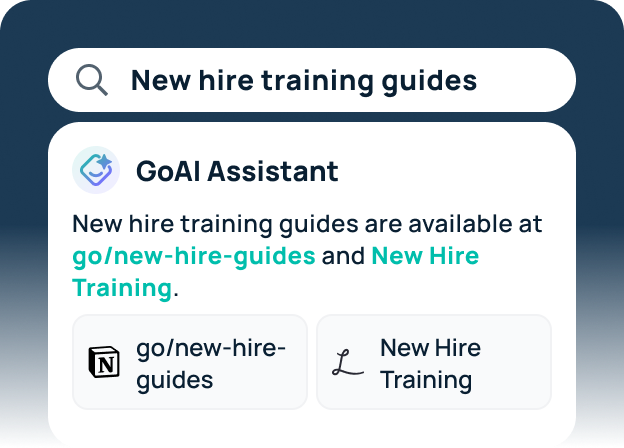
Frequently Asked Questions About Types of Search Engines
There are four main types of search engines: web search engines, site search engines, enterprise search engines, and application-specific search engines. Web search engines like Google index the public internet, site search engines work within a single website, enterprise search engines index private company data, and application-specific search engines operate within a single software platform.
Web search engines like Google crawl and index publicly available content across the internet. Enterprise search engines index private, internal company data — such as Slack messages, Confluence pages, and Google Drive files — and restrict results to authorized users only. Unlike web search, enterprise search is designed for internal productivity, not public discovery.
An open source search engine — such as Elasticsearch or Apache Solr — makes its source code publicly available. Organizations use open source search engines to build fully customizable, transparent search experiences while maintaining control over their data.
The most widely used type of search engine is the web search engine. Google leads with over 90% of global search market share, followed by Microsoft Bing, Yahoo Search, Baidu, and DuckDuckGo. For business use, enterprise search engines and application-specific search engines are the most common types of search engines.
A site search engine helps users find relevant content within a specific website — such as product pages, blog posts, or help center articles — without using an external search engine like Google.
AI-based search engines use machine learning and natural language processing to understand query intent, generate summaries, and personalize results. This moves search beyond keyword matching toward contextual, conversational information discovery.
The best enterprise search engine depends on your organization’s data sources and needs. GoSearch is a leading option for teams needing unified AI-powered search across 100+ workplace tools. Elastic Workplace Search is another popular choice for technical teams requiring deep customization.